Saturday, April 18, 2015

What You Might Leave Outside to Inspire Creativity and Fun

Loose parts!


Natural objects.  Random plastic ones.  Anything without a defined play purpose or even objects that have typical uses, but that can be used for other things.  That is what I like to keep on hand in our yard, and, oh, the creativity, imagination and fun that unfolds!

Just the other day, yet another example of loose parts at play developed right outside my front door.


The kids were in the front yard as I prepared a picnic meal.  When I walked out to lay the food on a blanket, I found the pathway blocked by "a boat".  It seems "the ship" (our home) was sinking and the children were trying to rescue all that they might need to survive.  Imaginations, muscles and cooperation had been at play and the scene was unfolding with fun!


It brought such joy to my heart to witness how sunshine, sibling relationships and simple loose parts came together to inspire the "work of childhood" -- play!


And, since you are never too old to play, I joined the children in their imagination.  I dodged floating and sinking debris and found my way to an "island" (our picnic blanket).   Eventually, I let my almost-sinking shipmates know I had gotten to an island where we could await rescue and had been able to prepare a meager meal to keep our energy up... if they could just make it to the island eventually made their way over to the "island".

They did, and our adventure continued.


Such simple, wonderful fun inspired by loose parts!

What do you keep outside at-the-ready to inspire imagination and creativity?

Thursday, April 16, 2015

What Unique Online Program Has Proven a Triple Hit Here? {A Review}


I love it when I get to review a program that proves to be something that:

  • completely engages my son.
  • makes a fabulous fit for homeschooling families like ours.
  • is something I can recommend to non-homeschooling families, too!

That is just what has happened with Orphs of the Woodlands, an Online Educational Resource and Game by Star Toaster.  My nine-year-old loves the first story in the series, The Treasure of the High Tower, and I am impressed with it, too.

What is Orphs in the Woodlands?
Star Toaster Review

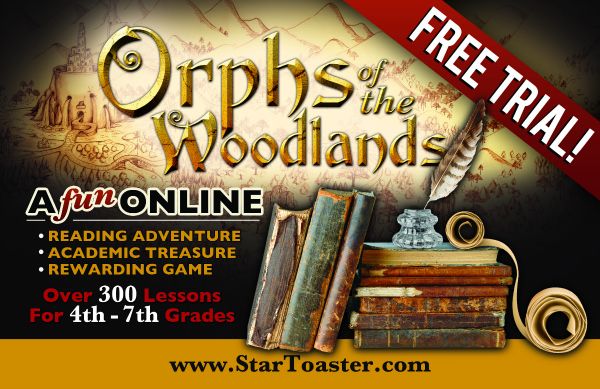
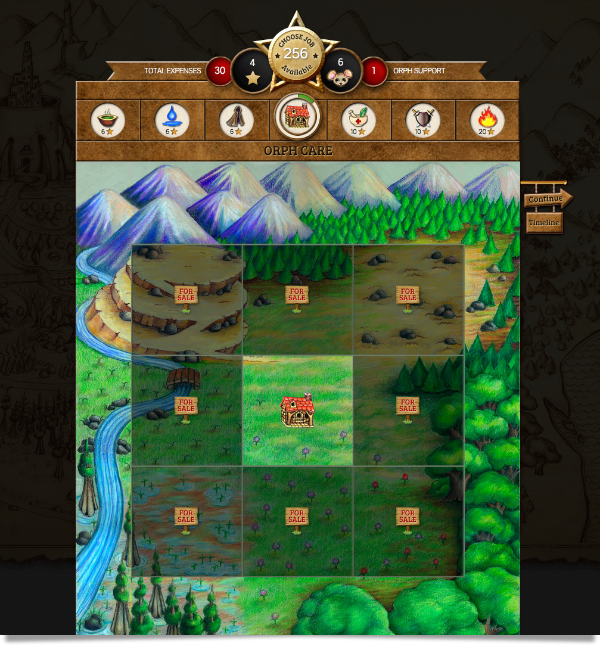
Orphs of the Woodlands is a learning adventure geared towards children in grades 4-7.  It combines an engaging story, with a creative online game that layers in 300+ lessons in a variety of subjects (such as math, science, vocabulary, thinking skills, life skills, the arts and more).  Part reading adventure, part academic treasure and part enjoyable online game, the program wraps a lot of learning and fun into one package.  When using it, children read the engaging story and then earn gold stars for completing "jobs" (lessons on a variety of subjects).  These gold stars become the currency for an online game in which the children buy land, food and other supplies to build orphanages for orphaned woodland creatures.

What Was Our Experience?

When we first received our login information for Orphs of the Woodlands, I actually signed in with my seven-year-old daughter since I wanted to check out the program myself and she did, too.

We began by applying to be a spy to help the "WAK Underground" stop Night Creatures from taking over the Woodlands.  By then, my oldest son had come over, and our adventure began.


My daughter listened as I read the online story aloud and, together, we enjoyed its interactive features (music, sound effects, vocabulary pop ups and more).  Finally, we got to the lessons, which, of course, were a bit above her level.  Not so for my son, though, who begged to have his turn.

Thus, soon, my son logged in, applied to by a spy for the WAK Underground himself, and began his adventure, too.  He loved it so much, he could not wait to show the program to his father  And, since then, when my son has had time, he has happily continued to use
Orphs of the Woodlands for as long as he is allowed to be online in one sitting.


He thoroughly enjoys the reading the story online.  Then, he perservered through the lessons and questions so he can thrill at using the stars he earns to build the woodland orphans a home.


A Child's Point of View

Since there is nothing like a child's own words to describe a program, and since my son was sitting near me when I was writing this review, I asked him for his honest thoughts about Star Toaster.  He said:

My favorite part of the program is the video game where you get to buy stuff to help your orphs because I get to create my own world.
Star Toaster Review

My least favorite part is the language arts and the vocabulary and the math lessons.  I do them to get money.

I like a few of the lessons, like the cooking lessons, the animal lessons and some of that. 

I was amused to find this recipe in a pile on our table.  My son had copied it from one of the Orphs in the Woodland cooking lessons, adapting it to his liking.

I also love the reading part, because it tells you a story and I just love reading.  I could the whole thing at once if my mom let me, but she won't let me stay online that long.

The story is interesting because you are a spy battling the evil, evil night creatures.  I just hate them, because they are so mean.  I named myself Sir Ned and got to pick the character's favorite color and a few things.  I wish I could choose more though.  I was forced to be a grey squirrel, but I'd want to be a huge lion!

The program is fun, but parts of it are very hard.  (I actually had to use sticky notes to remember stuff like vocabulary.)  I actually think they (Star Toaster) could make a just for fun version where the work is just moving stuff across the screen to build, write books, clean, etc.  If they did this, though, I would still want the story part to be the same.  I LOVE stories and reading.

Some of the chapters are short, but some are long.  The long ones should be shorter, because it takes so long to read and to do the lessons before the game part.

If you really like reading, hard work, having fun and building a community then this is for you!

A Parent's Point of View

And me?

I am pleased with the program, too.
 

The story engages, the lessons are varied and positively challenging and the game keeps my child coming back for me.  Plus, the parent features are helpful.

I don't know about anyone else, but I constantly forget usernames and passwords.  Thus, I appreciate the reminder I get every time I go to log into
Star Toaster:


It's simple details like the log-in page reminding me what to use for the parent account and child account login that make me smile.

Another thing that makes me happy is knowing how my son is progressing!

Honestly, I would love to say that I am a totally on-the-ball parent who keeps regular tabs on all of my children's explorations and learnings, especially their online ones.  That would be lying though.

In truth, as I balance
homeschooling three children with working, blogging, running local homeschool groups and more, I often find myself using our computer to "babysit" my children while I do other tasks.  In fact, once I trust an online program, if my children can use it independently, I often tend to let them at it while I do something else.

When I do so with my oldest child, who simply loves to be online and works independently when he is, I cannot help but to wonder:  Is he truly succeeding with the skills and content presented?  What topics has he covered and what might he be introduced to next?  Is he actually staying on the program he is supposed to or is he clicking over to other things when I am changing laundry, taking a phone call or helping one of his siblings? 

Star Toaster helps answer such questions by sending me regular email updates that include notes on what my son has been working on, such as:

"(Your child) has finished Chapter 7 and has learned about lines, angles, sound waves, rounding, perimeter, animal facts, memory tips, music, vocabulary, inspirational quotes, and so much more."

Likewise, email updates tell me what he'll be introduced to next, such as:
 "There are so many interesting things to learn in the next chapters.  (Your child) will be studying complementary and supplementary angles; sentences; fragments; punctuation; facts and opinions; homonyms; capitalization; cooking and nutrition; character; animal facts; and vocabulary.  Along with all of that, there's even a lesson on estimating tree height! There are always fun things to learn in the Woodlands.  (Your child) will enjoy the journey!"

Plus, the updates provide a quick look at how many lessons my son has completed correctly:


... and where his other stats stand...


I appreciate these emails and the fact that I can login to my parent account to see which specific skills my son has completed work on, for example: 


... and which questions he has had trouble with, such as:
 

These features allay my concerns and make it easy to keep tabs on my son's progress.  They are so handy!


Final Thought

I have never seen an online program like Orphs of the WoodlandsThe storyline sweeps you in and, then, the interactive nature and varied content of the activities included in the program, keep you engaged and learning.  My son has loved using Star Toaster and I look forward to reintroducing it to my daughter when her skills are a bit more advanced.  For the program truly provides a unique approach to reading and learning.   
Both my son and I highly recommend Orphs of the Woodlands to homeschoolers and to public, private or charter school students who might be looking for a fun, educational program to keep brains sharp during summer break! 


Star Toaster Review

Learn More

Watch a video clip about Orphs in the Woodland.


Enjoy a FREE TRIAL, which will allow you to access the first 100 pages of the online book, including access to 50 games and lessons!


Or, sign up at the current price of $19.99 for a 60 day subscription for up to three children.

 Find Startoaster on:
Star Toaster Review

Read how 90 Schoolhouse Crew Review families used Orphs in the Woodlands.

Crew Disclaimer

Wednesday, April 15, 2015

Learn Cursive the Early the Easy Way {A Review}


Disclaimer: I received a FREE copy of this product through the HOMESCHOOL REVIEW CREW in exchange for my honest review. I was not required to write a positive review nor compensated in any other way.
Some links may be affiliate ones.

My daughter struggles to read, but loves to write letters and has shown increased interest in learning cursive over the past year.  So, when an opportunity to review New American Cursive:  Penmanship Program Workbook 1 by
Memoria Press in exchange for an honest review came up, I took it!  I knew my little girl would delight in having a book of her own to learn and practice cursive penmanship with.


What Is Memoria Press?


Memoria Press is a family-run publishing company that produces simple, effective, easy-to-use Classical Christian curriculum for all ages.  Since Memoria Press was founded by Cheryl Lowe in 1994, it has exploded with popularity among home educators and private schools and continues to develop new materials that focus students on the rich tradition of classical education.


What Is New American Cursive?

"New American Cursive" and "traditional classical education"?  How do these two things go together? Isn't classical education pretty "old" school?  And, how can cursive be "new" and "American"?


New American Cursive 1
New American Cursive


These were some of the questions that came to mind when I first read the title of the workbook my daughter has had the chance to review.

Quickly, those questions were answered.


While many American schools these days have been dropping cursive writing programs, classical schools - be they homeschools or traditional brick-and-mortar ones - continue to embrace the many practical and developmental benefits of cursive penmanship.  In doing so, they promote the ideas that cursive penmanship:


  • improves the fluidity and continuity of thought in written communication.
  • involves the mind, arms, hands and eyes, requiring accuracy, attention to detail, discipline, focus, organization and patience (all of which are skills youngsters do well to develop!)
  • improves the neural connections in the right and left hemispheres of the brain.

In short, Classical educators continue to laud the positive effects of learning cursive handwriting even when many other modern folks toss cursive handwriting efforts aside.


That said, the hard truth is that even if learning cursive is good for children, it is not always easy for them.  Some children struggle when learning cursive letter formations and connections.  Their challenges really put a damper on an otherwise positive experience.  That is where 
New American Cursive comes in.

Irish Hatfield, a woman with over 35 years of experience in the handwriting field, developed 
New American Cursive with all learners - including struggling learners - in mind.  Within the program she incorporated easy-to-follow, multi-sensory methods to aid the learning of motor skills necessary to write well.  She also developed New American Cursive as a resource that makes "old" cursive "new" by: 


  • simplifying letters though using 26 fewer strokes than the top three most common cursive programs.
  • retaining the classic form of letters, despite their simplified strokes.
  • encouraging a modified natural right slant that makes learning cursive easier for both beginners and left-handers.
  • developing the animated character of Mr. Meerkat to help make step-by-step learning fun for young children.

Further, while retaining the traditional beauty and practicality of cursive writing, 
New American Cursive is designed to hone students in on ccuracy and legibility, while adding a bit of space for creativity, too.


Our Experience


My daughter was delighted when her copy of the 
New American Cursive workbook came in.  How could she not be at the thought of a book we'd gotten just for her, which would help her to learn and practice how to write with loopy letters like Mom and Dad can?


Immediately, my daughter and I sat down to begin her penmanship practice. Just as quickly, she noticed that some of the letters in 
New American Cursive workbook look different than the cursive ones she had seen before.  In fact, since we had previously practiced cursive a's and d's through the chant, "curve line up, rock back around, touch the top and swoop on down", my daughter immediately commented that the New American Cursive letters looked different.  The lower case a and d did not have the slant line up to the top of the circle.


I explained to my girl that just like printed type has different fonts, written cursive does, too.  
New American Cursive is a simplified written font that makes learning handwriting quicker and easier by using less strokes to make the same letters.  Like many children, my daughter was pleased with the idea of taking a simpler, quicker route to mastering a new skill.  And, so we were off.


During handwriting times, my daughter followed Mr. Meerkat in learning how to write cursive letters.  She used the large printed model on the "Instruction Page" of each newly introduced letter to say, feel and write the target letter.  (Well, usually she did this.  In truth, sometimes, she did not actually SAY the letter, but she did trace and write it.)  Then, she traced the capital and lower-case form of the letter in a smaller size.


On the next page of each introduced letter, my daughter followed the numbered arrows and dotted lines provided to trace the lower-case and capital form of the target letter on appropriately-spaced lines.  Since I am not a stickler for repeating a skill once you've done it sufficiently, my daughter did not always trace all 10 or so models of each letter, nor did she always circle her best one as directed.  She did, however, use spaces between the dotted model letters to write the letters on her own.


Then, my daughter turned to the "Fun Exercises & Artwork" page, where she traced the letters shown and used the space below them to do as she wished.  Sometimes she chose to write her own letter boxes.  At other times, she drew or simply opted to skip doing anything at all in the large, blank creative space.


Although my daughter always used the three consecutive learning, practice and fun pages for each letter, she did not do the letters in alphabetical order as they are presented in the book.  Instead, she moved ahead to practice the "n" and "i", because those letters are in her name.  And, sometimes, she skipped forward  or backward to do letters that have similar stroke style and order. For example, since a lower case "a" and a lower case "g" both rock around and go back up, she did those letters one after the other.

When my daughter was not using her penmanship book, I browsed the Teaching Guide included in it which details things such as:


  • recognizing the benefits of early cursive learning.
  • focusing on posture, pencil position, and paper position.
  • remembering the "Three S's" of size, slant, and spacing.
  • teaching letters through instruction, practice, and play.
  • testing and scoring letter formation and connection to evaluate progress in spacing, accuracy, and speed.

Of course, because we take a rather relaxed approach to learning in our home, choose to avoid most testing, and tend not to promote a lot of top-down direction for what lessons have to be done when, for how long and in what way, we opted not to test our daughter weekly on her penmanship as suggested.  Rather, I just noted her developing skills as she worked in workbook and also how she applied her new learning, consolidated with prior learning, in self-selected activities, such as playing school.


For, yes, even relaxed homeschoolers play school in traditional ways sometimes.  In the picture above, my daughter was playing school after using her handwriting workbook, and, although obviously she was choosing to still opt for a slant line up on her a's, she was delighted with the idea of writing cursive after having practiced 
New American Cursive.


Final Thoughts


The goal of New American Cursive:  Penmanship Program Workbook 1 is to get young children writing confidently and accurately in cursive.  So far, our experience with the workbook is that it meets that goal.  Not only has my daughter been making progress with cursive handwriting, but her younger brother has shown an interest in learning it, too.  Sometimes he sits himself next to my daughter, grabs blank paper and pencil or whiteboard and marker, and tries to follow along.  In my book, that is success!


Some things I particularly like about the workbook are that it includes:


  • lots of white space and wide writing lines.
  • graphic reminders of correct pencil and paper placement.
  • animated Mr. Meerkat graphics to encourage memorization of skills. 


  • easy-to-follow learning and practice opportunities.
  • a horizontal, spiral-bound orientation that provides plenty of lay-flat writing practice space.

The only things I did not care for as well were personal preferences that were easily dealt with:


  •  the formation of some of the capital letters, such as the F, K, and T, which were too much like printed letters for me.  I like the loopiness of other traditional, cursive capital letter fonts. So, I will be teaching my daughter alternative ways to make these same letters later.


  • the order of the presentation of letters.  While alphabetical order is traditional, I prefer programs that group letters by the similar formation of lower case letters, such as grouping c, a, d, g, and q together in order since they all rock around and back up.  Then, letters that climb and slide up.  Then, letters that are loopy and so on.  That is why I encouraged my daughter to skip ahead and then move back in the program at times.

As for my daughter, when I asked her for her review of New American Cursive:  Penmanship Program Workbook 1 

she said:

I like it.  I especially like how you get to draw pictures. I can now write my name.  I want to finish the book.

And, that, my friends, sums it up:  The workbook, in our experience, is a straight-forward, simple, enjoyable tool for learning and practicing cursive handwriting with young children!


Learn More


Check our samples of New American Cursive at the Memoria Press website.


Read what 100 Schoolhouse Review Crew members have to say about Memoria Press' New American Cursive:  Penmanship Program Workbook 1 or their First Start Reading program.

First Start Reading Program


Connect with Memoria Press on social media.

Sunday, April 12, 2015

Go Egging This Easter Season with A Free Printable!

Do you want to continue to spread Easter season cheer? Did you miss egging before Easter Sunday?  Or, can you just not get enough egging fun this year?

Then do we have something for you!


https://drive.google.com/file/d/0B6Lk1nwk2KPdQWVack9OLUNjdU0/view?usp=sharing


Because we had so much fun egging on Spy Wednesday, using the You've Been Egged printable that we created a few years ago, we decided to create a similar one to be used after Easter Sunday throughout the Easter season.  Please enjoy our Post-Easter Sunday You've Been Egged printable!

Now is the perfect time to pick up plastic Easter eggs on sale and, then, to use them to spread Easter season cheer.

Egging is Easy!


To egg, simply:

  1. Print out a You've Been Egged sheet.
  2. Fill 11 of 12 eggs with treats.
  3. Grab some tape and an empty egg carton.
  4. Go to the home you want to egg.
  5. Tape the You've Been Egged sheet to a door or post.
  6. Put the empty egg carton under it.
  7. Hide the eggs.

And, of course, don't get caught.

Our Favorite Egg Stuffers

(Note:  Affiliate link follows for your convenience.  If you click through it to purchase anything, we may receive compensation at no extra cost to you.  Thank you.)

To stuff our egg, we prefer to use non-edible treats, like coins, small toys and stickers.  We also LOVE allergen-free, packaged goodies like YumEarth Organic Candy Drops


These tasty little drops pack a lot of flavor in yummy wrapped candies that easily fits inside any plastic egg.  Better still they are gluten free, peanut free, tree nut free, dairy free, egg free, shellfish free, soy free, wheat free, corn free and organic!  So, we do not have to worry about harming our friends who have allergies and intolerances.

If you'd like to try YumEarth Organic Candy Drops, you can find them at Amazon, at health stores or at regular grocery stores.  We have also found them in stock at discount stores, like the Marshalls and TJ Maxx ones in our area, tooWhen we find them there, we stock up, because not only do we love these hard candies for Eater egg stuffing, but we also love them, and the similar YumEarth Organic Lollipops, as an occasional Sunday treat.

Egging Earlier This Season

This year, when we went egging on Spy Wednesday, we did so in broad daylight.  We thought we'd timed our egging excursion perfectly, until we realized that people were home at some of the houses we planned to egg.  The surprise was on us then!  But, we did not let it stop the fun.


Instead, I put a piece of tape on our egging printable and grabbed an empty carton as the the kids split the dozen eggs between them.  Then, we opened the doors of our getaway van and giggled our way quietly about our friends' yards.  While I ran up to place the printable and carton on the door, the kids dashed around, giggling quietly to hide eggs.  We left the van doors open for a fast getaway and attempted to out of view of house windows.

Not a single family caught us in the act!  (And I only snapped a few pictures so I wouldn't get caught due to shutterbug habits.)

It was definitely challenging to be sneaky smile sharers in broad daylight with some families home, but we did it and we had so much fun as we did.  My daring little trio was filled with excitement and giggles while prepping the eggs, when hiding them and, then, when seeing thank you notes to anonymous "bunnies" pop up on friends' Facebook pages.

Luke declared, "We have to tell everyone about egging so more people will do it.  Then, no one will know who actually eggs them."
  His wish is my doing.  Consider yourself both told about egging and encouraged to spread the fun!  Just print out the You've Been Egged note and go.


Happy Egging and Happy Easter Season!

LinkWithin

Related Posts with Thumbnails