Showing posts with label Practical Life. Show all posts

Monday, May 15, 2017

Adventures in Wild Edibles: Gluten-Free, Casein-Free Dandelion Cookes

The other day, relative cold and dampness had me feeling a bit sluggish.  I longed for afternoon sunshine to burst through the clouds, offering its warming energy, but there was none to be had.  So, I decided to embrace the chill by doing something I refuse to do when it is warm and sunny outside:  heat up the kitchen by baking. 

And not just baking anything.  Rather, I suggested we make Dandelion Cookies!


My daughter and youngest son were all for it.


My daughter has been keen on wild edibles this spring and was eager to try a new-to-us one.


My youngest son likes to explore in the kitchen with me and claims eating is one of his favorite things to do.  He also enjoys being outside.  So, he was psyched with the idea of making cookies from wild edibles.


Thus, outside we went to collect dandelions from our front yard.


Then, in we came, where the kids found ingredients set on the table for a recipe I put together myself, since I could not find any gluten-free, casein-free dandelion cookie recipes online that called for ingredients I already had on hand.


Once inside, we washed the dandelions and pulled the yellow flower bits out of the bitter greens.


We mixed these with the rest of the ingredients...


...popped them into the oven, and baked them for 10-15 minutes.

The result? 


A light lunch:  Cookies that my youngest boy loved, my daughter and other son liked, and that Daddy and I liked, too. (And,
yes, cookies can be lunch in our home at times when paired with fruit.)


Each cookie had visible dandelion pieces in every bite, but not a strong dandelion flavor.  (So, we might try the cookies again with even more dandelion flowers next time.)

Here's the recipe we created want to try it:


Gluten-Free, Casein-Free Dandelion-Almond-Coconut Cookies

1/2 cup dandelion flower heads (or more, next time)
3 eggs
1/2 cup maple syrup
2 teaspoons vanilla
3/4 cup almond flour
3 cups shredded coconut

Preheat oven and baking stone to 350 degrees Fahrenheit.

Wash flower heads and separate the yellow parts our from the green parts, discarding the green portions.

Mix yellow flowers together with eggs, maple syrup and vanilla.

Add in almond flour and coconut.

Mix well.

Drop by rounded spoonfuls onto a baking stone.

Bake for 10-15 minutes, checking for golden brownness at 10 minutes.

Cook for a few minutes and enjoy!

You might also like recipes from one of our prior adventures with wild edibles.

 
http://traininghappyhearts.blogspot.com/2016/06/wild-clover-chia-seed-pudding.html

We'd love to hear about your favorite wild edibles and how you prepare them.  Please do share recipes and notes with us in a comment!

Saturday, June 13, 2015

What Can A 4-Year-Old Do in the Kitchen?


Jack is four and guess what he has mastered? Planning and preparing a full meal with but a little help from Mama sous chef.

Jack asked me to peel and cut fruit alongside him and to help him get the roll ups out of the toaster oven where they were warming,  Besides that, he planned and prepared this meal for our family with focused and satisfied independence.

Now, before anyone cries, "Danger!", let me explain:  We are not negligent parents.  Rather, we are parents with a mission to guide our children to be happy, healthy, competent adults.  Part of this means giving them freedom and responsibility in the kitchen.


He only began cooking eggs after putting the roll ups in to warm and prepping the fruit for our meal because I reminded him  that the eggs would not take long, but would need full attention.

Inspired by Montessori principles, Mike and I have long involved our children in food preparation -- yes, even wielding knives and cooking over fire.  For while some think that doing so is just too unsafe, we disagree.  

Dangerous to us is cowering in the kitchen, thinking that young children are incapable of learning how to plan and prepare healthy meals even after they have shown an interest in doing so.  

Earlier in the week, Jack has decided he wanted to prepare eggs for protein, sliced apples for produce and rolls ups for carbs.  However, when the day came for him to make our family meal, he swapped out apples for strawberries, peaches and nectarines.  A tasty choice!


For time eternal, children have had kitchen responsibilities.  In "the old days" these responsibilities included working with tools far more ominous than any of our kitchen knives are and cooking over a much more open flame than our little gas stove can produce.

 
Because the task is challenging for him and he was eager to cook eggs, Jack asked me to peel and slice some of the fruit alongside him.


So it is that Mike and I choose to take extra time when we can to work alongside our children in our kitchen.  At first, this means, agreeing that our children can be our sous chefs, which, of course, does find us sacrificing some speed in food in order to mentor the the children in meal prep.  For, in the short-term, planning and prepping meals child-free can be far more expedient.  No eggs accidentally broken on the floor.  No pan to scrub after food was cooked a bit too long.  No constant pausing to answer this question or direct that next action.


I have cleaned up a fair share of broken eggs and fished out many an egg shell bit over the years, but it is so worth it to witness this concentration and ability now!

Over time, though, choosing to have our children as sous chefs becomes the more efficient choice.  For it leads to the tables turning:  the moment when we become the kids' helpers.  When we can simply smile and attend to another thing here and there as the children do the majority of the meal prep, asking us only for a bit of help.

Then, one day, one meal at a time, the children become the solo chefs -- ready, willing and able to plan and prep a meal from start to finish.  Jack is not 100% there yet with egg roll ups and fruit, but he is oh so close and it makes us both smile.

 
There is a simple joy that comes when a four year old sees "egg soup" turn to scrambled eggs, doing it "all by myself!"


As each of our children gain independence in the kitchen, we savor the fruits of all our labor:  the meals the children make and the efforts we put in to set them free in the kitchen.
 

What other "dangerous" practical life skills might children be capable of?

Monday, October 7, 2013

The Homemaker’s Mentor (A Rich Review and Giveaway)


One of the perks of being a blogging homeschooler is being able to review wonderful home and schooling products that we can use here in our home.  Recently, I was invited to do just that as a part of the Bow of Bronze launch team for The Homemaker’s Mentor Library CD.  In exchange for an honest review, I was given an advance copy of the CD, which, essentially, is a huge library of hands-on homemaking lessons and tutorials.


What a delight it was to dive into this practical homekeeping library  of 110+ tutorials, recipe pages, ebooks and resources, especially since I am admittedly a mom with homekeeping deficits. 

Okay, true confessions honesty check. 

It was both a delight and a deluge. 

Just Some of the Books Included
With so many tutorials, resources and recipes. when I first dove into the Homemaker’s Mentor, I – a challenged homemaker – was admittedly overwhelmed.  There was just so much there! 

However, once I navigated my way through the table of contents and previewed each section of the library, I realized there was no need for overwhelm.  The Homemaker’s Mentor would be easy enough for me to categorize into portions that might be useful to me and mine now, what could be useful later and what would simply be good to know I had at hand should the need for it ever arise.  And, so, it was, I continued to dive in.

Now, I invite you to take a moment to dive into a review of my first impressions of the Homemaker’s Mentor, followed by opportunities to enter to win a free copy of the collection, as well as to enter a Mega Giveaway, which includes the Homemaker’s Mentor and more, and is valued at $400.

A Review of The Homemaker’s Mentor

* * * * ¾’s

A * READABILITY

Each section of The Homemaker’s Mentor is formatted in a clean, clear style and contains easy-to-follow tutorials, recipes, ideas and inspiration as you can see in the free downloadable sampler you can find in the middle of this page.  Some pages have photos.  Some have vintage graphics and borders.  Some have both.  All are easy to read and learn from, even the truly vintage ones that come in the bonus materials, which the kids and I consulted for their button sewing lesson the other day.  

Vintage Inspiration for Our Button Sewing Lesson

A * RELEVENCE

In the first Rich Review I ever wrote, I set out criteria for how materials might earn stars.  For “relevance”, that criteria was, “Does the book provide information and ideas I can use right now, or in the relatively near future?  It gets one star if I find myself thinking ‘Do now,’ ‘Think about soon,’ or ‘Ah-ha! That’s it!’ while reading a portion of it.  That said, The Homemaker’s Mentor certainly earns a star.

“Do nows” included the aforementioned button sewing and also our latest bedtime read aloud for the kids, Mary Frances’ Adventures Among the Doll People, which inspired the kids’ own do now – making their own doll house and furniture!

Nina and Luke's free time one day was spent making self-designed tables, rugs and cups for a doll house inspired by Homemaker's Mentor Bonus materials.

Among the items from the resource on my “Think About Soon” list are the oil lamps – which I wish I had noticed before St. Jerome’s feast day passed since they would have tied in wonderfully with the storybook we read each year on that day – and the pages about embroidery.  (My children have recently showed an interest in embroidery and in order to mentor them, I need someone to mentor me.  Enter this resource!  Yeah!)

A * PRACTICALITY

The Homemaker’s Mentor is all about practicality – timeless practicality that speaks to modern times with a vintage flair. 

As a someone with homekeeping deficits, I appreciate that the library focuses on encouraging skills that I have not mastered, yet want my children to develop young so that they never become struggling homekeepers like I am.  I am certain that lessons from the collection will both inspire and equip me to be both teacher of – and co-learner with – my children in all facets of homekeeping.

Nina's second attempt at button sewing (right) shows improvement over her first (left) with just one lesson.

A * LONGEVITY

Because the Homemaker’s Mentor includes over 110 recipes, tutorials, etc. I have yet to dive fully into the whole thing.  For that reason alone, I know I will be accessing the resource for quite a while to come.  With how-to’s, reminders and tips on everything from gardening to canning to sewing to embroidering to cooking to cleaning and more, this resource will stand the test of time.  It may well become our family’s go-to source for all those home ec. sort of skills that I somehow missed mastering while I was growing up, yet value as timeless, important and, perhaps one day even enjoyable, skills to explore now that I am a parent.

Inspired by his homemaking lesson, Luke has decided he wants to add more buttons around the first he sewed to make a "button quilt" for dolls.

A ¾ * VALUE

At $47 ($37, plus free shipping through October 18th) for 110+ lessons, tutorials, recipe pages, e-books and resources to inspire and encourage homemakers of all ages, the Homemaker’s Mentor is a solid value  However, for families like mine, some of those pages may not be worthwhile.  Why?  The Homemaker’s Mentor contains page after page of traditional mouth-watering recipes that are anything but GFCF. 

I know that many readers here at Training Happy Hearts have special diets like we do.  As such, I want to be honest:  many of the recipes in the Homemaker’s Mentor will not be read-and-go for you.  In order to test many of the recipes out, while still honoring our family food goals, I will need to tweak them.  That said, there are plenty of other useful pages of non-recipe information (and even some useful recipe pages) that anyone can benefit from.  So, I am subtracting a ¼ star in consideration of my special diet readers, but do so with the caveat that I’d give it a full star outside of this.

Want Your Own Copy?
o      Order your copy of the Homemaker’s Mentor for $10 off through October 18 through this page.

o      Or, enter to win one of the two copies that the Erskine’s have generously offered for me to giveaway by using the Rafflecopter entry form below.  (CD's will be sent to US addresses only.)

o      And, enter to win the Mega Giveaway, valued at over $400, here.
 
Included in the Mega Giveaway
o      You can also check out other reviews and impressions of the Homemaker’s Mentor – along with their additional giveaway opportunities – through the Bow of Bronze Launch page link-up.

Whether you win one of the free copies the Erskine’s are generously offering as giveaways or purchase a copy of the Homemaker’s Mentor, I think you’ll discover many ways to sharpen your homekeeping skills and enjoy making your home a clean, comfortable, hospitable place.

a Rafflecopter giveaway


Monday, February 4, 2013

The Breakfast Girl: A Learning Story of Practical Life, Homeschool Style

Since hearing about Learning Stories, I have written many in my head, but only two on paper -- or on screen as the case may be. When I was reflecting on last week's homeschool happenings, another one came to mind, so I thought I would get it down and share it before the moment passed. I hope it inspires you to try Learning Stories as a form of documentation, assessment and planning in your home or school.

The Breakfast Girl

Nina, growing in independence, and shining with pride and joy
I was catching up on a few things when Nina finished her Five Before Breakfast and decided it was time to eat.  So, she asked if she could serve the oatmeal that I had made, which was warming on the stove.  With purpose and independence, she took bowls from the cupboard and silverware from the drawer and, then, began to spoon out a serving of oatmeal for herself.  

Although Nina was hungry, she did not simply sit down to eat what she had served herself after doing so.  Instead, she spooned out a second portion of oatmeal for her baby brother, who was still doing his Five Before Breakfast, and one for her big brother, who was still sleeping.  She also prepared one for me.

At this point, Nina still did not begin to dig into her breakfast.  Rather, she asked if she could go in the fridge, where she found defrosted raspberries in a bag and our big jug of maple syrup.  She, then, spooned some of the raspberries out and put them next to each serving oatmeal.  After this, she found the small silver pitcher that we use for maple syrup in the cupboard and poured some maple syrup from the large jug of it that we keep in the fridge into the small pitcher that we use at the table.

With sides and toppings to the oatmeal all set, I would have thought that Nina would have finally begun to dig into breakfast so that she could satiate her hungry morning belly.

She did not.

Instead, Nina went to another cupboard, got a small, lidded plastic container, spooned some oatmeal which was still leftover in the pan into it it, added some raspberries and syrup and declared, "for Daddy."  (Daddy was already at work.)  She put the container in a bag in the fridge so Daddy could have it the next day. (Later, Nina and her brother added many other things to the bag, but that is  "Part Two" of this Learning Story, which I hope to share another day.)

The oatmeal and raspberries Nina prepared are on the top right, between the salmon can and the mixed vegetable salad.

With everyone else in the family accounted for (and Nina's brothers finally ready to eat alongside her), Nina led a prayer and, happily, dug into the breakfast that she had so independently prepared for everyone -- eating a few bites of raspberries first.

What It Means

Nina, at but five-and-a-half years old, you demonstrate independence, competence, kindness and a sense of service.  As you served breakfast for everyone last week, you also proved to Mommy that, even if we do not always "do Montessori" in ideal ways at home, practical life skills are constantly practiced and mastered.

As you spooned oatmeal and raspberries out onto people's plates, as you poured maple syrup from one container to another, as you placed dishes on the table for the family..., you proved your mastery of so many practical life skills.  You also showed a sense of independence and service.

When you paused to think of Daddy, even though he had already gone to work, you demonstrated the practical kindness that you so often do.  Even though preparing leftovers for Daddy could have waited until after you had eaten breakfast yourself, you decided to get them ready and and in the fridge first.  Nina, you often prioritize other people's needs.  You truly have a compassionate heart.

The fact that you served raspberries alongside the oatmeal and, then, ate the produce first evidences that you understand the importance of including "produce power" in our daily diet and are happy to follow our new practice of eating "raw foods first" in the morning.

Throughout the entire time that you served breakfast, you remembered some of our family rules, guidelines and practices.  You finished your Five Before Breakfast before asking to eat; you asked for permission before going in the fridge; you served a portion of the meal into a container for Daddy to eat later; you shared your time and talent; you led prayers...  The list goes on.  As I reflect upon all that you did on that morning last week, I recognize growth of skills and of character.  You are quite a young lady, Nina!

Opportunities and Possibilities

Nina shows both skill and independence in serving breakfast for herself and her family.  She also demonstrates an enthusiasm for serving Daddy's needs.

To help Nina take the next steps in the practical life skill of preparing and serving meals, we can choose one morning a week that Nina is in charge of planning, making and serving -- from start to finish -- for the family.   We can also have Nina prepare Daddy's lunch bag for him at least one day a week. 

First, we can practice by having Mommy act as a helper to Nina throughout the entire planning, preparing and serving process of a breakfast menu, which does not require use of our stove.  Then, we can encourage Nina to plan, prepare and serve whatever breakfast meal that we worked together to get on the table, entirely on her own as a service to our family.

Likewise, we can ask Nina to get Daddy's lunch bag ready one day a week using leftovers from breakfast and other meals, as well as sides form the cupboards and fridge.

Over time, we can also teach Nina how to use the stove safely so that she can prepare other types of breakfast foods for us.  At this point, she sometimes helps to turn burners on and off, to stir foods in pots and to flip foods on the griddle, but, for safety sake (both her own and her ever-watchful, model-after-siblings, baby brother's), we stress that no child should use the stove without an adult's help.
 
Nina's Reactions

When I read this story to Nina, she beamed with a big smile and recalled, "That's what I did last week!"  She then ran into the kitchen declaring "I'm getting some oatmeal for Dad," since we happened to have leftover oatmeal today, too.

She is excited to make Daddy's lunches and to learn to make a family breakfast --from start to finish -- all on her own. 

What is a Learning Story?

Learning Stories are a form of assessment, reflection and sharing that I first heard about through a Reggio yahoogroup I belonged to some years ago, which offered a link to this website.  Basically, they consist of narration and photos (or other visual documentation) that tell the story of a child's singular learning experience, followed by a "What It Means" section, an "Opportunities and Possibilities" section and a "Parent's Voice" section.   There is no right or wrong way to write them, but, to be most effective, there are conventions that a man named Tom Drummond conveniently summarized in a PDF entitled Writing Learning Stories.

What learning have you observed recently and how does it inform possible future activities?

Although my interest in Learning Stories was initially inspired by an interest in Reggio practices, I feel that Learning Stories can be an effective tool in Montessori-inspired teaching, too. If you'd like to see other folks' Montessori-inspired ideas and work, click on over to Montessori Monday, where this post is being shared.

Monday, November 19, 2012

Montessori Fun Comes to a Grind

Nina Grinding Herbs and Corn

Yesterday, while we were visiting the Patuxet Pavilion, the kids had a chance to grind Indian corn and herbs in a traditional mortar and pestle.  Who knew it could be such fun?

Luke at the Grinding Spot... Again!  (He loved this activity.)
Who knew it would invite a child to come try again and again, promoting concentration while also offering some hand heavywork ?

I do now!

So, this morning as I prepare foods for our annual homeschool co-op Thanksgiving luncheon, I have been thinking about how to add grinding activities to our Practical Life pursuits.

A quick search online brought me to several other Montessori-inpired mommas and educators who have children grinding away:


While the interest is there among my children, I definitely want to bring our kitchen help to a grind.  Thus, it's time for me to look for the ceramic mortar and wooden pestle that I tucked away some time ago as a fragile artifact from my Japan days.  It would be better used by my kiddoes now than it is stored in the back of a cabinet!

What new Practical Life activities are your children showing an interest in and how can you encourage it?

 Want to be inspired with others' Montessori ideas an work?  Click on over to Montessori Monday and enjoy.

Monday, September 10, 2012

Montessori Monday: Making Chicken Soup for Daddy

Concentrated, Content and Capable Practical Life Work
Sometimes, I chide myself for not being “more Montessori”.  Other times, I reflect and realize that it is not the materials or even the exact work presented that make a home Montessori-inspired, but rather the philosophy.  Then, I stop lambasting myself.

Even if our home is not as prepared an environment as it could be, it is one that fosters key elements of character that more traditional Montessori environments aid children in developing: 

  • freedom
  • independence
  • industry
  • a sense of reality
  • an atmosphere of cooperation
  • and, to a growing degree, concentration and self-discipline in our children.

For all its faults, our home is a place of opportunity where our children can be (and often are) joyful.

We model learning for our children and guide them as needed on an individual basis, allowing them to work at their own paces and encouraging them to fulfill their own potential.  We try to instill habits and skills in them that will remain for a lifetime, and, although we value academic prowess, we value self-discipline, self-mastery and love of learning even more.  That, and love of God and others!

As I look back at the past few weeks, I recall many moments that may not have looked traditionally Montessori, but were routed in our experience with incorporating Montessori principles into our home and home education.  The one pictured at the beginning of this post was one of those.

Daddy went to work feeling cruddy and congested.  I told the children he could use some soup to make him feel better when he got home.  Before I knew it, three skilled helpers were chopping mushrooms, broccoli, celery and more to make a produce-packed get well soup for Daddy.  And, since Daddy likes his meat, we even added some previously cooked and frozen chicken breast on top of the crock pot to defrost and then chop and mix in.  

Yum!
It was practical life at its best...  And, the soup worked!  Not only Daddy felt better the next day after having healthy servings of the soup, but even our pickiest eater willingly swallowed some of his handiwork.

How do Practical Life and Real Life come together in your home?


Want to be inspired with others' Montessori ideas an work?  Click on over to Montessori Monday and enjoy.

Monday, January 23, 2012

Luke's First Dinner Chef Experience -- A Success!

“Don’t blink,” folks say. These years pass quickly.

Indeed, they do!

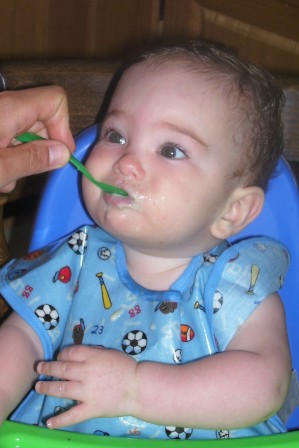
In 5 ½ years, Luke has moved from this:


to this:


Now, going from slurping up first “solids” to popping a bite of stir fry with a side of eggs into one’s mouth may not seem that momentous, but, for us, it is noteworthy.

Why?

Well, for one, guess who made dinner last night?

You got it! After an afternoon of sledding, it seems that Luke had worked up not only an appetite, but also a cooperative, independent spirit.

All the turn-taking had had done throughout the afternoon with his siblings on our single unbroken sled seemed to have put Luke in an accommodating frame of mind. Much to my pleasure, upon getting home, he did not immediately shed his sledding gear and beg for food. Instead, he seemed regulated by the heavy work of whizzing down a big hill and pulling a sled back up it countless times throughout the afternoon and was willing to wait until dinner before eating. Better still, when he saw me take carrots and asparagus out of the fridge in order to prepare part of dinner, he did not balk.

In the past, carrots alone have been known to trigger long tantrums with Luke, and adding asparagus into our mealtime mix is something that Luke has only recently accepted with extreme reluctance. So, the fact that Luke did not complain about what was “on the menu” for dinner was surprising. More unexpected was Luke’s request to make our family’s dinner on his own.

Now, Luke has helped me to cook and bake many a times before and has even gotten a breakfast or snack together for us, but, until last night, he had never been the main dinner chef.  Thus, when he asked me if he could make our meal "without your help, Mommy", I was pleasantly taken aback. I guessed that our afternoon of letting Luke loose to slide down a snowy hill as many times as he requested to do so without anyone else on his sled had built his confidence and that he wanted to prove his capabilities still further by preparing dinner.

I quickly reflected that it was not long ago that our boy was afraid of the sensation of sledding down hills and still needed the comfort of someone aboard the sled with him more often than not.  Yet, he had spent the greater portion of the afternoon's sledding runs going solo-by-request with us simply looking on.   Maybe it was time to let him do the same in the kitchen.

So it was that Luke sliced carrots


and scissored asparagus.


Then, stirred them with steak bits in a pan,


before mixing in leftover rice and cooking it all over low heat.


He, then, cracked eggs (with just a little requested help from sous chef Mom) and cooked them up (again asking Mom to help for a moment, but only "to watch the pan while I go potty.")

Finally, Luke set the table and proudly presented a simple stir-fry and eggs to our family.

Before we all dug in, while the children offered thanks for our day and meal aloud, I silently offered even greater thanks for the way the meal had been prepared, with concentration, determination and independence by our not-so-little-anymore boy.

I also gave thanks for the second reason the occasion seemed so momentous, which I will share more about in my next post.

Monday, November 14, 2011

Crock Pot Applesauce Printable Children's Recipe Cards

Quite a while back, I saw Cookin Cards: Individualized Cooking Recipes for Classroom Snacks in a Montessori Services catalog and wished I had a set to help guide my children's Practical Life food preparation skills.  However, at nearly $30, I just could not justify the cost-benefit ratio of the cards.  For while the cards look wonderfully designed, with both notes for educators about suggested pre-cooking activities and step-by-step drawings of how to make each recipe, they also looked like something I could almost make myself.

"Could" and "will" are often two very different things though.  Somehow,  making cooking cards for my kids got back-burnered.

Then, recently, I saw Heidi's awesome homemade Banana Blender Cookie cards at Work and Play.  These brought the idea of step-by-step pictorial cooking cards for the kids back to the fore of my mind.  Thus, I began creating some with a simple GFCF, sugar-free recipe that my children and I enjoy making every autumn (and sometimes at other times in the year):  

Crock Pot Applesauce  

I think I have turned my Publisher file for these recipe cards into a PDF correctly and uploaded it to a site for your ease of download.  So, please feel free to give it a try by clicking here.  (Off course, if it doesn't work, let me know.  I am new to this way of sharing files.)

To use the cards with your children, simply print them, cut them and laminate them if you wish.  Then, put them in a flip photo album, on a ring or in a recipe file box, and follow the steps, one card at a time.

I hope you and your children enjoy this simple recipe as much as we do.

Next on my Montessori Recipe Cards printable list will be one our favorite protein-packed GFCF pancake breakfast recipes.  I aim to have it up within a couple weeks.  So, stop by to check for it, and, if you have any tips or requests for improving the format of the cards before I post the next ones, please share your thoughts in a comment.

Happy "I Can Do It" kiddo cooking!

I am linking this post to my BloTaAcMo initiative, as I knocked three more things off my task list in preparing this post:  figuring out how to convert a Publisher document to a PDF, opening an account for sharing files online and linking blog posts to items to share.  Hopefully, I did all this correctly....  If you've managed to publish a post that you've been meaning to for quite some time, or if you have blog tasks and tips to share this month, please feel free to link them up to the linky at my initial BloTaAcMo.


This post is being shared at Montessori Monday hosted by One Hook Wonder and Living Montessori Now, where you'll find many wonderful ideas for exploring Montessori with your own children.  It is also being shared at:


LinkWithin

Related Posts with Thumbnails