Showing posts with label Writing. Show all posts

Sunday, November 14, 2021

Combine Picture Study, Paragraph Writing and Saint Stories for St. Clement's Feast Day


November 23rd is the Optional Memorial of St. Clement 1, Pope and Martyr. It can also be a wonderful day for coming together as a family for art appreciation, writing, and saint stories.

We did just that last year.

St. Clement Picture Study and Art History /Appreciation


I gathered my children together and presented them with these two images:


I asked them to
study the images for a full minute without speaking, and, then, hid the images and asked each to share some recalled details.

Then, I showed the images again and asked my children to notice any similarities and differences in them, which, of course, had them noting that the main figure in both paintings is similar.

This led to me explaining that both paintings were created by the same artist - Bernardino Fungai, an Italian painter.

I, then, asked my children if they could guess when the artist lived based on the style of the painting.

We noted that the painting had rather flat figures, lacked naturalistic depth and volume, but had some semblance of a realistic nature and a definite background (rather than, say, gold leaf).

With this in mind, we determined the paintings must have been done after the Medieval art period - when figures were painted quite flat and stiff without much background - and before or just entering into the Renaissance period, when human figures were painted with realism and backgrounds were highly detailed. Thus, the painting must be from the Gothic era, bordering on the Renaissance. (
The painter lived 1460- c.1516.)

I, then, asked my children what purpose they thought they painter had had in creating the paintings.

We decided it was to tell a story.

I asked if anyone could think of another word for telling stories and we got to the word narrations.

Types of Paragraphs Mini-Lesson


I bridged to the idea that storytelling, or narration, is also done with writing, of course, and that one type of paragraph is a narrative paragraph - or one that tells about an event or series of events, usually in chronological order.

I, then, asked the children if they could recall the other three main types of paragraphs:
  • descriptivedescribes a person, an object, or a scene in detail, often using many sensory detail
  • expository - often lists facts, gives directions, or explains ideas; sometimes defines terms, makes comparisons, and/or shows cause and effect and typically uses logical order
  • persuasive - shares an opinion about a particular subject and tries to convince readers to agree with the opinions and to take action; often uses order of importance
We, then, discussed that just as painters rarely arbitrarily select the figures, colors, and more for their artwork, writers often select types of paragraphs with specific purposes in mind.

If writers seek to entertain readers or express themselves, they typically use narration or description.

If they seek to inform, they often use exposition - and sometimes narration.

If they wish to influence people, they use persuasion.

Thus, several paragraphs written about the same subject might be very different, depending on why a writer wrote them.

With this in mind, we chatted about other things we know about paragraphs, including going over the fact that we divide a larger body of writing into paragraphs to give a readers’ eyes a rest and to indicate switches to new main ideas.

We also talked about starting a new paragraph when:
  • expressing a new or different main idea
  • explaining another part of your subject or step in a process
  • providing another kind of support for your opinion 
  • changing the time or location
  • changing speakers

Writing Challenge

All that discussed, I set a timer and challenged each of us to choose ONE type of paragraph and to write something inspired by the paintings in paragraph form.

After that, we shared our paragraph's and guessed what type of writing - narrative, descriptive, expository, or persuasive - each of us was going for. (We had all chosen narrative!)

I then revealed the names of the paintings: St. Clement Striking the Rock and Martyrdom of St. Clement and asked if anyone could recall anything about St. Clement.

St. Clement Study

{Some links which follow may be affiliate links.}

Our own stories shared, I then read the St. Clement story from Once Upon a Time Saints, which we chatted about briefly.

Finally, as a sort of invitation to creativity, I showed my children this St. Clement video from Youtube:


My hope was that the video might inspire my children to learning more about this saint and other saints through questioning and/or perhaps decide to make some videos/film shorts inspired by this one.

That did not happen that day, but the seeds were planted for another...

And the creative writing that came out of the day was entertaining enough to share - which I will do in a moment.

First, though, I would just like to say that the paintings, mini-lesson, writing, and reading became a worthwhile cross-ages, cross-curricula study, and I pray that by sharing about it here, you are inspired to enjoy art, writing, and the saints with your own children.

Stories to Share


In the first narrative piece, the writer married elements of Biblical writing with humor, with his own personal style, combining inspiration from both Fungai paintings - as well as from the characteristic style of Gothic paintings - into the story.
The Bishop hit a rock and said, "Let there be water." And water gushed from the rock. 
Now, there happened to be a dancing lamb on the rock, and he got swept away away into the ocean where he got hit by an anchor that the same bishop that hit the rock threw.  Yes, he can bilocate at any given time. Also, he can grow giant whenever he wants. Shrinking stuff for him is as easy as breathing for us mere humans.
The next story told took inspiration from the Martyrdom of St. Clement, and then began to use ideas from the other painting, Some paragraphs are move narrative and others more descriptive All work to tell a story with strong imagery, vivid verbs, and specific nouns.
It has been six weeks since we set anchor in this foreboding place. 
When we arrived, the land had seemed cheerful and welcoming because land does not roar and pitch poor vessels into the sky only to crash them back down with the snapping of timber. And land does not swallow ships whole in the belly of a wave. 
But, we soon learned and had its issues as well. 
Now, as we travel through this land, I long to hear the trickle of water in this desert.
The third story was only loosely inspired by the paintings, taking the figure in the armor-like head covering and the "gush" as inspiration for a dramatic, action-packed, and gruesome narrative.

The tall man wrenched his weapon from the dead guard and headbutted his next attacker.

Thane had seen enough. He threw himself at the scythe-wielding reaper of men, thrusting forward his spear. The pointed shaft penetrated the muscle of the man and pierced his heart, showering those nearby with blood as it skewered him.

Thane dropped his spear and drew his arming sword. Before him, northern raiders pillages the town, plundering its wealth, setting its building ablaze, and slaughtering or enslaving its people. 

A gaunt prisoner barely covered with threadbare strips of cloth, plodded away from the stone quarry. His throat ached with dryness.

As he paused his weary steps, closing his yes and drawing in a weak breath, heavenly vision of thirst-quenching water played in his mind's eye. 

Drip. Drip, Drop. The prisoner thought he could hear the soothing water in his imagination. Then, the gentle dropping sound turned to a full on splash that taunted him so strongly that his eyes flew open.

"What?" he croaked incredulously.

In front of him stood that crazy Clement who called himself and exiled Christian, and, in front of Clement stood an incredible flow of water - real, sweet water.

I hope you have enjoyed this look into our eclectic study of St. Clement and can enjoy your own inspired lessons with your children.

St. Clement, pray for us.

Wednesday, March 10, 2021

What a Helpful 2-in-1 Resource for Essay Writing, Style and Usage! {An Excellence in Literature Handbook for Writers Review}

DisclosureI received this product free through the Homeschool Review Crew.


Do you have a middle school or high school student who could benefit from a writing reference resource which is comprehensive yet offers clear, concise explanations and examples?

The Excellence in Literature Handbook for Writers from Everyday Education could be just what you are looking for.

We have recently had the opportunity to review this 400+-page reference guide, which addresses essay writing, including style, grammar, usage, and punctuation, and is effectively two books in one.

The first "book" introduces and details essays and arguments. It devotes over 200 pages to illuminating for students how to structure an effective essay, emphasizing that a thesis must be "arguable" - not simply a point of fact or an opinion most already agree with.

Part One then takes students through the "anatomy" of an essay step by step, explaining how to write paragraphs that define terms, give background information, provide details examples, etc.
 discussion of essays arguments and more.

Through clear examples and exercise, Part One can truly help students craft effective and passionate arguments in clear and engaging writing. 

The second "book" of the Handbook is a style and usage guide. It includes more than 200 pages that offer tips and guidelines for grammar and word usage, covering spelling, punctuation, parallel structure, formatting, APA and MLA guidelines, and so much more - all listed in an extensive table of contents explained clearly with effective example, and numbered by paragraph for easy reference.

Together, the two-books-in-one work as a thorough teaching and reference tool which is designed to be used with high school through college students, yet is written and organized in such a way that it can he helpful for eager middle school students, parents, tutors, and teachers, too, I believe.

Middle school and high school students can take a break from other ELA studies to use the Handbook to fill in gaps in knowledge and to learn how to write strong essays. They can also use the reference in tandem with other resources, checking style, grammar, and usage points in the Handbook as they move through other curricula. 


College students can access the reference to tighten and improve their writing. They can also take comfort in knowing that by looking up key points in this vetted Handbook rather than, say, some random article they find on Google, they are getting sound examples and explanations.


Parents, teachers, and tutors can use the rubric in the Handbook to grade and give feedback to students. They can also direct students to specific numbered sections of the Handbook to review specific points. Plus, they can use the material in the Handbook to improve their own writing.


Most definitely,  I see the Handbook as a guide that can help students (and grown-ups) now, and also for years to come.

How Have We Been Using the Handbook?

I have been browsing the Handbook to become familiar with al of its parts so I can use portions of it to direct all three of my children to as I edit and evaluate their writing.

I have also been using the book as my high school age son's current ELA studies. Having had him fail to fully utilize other writing resources he has begun, I have opted to use this one together with him during 1:1's.

Basically, we read portions of it together, do the exercises in them aloud, and discuss examples. I also use the Handbook as a reference when I see mistakes and areas of improvement in my son's creative writing.

My Son's Thoughts

When I asked my son for a few words for this review he said:

When you first told me we would begin work with this Handbook, I thought, "Whatever." I have begun a multitude of writing programs - especially about essays - but never finished one, because they tend to bore me. I prefer creative writing, particularly writing fantasy tales. 

Since then, we have taken time to sit together, read this, and do the exercises out loud, and I think the Handbook is well written, besides its overuse of the words "very", "really", and other such weak words.


I would recommend this Handbook to others.


My son also made me smile at the end of our 1:1 the other day, when, after balking at having to come do the 1:1, he said, "Mom, this Handbook is good. It makes sense." 

I am glad it is working for him!

My Thoughts

My son, who loves to write fantasy fiction and does so well, still has much room to grow in writing nonfiction pieces. He also has always had trouble formulating clear, interesting theses and following them with on-point and effective arguments.

As we've been moving through 
Excellence in Literature Handbook for Writers, I am seeing his understanding of how to craft persuasive writing grow.

I appreciate that the Handbook is part teaching tool and part ready reference. It does well encompassing many aspects of style, grammar, and usage and I like that it:
  • teaches how to construct logical, engaging arguments for essays, debates, and research papers
  • dives into different ways to organize essays and literary critiques, from research papers to narratives, outlining essential components for each.
  • offers images, outlines, examples, and more to drive home ideas.

  • offers a thorough treatment of paragraph structure, teaching about transitional words interpreting evidence, paragraph coherence, and more.
  • discusses how to read and write thoughtfully about literature including Shakespeare, classics, short stories, poetry, etc.
  • presents how to use inductive and deductive reasoning.
  • gives topic sentence outline examples for papers across curricula.
  • is organized with numbered paragraphs in the grammar and usage portion
  • provides multiple examples and exercises
  • goes over basics such as phrases, clauses, and dependent clauses, confusing words, etc.
There truly is much "meat" in this 2-for-1 Handbook.

The only things I have not liked so far are the overuse of unnecessary words such as "really", the lack of an index, and the fact that I don't have a physical copy of the book.

To this last point, we  received a PDF edition of 
Excellence in Literature Handbook for Writers and, although it is handy to have it available on my computer so that no one can misplace it around the house, I find myself missing the ability to pick up a print copy to flip through. Thus, I would recommend that if you - like me - prefer to have your reference resources in a physical format, it might be worthwhile to get the print version of this resource.


The
 Handbook for Writers Excellence in Literature is available in both print and ebook.

You'll find a complete list of contents and more information on the Handbook page at the 
Everyday Education website and, I believe, will find this Handbook an excellent resource for writing!


Learn More

More than 25 Homeschool Review Crew families have been using the Handbook for Writers Excellence in Literature. Click on through to find links to video, social media and blog reviews.


You can also connect with via social media:

Facebook  | Facebook 2  | Twitter  |  Instagram  |   Pinterest

Tuesday, September 10, 2019

Write First-Rate Persuasive Essays {A BetterRhetor Review}


My oldest child has no current plans to go to college, yet has decided he would like to start his high school studies early and to compete with a speech and debate team this year. Thus, when an opportunity to revieCollege-Ready Writing Essentials™ from BetterRhetor came up - even though my is several years "too young" for the program's target age, he said he would like to try it.

I agreed to support my son's desire, since we both figured that using BetterRhetor would help him gain skills for the long run while framing an essay that might double as the basis for his competitive platform speech this year.

I also hoped
 College-Ready Writing Essentials™ would offer my son structure, flexibility, and top-notch teaching as he gains more skills to put into his personal writing toolkit. For, while I could help him improve his writing prowess myself, he does not want me to do so.

My son has articulated that this year he would like to learn from the that books he reads, online programs, or "teachers besides Mom". So, I am trying to support that and BetterRhetor is helping me to do so.


What is 
College-Ready Writing Essentials™?


College-Ready Writing Essentials™ from BetterRhetor is a self-guided online resource with lifetime access that is targeted to high school juniors and seniors and recent high school grads, which can also be helpful for sophomores who would like to run through the program once now and, perhaps, again, as seniors.

The program, developed by William Bryant, PhD, is offered in the form of two paid packages: Full or Premium (with the main difference being that, with the Premium package Dr. Bryant, offers personal essay feedback).

Both packages take you through 25 lessons initially designed to be completed within five weeks. However, with lifetime access to the self-paced platform, families at home can follow the step-by-step instructions to develop a first-rate academic persuasive essay at whatever speed life and learning allow. This is good news for homeschool families like mine that have a child who is young for the program, but desires to try it or for those that have children with special needs or simply have a life that often takes turns which temporarily derail planned studies. (Yes, I am still referring to families like mine.)

With the lifetime access, 
College-Ready Writing Essentials™ certainly offers flexibility and sound teaching. These are true plusses of what BetterRhetor has to offer in my book!

My Son's Experience


As I said, my son is several years "young" for 
College-Ready Writing Essentials™, but wanted to give it a go. So, right from the start, we knew he'd take the course at a much slower pace.

He has been doing so, and this is what he has to say:


I saw this and was like 'Yes! more credits!?' (I want to finish high school early.)
For, of course, BetterRhetor gives you credits, but it also teaches you how to write persuasive essays. 
Though BetterRhetor is not the most exciting course, it does some things extremely well. 
For one, it does not assign you uninteresting topics to write about. Instead, it allows you to choose your own topics - an extremely helpful thing since I am in a speech and debate club. 
For another, it does not have you write out multi-paragraph essays for each lesson. Rather, you focus on developing one main essay using an easy step-by-step platform. 
Finally, it is concise. It does not use an extensive amount of adjectives to describe a simple and sometimes unnecessary point that no one can use or care about - which is what I sometimes do. Instead, it guides you directly, giving you something concrete to do with each lesson. 
I have worked on BetterRhetor consistently and, though I sometimes find myself drifting to other thoughts, I understand that BetterRhetor is a valuable tool toward helping my future. So, I draw my attention back and do the next thing. 
That means I need to read and watch the material...


Then, download the next assignment...


and complete it.

 
 This process is challenging for me, because I have an extremely short attention span, that probably, if it were put out on a table, would not even make a few inches, and each lesson takes at least 30 minutes. So, often, I stop a lesson midway and get back to it.


So, I warn you now that BetterRhetor is only for those ready to embark on a long and hard, but rewarding journey. For simple is not always easy.  
BetterRhetor is simple to use, but hard to finish. It teaches challenging skills and does it well 

As you can see, my son has struggled with stepping up to high school level with his focus and skills, but desires to do so and, thus, persists in his efforts. He has not had a easy time with BetterRhetor and is going through the program much more slowly than a typical student would, but we both agree that the program is a quality one and will be fruitful for him in the long-run as it tpresents
  • 25 step-by-step lessons
  • targeted exercises and worksheets
  • strategies, models, and examples of writing
  • links to helpful resources
  • a reference sheet of key terms and phrases
  • a discussion forum and interactive comments
  • a certificate of completion (to prove he's earned that credit he so wants!)

We both recommend the program to any high school level student that needs to level up with writing skills. (There is a 30-day money back guarantee.)

Learn More


Thirty-one Homeschool Review Crew families have had children working on writing using BetterRhetorRead about their experiences moving towards student success with college readiness and academic writing.

Read all the reviews.

You can also find BetterRhetor on social media:


Crew Disclaimer

Sunday, April 14, 2019

Have Your Children Write and Illustrate Their Own Holy Week Book

Training Happy Hearts


Some years ago, when all my children were young, we enjoyed a hands-on Holy Week during which we did a different art project each day in conjunction with the readings. 


This year, we'll be continuing a writing and illustrating project that we began at the beginning of Lent - one that you could easily adapt into a Holy Week book in your home.

Our Simple Lenten Project

First, let me tell you about our simple project:

At the beginning of Lent, I was looking for a way to get my children and I back into regular Together Time studies including Bible reading.  I also wanted to highlight narration, writing, and handwriting skills.

Thus, when I spied three copies of Upon a Tree, a 2016 devotional booklet from Creative Communications, in my Lenten files, I decided that we would use the booklets for a simple Lenten project: Each of my children would write and illustrate their own book, retelling parts of Salvation History.


{Some links which follow are affiliate ones.} 

To do so, I placed three primary composition books (somewhat like these ones) and the devotional booklets near our kitchen table.  Then, daily, we took these out, along with our New Saint Joseph, Family Edition of the Holy Bible, pencils, and colored pencils, and I read the Bible verses noted in the devotional.


On some days, we chatted about what the Bible verses said, how they related to Salvation History, and what their application to our lives might be, while, on other days, we simply read the little poems in the devotional that went along with the Bible verses and then carried onto the next step.


That step was to have children either write and illustrate a narration about the verses which we had read aloud or to compose a poem or story segment related to them.


Then, I would help them correct their spelling, punctuation, etc. and comment on their handwriting efforts.


Some days this worked beautifully for all of us.


Other days, one child or another wasn't into it and rushed their work.


While, admittedly, on still other days, we neglected to get to our simple project and, then, played catch up later on.


Regardless, here we are, headed into Holy Week, ready to write the final portions of the story of the Passion before adding a page for the Resurrection on Easter Monday.


And I am pleased. For, although my children and I did not manage to make Bible reading a daily Together Time habit this Lent, we got closer to making it one and each of my children wrote their own simple Salvation History story.

How Could You Adapt Our Idea for Holy Week

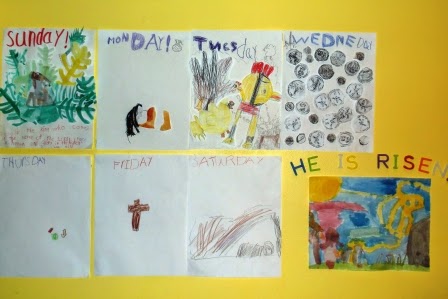
I know what we have been doing is not rocket science - just reading the Bible, chatting, narrating/writing, and illustrating - but it is worthwhile, and because we are doing it in bound notebooks, it will become a keepsake for the kids that they can reread in future years.

You could do a similar thing this Holy Week, using an inexpensive primary composition journal, printing out free story writing paper, or using a blank book; then, reading the daily readings, and having your children write and illustrate.

Alternately, read a page or two of a favorite Lent/Easter picture book, such as The Easter StoryA Child's Easter He Is Alive Love One Another, or He Is Risen: The Easter Story each day, look up the Bible verses that would correspond to what you read, read those, then write and draw away.


In the end, you should have a lovely, child-written-and-illustrated book to read for years to come.

May you have a blessed and beautiful Holy Week!

Tuesday, April 9, 2019

Can You Really Teach Grammar, Vocabulary, and Writing in 15 Minutes a Day? {A Fix It! Grammar Review}

What kind of program can get a non-workbook kid happily focusing on grammar, vocabulary, and writing in an effective and engaging student book format more days than not each week?


{Some links may be affiliate ones.}

Fix It! Grammar
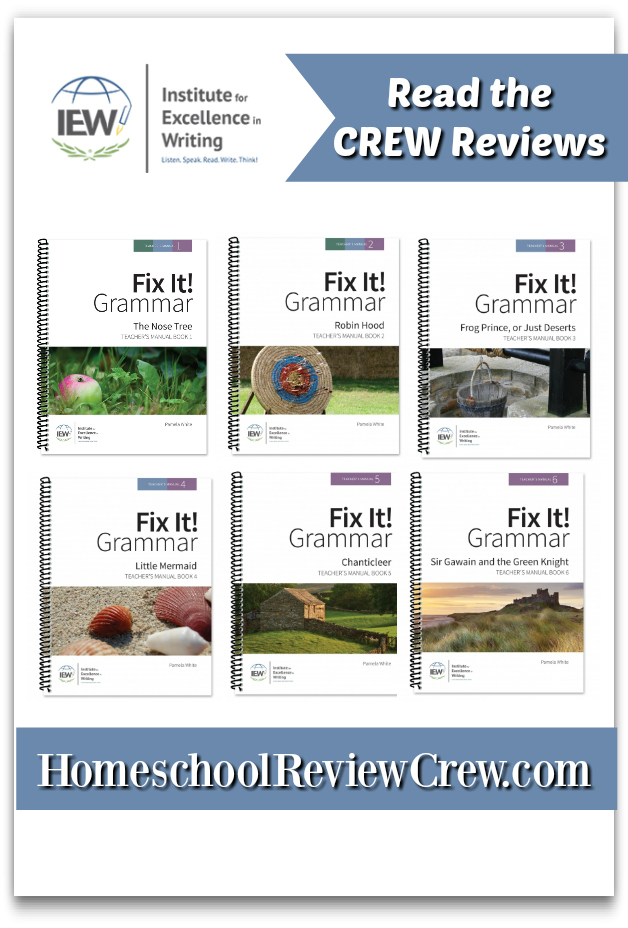
 by the Institute for Excellence in Writing (IEW) - program authored by Pamela White, a traditional classroom and homeschool teacher with over three decades of experience and explained here by Andrew Pudewa:


Without question, since my son has began reviewing Fix It! Grammar Robin Hood Student Book 2 we've found it to be an easy-button for English Language Arts that pleases us both.

I appreciate that the program is off-screen, open-and-go, and truly easy and effective to use, while my son likes that it he can take 15 minutes or less a day to build his skills while also enjoying a story.

Indeed, Fix It! Grammar has proven itself to be a happy surprise in our home - drawing my son in and helping him review and build skills, little by little, in an applied grammar, spiral approach that transfers well to personal writing and editing endeavors.

Moreover, I am delighted with how easy the corresponding Teacher's Manual is. 


To guide my son and help him to correct his work, I do not have to do any more prep than to open the spiral bound manual to the page that matches the work he has been doing in his Student Book, then read, check, and chat.

It's really that simple to use!


The Teacher's Manual is a 208 page, softcover, spiral bound book that includes:

  • an introduction to the Fix It! Grammar program
  • a scope and sequence
  • 33 weeks of lesson keys, grammar lover notes, teaching tips, etc.


Bound with it is a 45 page grammar glossary and codes for accessing a free downloadable student e-book for family use and two e-adios on grammar.

Everything is right there to support you as you as guide your child in success!

The Student Book is equally easy to use.  It, too, is a softcover, spiral-bound book, which means it lays flat for writing in.  It contains:

  • 33 weeks of 4-day lessons within 69 pages
  • 5 pages of ready-to-cut grammar cards on heavier cardstock
  • a 45-page grammar glossary.


My son has this to say about it:


When Mom first gave me the book, I was happy because it is about Robin Hood.

I like fantasy and stories about archers, so even though Robin Hood is not exactly fantasy, the content is enjoyable for me.
 
I also appreciated the fact that you are editing a story and not writing boring answers to questions or paragraphs and essays. 

Instead, each week, there is a page that teaches you about points about grammar, such as:

  • when to indent
  • where to capitalize
  • what different parts of speech are and how they are used
  • how to punctuate
  • and more

Then, each day, you are given a short part of the story that you must edit using things you have learned about.


You also have to identify parts of speech using given abbreviations, define challenging words, and, sometimes, select correct homophones. 

Finally, you copy each week's passages correctly into a book, so, in the end, you will have a grammatically correct story about Robin Hood. 
The program is meant to be used a little each day, but I chose to do it in shorter or longer sessions a few days a week instead. This way, I could keep up with it, but also not work on it every day. 
I used the book by myself, then, about once a week, I worked with Mom to go over vocabulary orally so I would not have to write out definitions or synonyms.  We also checked my work and sometimes looked over my copywork. 
One time, when my mom was having a surgery, my grandmother worked on Robin Hood with me instead of my mom. It was easy for her to do so with the Teacher's Manual. 
Having been working on this for a number of weeks, I think it is one of the best ways I've learned grammar. Other than actually writing a book myself and having my mom edit it with me, it is the only thing I have used so far that is story-based. I have liked learning about grammar in context, learning little by little, building on things and reviewing them. 
I would highly recommend this book, and my recommendation is pretty huge, because I usually hate grammar things (besides writing and editing my own book), dislike workbooks and anything I have to handwrite, and don't like set curriculums. But I like this and plan to keep using it!


Seriously, my son has had no qualms with continuing to learn with Fix It! Grammar Robin Hood week to week and that speaks volumes!

The program has to be high-interest, low-"pain" for my son to like it, and he does!  I am thrilled.
He is enjoying reading, editing, and doing copywork of a version of Robin Hood while also keying into:


  • indentation
  • capitalization
  • articles
  • nouns
  • who-which clauses
  • end marks
  • subjects of clauses
  • verbs and helping verbs
  • coordinating conjunctions
  • adjectives
  • prepositions
  • main clauses
  • dependent clauses
  • clause starters
  • commas
  • quotations
  • homophones
  • vocabulary
Working with short passages, my son learns applied grammar, one small bit at a time, through a spiral approach that leads to long-term mastery and transfer to personal writing projects.

There are no fill-in-the-blank, drill-n-kill exercise and no time-draining assignments.  Rather, there is an engaging story to immerse yourself in while puzzling out increasingly challenging corrections and identifications that constantly keep you learning and reviewing grammar, vocabulary, and writing.

I am so pleased to have found Fix It! Grammar through this review and  already looking forward to using the next book in the series of six Fix It! Grammar books with my son.

Skills in each book build on those of the last, so you can begin with book one and head on up the series or you can go to the 
IEW website to find a placement test which will make it clear if you might be better off starting your child a bit later in the series.

Read all the reviews!


Whether starting with Book One, Book Two (like us), or the more challenging Books Five and Six, you are sure to find detailed, but not overwhelming lessons that flow perfectly from one to another providing ease for English Language Arts learning.

Bonus - the price is extremely affordable.  The Teacher's Manual costs only $19 and includes a link for a printable student e-book.  Or, you can pay $15 more for a pre-printed, spiral bound Student Book 


If you'd like to learn more about Fix It! Grammar, click on over to see what 60 Homeschool Review families think about different levels of the program.


You can also connect with 
IEW on social media at:

Crew Disclaimer

LinkWithin

Related Posts with Thumbnails