Showing posts with label Classical Education. Show all posts

Wednesday, May 19, 2021

Cross Seven Offers Musical Memory, Quiz Tracking, and More {A Review}


I received this complimentary product through the Homeschool Review Crew.
Disclosure: Impressed by Cross Seven, I am now an affiliate, which means I may earn from qualifying purchases.

When I was offered an opportunity to review a subscription of Cross Seven Ventures - Homeschool Musical Memory Tool by Cross Seven Ventures LLC, curiosity caused me to jump at the opportunity.

I had long wanted to see if the power of musical memory work might help my children learn, but, sadly, when my children were at ideal ages for it, I could not take advantage of the variety of programs out there that use it.

Budgets, time, and, to be honest, a child who went through a long period of being averse to any music with lyrics, precluded me from jumping on the bandwagon of awesome musical memory work that so many others I knew were benefiting from.

Fast forward to recent days: all of my children now like music with lyrics of one kind or another, and I remained curious as to how effective music memory work might prove here.

Thus, when I heard that we could try out 
Cross Seven Ventures - Homeschool Musical Memory Tool, which pairs music and audiovisual slides to help build students' working memory of many bits of knowledge considered foundational to Classical Education and also offers online quizzes and such, I was excited.   

What A COMPREHENSIVE, YET FLEXIBLE AND EASY TOOL!

The Cross Seven program is designed to be easy to use and to take minimum time so that families can benefit from it while attending to other life and learning, too.

It includes four cycles of musical memory work that cover Scripture, Hymns, Math, History, Science, English, Latin, Geography, and Timeline.

Each cycle includes 28 weeks of material on a four-year cycle, which means that relaxed families can use it as a spine for all learning, while families that prefer to can use it as a supplement.


Further, since the musical memory work and related online quizzes can be used week by week, or accessed by subject, there is flexibility and ease of use even for families that just want to focus on specific areas.

We use are using the program here for one child at present and he does it on a laptop, but I have heard others are using it on s
treaming apps such as AppleTV, Roku, and FireTV, so everyone is able to learn together! 

WHAT'S INCLUDED?

With your subscription, you get access to a parent portal where you can access quiz scores for your children. 
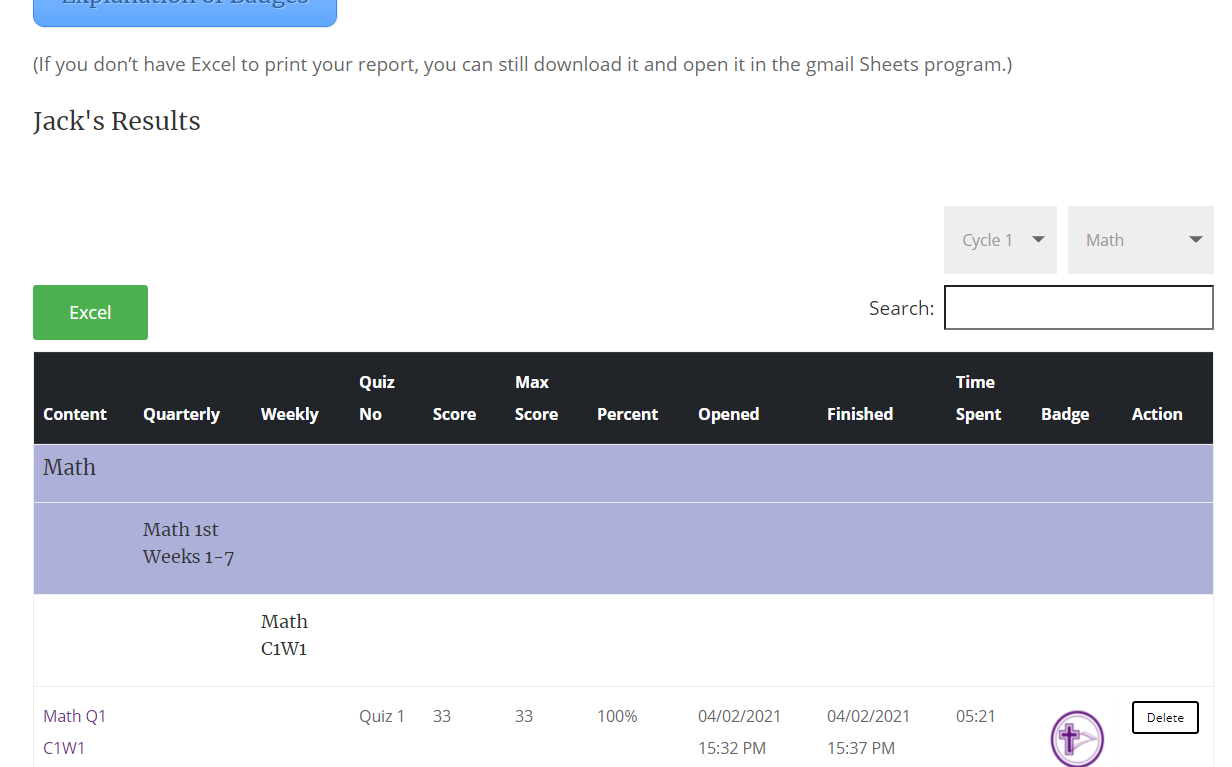


These results - we discovered after reading the site - will only appear if your child remembers to log in on his or her own account. 

You also get a plethora of resources for each cycle!


 If you use the program traditionally, your family or co-op class will start by listening to the hymn, followed by prayer, and then: pledges to the American flag, the Christian flag, the Bible, and the Lord’s Prayer. From there move into Scripture and the Timeline - which has both audio and visual components That completes the opening of each day. 


Then, children can move onto other subjects - weekly History, Latin, Grammar, Science, Math, and Geography - as well as quizzes and fun links that can be accessed to expand learning taking place.

If using the program with one child, like we are, the child can simply log on, select a cycle/subject to work on, click on links to view the slides listen, take quizzes, explore, etc.

There is so much potential learning in this program!

Grammar has lessons related to the parts of a speech, the purpose of a sentence, patterns, adverbs, and so much more. It is all presented with simple songs and visuals so students can read along with each song while learning about nouns & pronouns, adjectives & articles, verbs & adverbs, conjunctions, interjections, fundamentals of sentences, prepositions, phases & clauses, helping & linking verbs and more.

Math includes skip counting 1-12, 15, 25, squares, cubes, order of operations, common fractions, decimals, prime numbers, Roman numerals, conversions, percent, commutative, associative, distributive properties, prefixes for metric, Pythagorean theorem, absolute value, place value names, averages, etc.

Latin works through numbers, poems, and scripture to read and sing along with as well as  grammar lessons—verbs, declension, Scientia potentia and more, plus the Apostles Creed.

Science covers various laws and scientists; taxonomy, types of leaves, parts of a flower and more and takes but a minute at a time each, concluding in Cycle 4 with Physics: Kepler, Newton, Newton’s Laws, forces, work, energy, simple machines, Archimedes, electricity, Laws of Thermodynamics, heat transfer, Faraday, Maxwell, electromagnetic spectrum, light, sound, Einstein and more!

History begins with Creation and the Earliest People and works through, the topics from various historical events ending on September 11th. 

Geography starts with the continents and oceans; proceeds through the Seven Wonders of the World, Ancient China, and Egypt; expands to Canadian Provinces, U.S. cities, and capitals; and essentially takes you through each continent from ancient to modern times with short, simple videos.

Hymns
include classics with rich lyrics to hide in hearts or sing aloud when you wish.

The Timeline has a pdf download to help you create your own timeline as you work through each lesson. Oh, and there are videos with hand gestures to go along with each lesson. 

Together, the program provides a gentle approach to Classical Education where young children can simply read, hear and sing their way through all nine subjects that are contained in the cycles, then use quizzes - with matching to map work - to  quickly learn and recall what is being taught. 

Quiz results, as I said before, can be accessed on a parent dashboard, and students can earn a
 variety of badges and certificates through the subjects and completing their quizzes

HOW WE USED IT

When we first got Cross Seven, I introduced it to my just-teenage daughter, hoping she might be interested in it as a way to review and fill in some of her skills and knowledge. She tends not to like online programs, however, and I have no "fancy phone" for playing the musical memory work in the car when she is a captive audience, so my hopes for using Cross Seven with her did not come to fruition.

At the same time, I introduced the program to my tween son. He has been into Math, so asked me if, for now, he can concentrate just on the math portion of it, and, then, in the future maybe do other subjects. I agreed.

When I asked him for his thoughts for this review, he said:

It's a good program, but, of course, the math, which is what I chose to start with, would not be a full math curriculum, because it does not teach you, but gives you drills and memory. 
The drills are set up as easy, quick questions and proceed to get harder as they go on. The memory work is presented as songs and is okay. I did not like them much now, but I think I would have when I was littler. 
I am interested in trying the other subjects in the fall. 
I would recommend it to people ages 7-12, with under nine's probably enjoying it most.
WOULD I RECOMMEND IT?

I have browsed other Classical Education musical memory programs before and never seen one delivered like this - with full memory work, quizzes, videos/skits, fun links, a parent portal for quizzes, etc. So, for that reason alone, I think it is worth looking into.

Further, as I popped around our subscription, I was impressed with how much is included in the four-year cycle of work and thought the songs could have truly benefited my daughter and younger son had we had this when 5-10 years ago. 

I can see this full program working wonderfully for many families with right-age children and am finding it useful for my older children to cherry pick from.

It is well put together, easy to access/use, and appreciated. Also, i is NOT parent intensive!

All children in your household can login under the same family account. Then children can login to their student profiles and use the product on their own, with you checking in on quizzes through the parent portal. Or, you can join in or complete studies as a group with no need to do a lot of prep or follow up.

Many of us on the Homeschool Review Crew appreciated the ease of this program. Click through to find links to over 20 social media, video, and blog reviews which provide honest opinions and ideas for using Cross Seven.

A NOTE FOR FELLOW CATHOLIC READERS

Since we've been focusing mostly on Math, my son and I have not run into anything that would take further discussion for Catholic families. 

It is a Christian, not Catholic, resource though, so, like with all such resources, I suggest that if theological questions come up, you simply address them, and also, add whatever additional expressly Catholic teaching/memory work/hymns you wish.

CONNECT


You can get a FREE 1-day trial to Cross Seven online, then, sign up with a lmonthy or yearly subscription. You can also connect with Cross Seven:

Facebook | Twitter | Instagram | Pinterest | YouTube


Wednesday, September 12, 2018

Learn the Classical Art of Persuasive Speech {Review}

Wow!  Sometimes timing is everything!


{Affiliate links may follow.}

Shortly after my family and I joined a local Christian speech and debate club, I was offered a chance to review Fitting Words Classical Rhetoric (complete program) by Roman Roads Media.


At that time, I had not previously heard of Roman Roads Media, which also offers two subscription programs that other Crew Review families have been usingPicta Dicta Natural World or Picta Dicta Vocabulary Builder.  However, immediately upon perusing the Fitting Words Classical Rhetoric page on their website, I knew Roman Roads Media was a company I wanted more familiarity with.  Their curriculum on persuasive speech from a Christian lens was just what I needed to enhance my own learning.

Yes, I did just say "I".  


Although Fitting Words Classical Rhetoric is meant for high school students, I wanted to review it for my own edification and so that I could better assist with our local speech and debate club.  For, although I have a strong background in drama and education - and even made a living as a public speaker at one point  - I have little background in logic and debate and felt Fitting Words Classical Rhetoric would help me step up my game.


That it doing!  So far, I'm only partially into 
Fitting Words Classical Rhetoric's 30 lessons and already thoroughly impressed with what an informative, robust, yet digestible rhetoric curriculum it is!  Moreover, I love that it takes an unashamedly Christian worldview.

The complete curriculum surely s helping me hone my understanding  of how to be informative in truth, powerful through moving others towards goodness and virtue, and elegant by using delightful verbal beauty.  Surely, this understanding will help me help the students in our local speech and debate club, too.

They Aren't Kidding When They Say "Complete Program"


Fitting Words Classical Rhetoric (complete program) is just that - complete!


The program came to me  packaged with its very own sturdy tote bag - a touch that I appreciated and one that made me think how Roman Roads Media takes its teaching to heart - ensuring even its products - which teach truth and beauty - are packaged beautifully and can stay organized and neat at home or on the go.

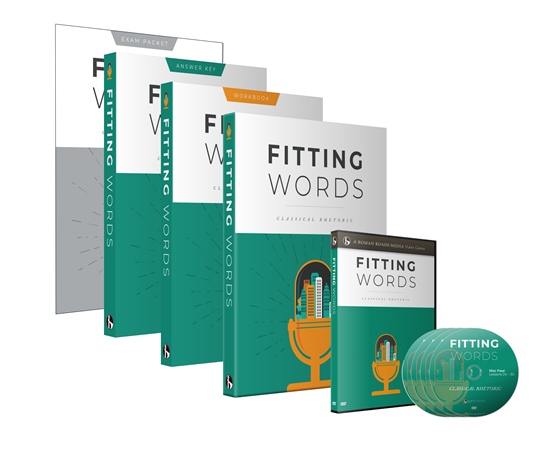
It consisted of:


  •  a thick hardcover textbook:  This meaty text is close to 400 pages with 30 lessons, spread over 7 units with introductory materials, an appendix of speech texts, an appendix of speeches within the Bible, a Glossary-Index, and Works Cited included.  That may seem almost too hefty, but trust me, it the layout is user-friendly and the content excellent!


Wide margins with images, Key Concepts, Famous Orator highlights, etc. make the text visually appealing.  Sections in each chapter for "Thinking deeper", "Developing Memory", "Reading Further", and "Notes" encourage depth.  And, well-written, clear, and relatively concise text explains everything you need to understand Rhetoric.


  • a spiral bound, soft-cover workbook: Details.  Details.  Details.  Not only does the workbook help you hone into details with clear though and no fill-in-the-blank filler, but the design of the workbook includes two favorite details I appreciate in such materials: spiral-binding and plenty of white space!  As you write out answers to each exercise, you do not have to fuss with trying to keep the workbook open since it is spiral bounce and lays flat beautifully.  You also have plenty of lined spaces for writing answers and wide margins for any notes you might want to add. The workbook also includes speech judging sheets.

  • a regular bound softcover answer key: This contains optional one-and two-year course schedules, answers to all the exercises in the student workbook, and answers to the exams. It also stands above many other answer keys I have seen, because it provides ideal answers for every question from the workbook.  There are no "answers will vary" - just good, solid, complete-sentence answer examples!
  • a shrink-wrapped exam-pack:  This handy stack of nine pre-preprinted loose 3-hole punched exams would come in handy for anyone taking thi course for credit that does not want to deal with printing and punching papers
  • a 4-disc video course: Clear, crisp video with eloquent presenters make this 18-hour video course an appealing component that compliments the text and workbook.  There are tow videos for each lesson from the text - one "lesson" and one "application video", like this:


There are also nine pre-exam videos to ad with studying.  It is recommended that student watch the video lessons before reading text lessons.  I found it worked well for me either way around.  I could read the text while out and about and view videos when I had quiet time, with one reinforcing the other no matter which order I was able to use them in.

Fitting Words Classical Rhetoric

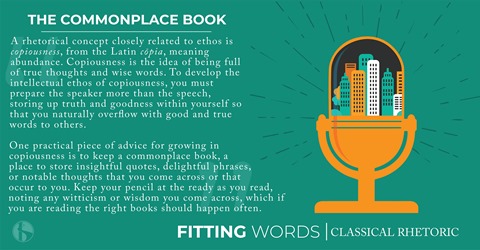
It is also recommended that you keep a commonplace book of quotes.


 Roman Roads Media
Roman Roads Media


Traditional in its approach, thoughtful in its design, and wholly pointing to what is true and beautiful, Fitting Words Classical Rhetoric truly is a complete program!

Would I Recommend It?  You Bet!

Roman Roads Media


My elementary and middle-school aged children are not yet ready to to glean all the benefits of this Rhetoric program, but as I make my way through the classical art it teaches, I cannot wait until they are old enough to learn directly from the program.  Until then, I a happy to be learning myself, so I can sprinkle bits of knowledge here and practical tips there.  I have no doubt that going through the program materials myself will help me be a better speech and debate mom!  I also have already found myself recommending the program to local parents of high school students.

By the time you finish the program, you will have prepared and delivered 5 speeches:

  1. one designed to produce a particular emotion in listeners
  2. a forensic speech of accusation or defense
  3. a political speech urging hearers to do or not to do a course of action
  4. a speech of praise
  5. a free choice final topic

You will also develop a comprehensive and practical understanding of rhetoric, having studied examples from some of the greatest speeches in history and Scripture and focused on theory, imitation, and practice of persuasive speech.  Further, you will do all this from the a Christian worldview, grounding yourself in truth and beauty as you practice a timeless art that you can use to affect change.

Roman Roads Media


Without question, I consider Fitting Words Classical RhetoricI  I would also be interested in checking out more of the Classical curricula they offer as highlighted here:


Read more reviews!

Find Roman Roads Media on social media:


Crew Disclaimer

Tuesday, May 17, 2016

We've Found the "Easy Button" for Poetry Memorization!

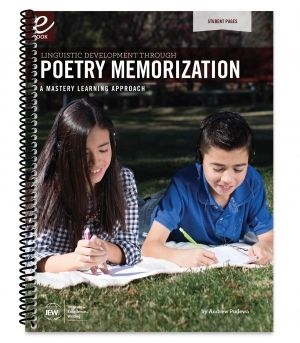
(Disclaimer: This post contains affiliate links for Linguistic Development through Poetry Memorization by Institute for Excellence in Writing, because we enjoyed the resource so much upon reviewing it that we know we will be recommending it often.)


https://iew.com/affiliate/272641/node/454

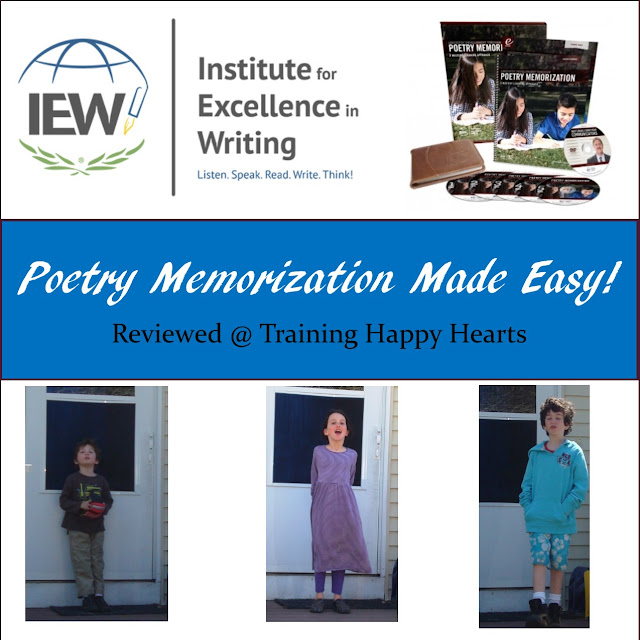
 At the beginning of this school year, my children and I invited some of our friends to join us in a newly hatched AMP club initiative in an effort to include more regular Art, Music, and Poetry study in our lives, while also enjoying learning and exploring alongside friends.  Thus, I was thrilled to receive an opportunity to review Linguistic Development through Poetry Memorization by Institute for Excellence in Writing  (IEW), since I had a feeling it would dovetail perfectly with our AMP club endeavors.

Was I ever correct!

At the beginning of last fall, when my children and I kicked off our AMP club, we were so excited that we collected loads of poetry books, poured over them, picked out some poems to memorize, and set to memorization efforts.  However, as the weeks and months went by, more and more often, we found ourselves too busy to repeat our eager search-and-memorize process and ended up hosting a few gatherings with no poems to share.

Enter
Linguistic Development through Poetry Memorization, and our memorization efforts are back in full swing.  From the first day we cracked open the Linguistic Development through Poetry Memorization student book and read its first poem (the cute and quick Ooey Gooey), my children began exercising their poetry memory muscles again with ease.  Since then, between listening to the CD's we received that accompany the book, and simply reading and reciting the other poems in the first section of the book on our own, the kids' mental muscles - and my own - continue to get a work out. 

Since we've had
Linguistic Development through Poetry Memorization at our fingertips, we have not missed being prepared with memorized poems for our AMP club.  Bonus, by reciting select poem from the program at our meetings and offering others a look at our student book, we've also drawn friends' attention to Linguistic Development through Poetry Memorization and are, currently, considering using it as a collective "spine" for the poetry portion of our club next year


One mom thinks
Linguistic Development through Poetry Memorization looks great and another mom, who was absent at our last gathering, is going to take a peek at our copy of the program, too.  Then, if she and her children are as excited about it as we are, we might make Linguistic Development through Poetry Memorization our club's official "spine" for 2016-2017. 

If our club does not elect to use
Linguistic Development through Poetry Memorization, however, the curriculum will still remain the go-to source our family's club preparations.  The program just makes selecting and memorizing well-written poems so easy and engaging.  We value its simplicity and its selections and the children enjoy reciting poetry learned from the program on the "stage" of our front porch during AMP gatherings.

Complete and Easy


Linguistic Development through Poetry Memorization  IEW Review

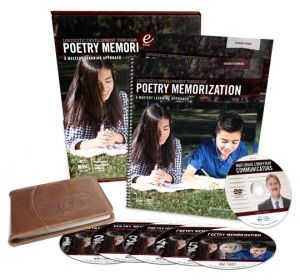
Linguistic Development through Poetry Memorization came to us nicely packaged in a sturdy box that contained a 200-page, soft-cover, spiral-bound teacher's manual, a 172-page, soft-cover, spiral-bound student book*, and a leather-bound case with five CD's and one bonus DVD in it.  Within these materials, we found quick access to:


  • poems and speeches divided into five different levels which are presented in large font with illustrations in the student book, are written in smaller font in the teacher's manual, and are also read on the CD's, thereby giving both visual and auditory learners easy access to the selections.
  • clear instructions for smooth teaching of the awesome selection of poems and speeches.  Better still, the teacher materials included not only how-to's for teaching poetry memorization, but also answered the question of why.  (Isn't it always easier to approach something when you know why it is important and how your investment of time and energy may bear fruit?)
  • memory charts for tracking progress.  These are perfect for parents and chidlren who thrive on checklists and can be ignored by those who don't (even if that's not officially recommended.)
  • certificates for noting when student's complete each level of the program.  These can work as effective motivators for some children.
  •  
  • brief poet biographies.  These are listed in an alphabetized format for easy access.
  • suggestions for connecting poetry memorization to related studies across various curriculum areas.  Areas include history, music science, and even topics like nutrition and Latin. 
  • information for accessing seven audio MP3's and a 170-page student book in pdf format.  (Who does not love information, tips, and encouragement to feed parent's souls and intellects?)
  • a bonus DVD of Andrew Pudewa’s conference talk called Nurturing Competent Communicators.  (Again, feeding the parents!)

When you add up all the components of Linguistic Development through Poetry Memorization, you get a simple system of poetry memorization that acts as a fulfilling feast for children and parents alike. With this feast on the table, my children and I been learning poetry, and I have been getting some virtual homeschool conference time in, too.  Love it!
When I get free moments, I enjoy  "Mama conference time"
through the DVD's and MP3's. Then, in the minivan, my children and I practice poetry review and memorization using the CD's.  Likewise, during many of our daily read aloud times, we open the student or teacher books to review poems we've mastered or begin new ones.  Finally, at our AMP club (and sometimes just for fun, too), we test ourselves by delivering the poems.

I also browse the notes next to the text of each selection in the teacher's manual and the lesson enhancement ideas towards the back of the manual to prompt chatting points or further exploration when we have time.  And, the children and I sometimes make up our own poetry modeled after that which we read. 

Oh how many vegetables can be stewed to develop jaws and how many creatures can become ooey gooey when imaginary mishaps happen as we create our personal poetry!  And, oh, what fun we've been having adding more poetry to our daily diet of food for our brains.


Linguistic Development through Poetry Memorization  IEW Review

(*Please note:  For our review, we were blessed by the generosity of IEW when they sent us a printed copy of the Student Book, which is typically only available as an extra purchase when ordering the Linguistic Development through Poetry Memorization package.  However, even in the typical package, you receive a handy pdf version of the student book, which we received access to as well.)

Final Thoughts


I think it is pretty obvious that Linguistic Development through Poetry Memorization is a hit here.  I especially appreciate that the program:

  • is family friendly. With five levels of increasingly difficult poems and passages to memorize, the collection works for both young and older here.  Plus, IEW's generous policy allows families to photocopy student materials for the entire family's use.  So, families with multiple children need not worry about the burden of buying extra materials. 


  • comes with CD's.  Listening to the CD's in our minivan helps us memorize and recall poetry selections.  The CD's also give strong examples of oral communication skills.  For it is one thing to read a poem and another thing to deliver it with clear vocal choices.

  • offers excellence in writing through diverse styles.  With selections ranging from 4-line Ogden Nash poems, to Lewis Carroll's Jaberwocky, to orations from Shakespeare plays, to famous historical speeches, children develop a mental library of excellent examples of vocabulary use, purpose in writing, strength in style choices, etc.

And What Do My Children Think?  


Each of my children appreciates how IEW has made poetry selection and memorization a breeze for us.  Truly, it's been our "easy button" for our AMP club preparations and also has provided us with general reading fun and listening times together.  Without question, we have all been enjoying memorizing poetry together in just a few minutes at a sitting. 

Should You Consider This Program?

In a word: YES!
Linguistic Development through Poetry Memorization has been a win for us and, I dare say, could be for you, too!  If you've been wanting to include poetry in your homeschool endeavors or if you have been seeking a simple way to exercise memorization muscles, I'd definitely recommend this program!  It's ideal for:
  • families inspired by Classical or Charlotte Mason philosophies of home education
  • families with multiple children
  • those seeking to enhance their writing skills
  • those who need to practice oration
  • those who are looking for one-stop shopping for excellent poetry and speech selections to focus on.
 If you'd like to see parts of the program yourself, be sure to go to the IEW website to access samples.

Learn More


Linguistic Development through Poetry Memorization  IEW Review 
 

Learn what 100 Schoolhouse Review families thought about this wonderfully easy poetry memorization system that also helps with reading readiness, provides a writing foundation, and centers on mastery learning.


Linguistic Development through Poetry Memorization  IEW Review

Find IEW on Facebook, Twitter, Pinterest, and YouTube


Crew Disclaimer

Thursday, August 6, 2015

Practical Advice and Encouragement for Homeschooling High School {A Review of The Conversation}

I am not a classical education purist, nor do I have high school age children, so why on earth would I choose to review Leigh A. Bortin's The Conversation by Classical Conversations?


First, because I have heard nothing but fabulous things about
Classical Conversations from friends who use the program at home and in co-ops.  Second, because even if the classical education model is not a perfect fit for my family, it is an educational path that I respect and am inspired by and is, therefore, one I find myself reading up on regularly.  And, finally, because all around me I see homeschooling families suddenly enrolling their children in private, public or hybrid schools as their children hit high school age and, while I realize that one day my children may request to experience brick-and-mortar schools and my husband and I may acquiesce, I never want to send my kids to "regular school" simply because I have given up on educating that at home and in our community.

What is The Conversation?

In
The Conversation,  is a 267 page, soft cover book that is full to the brim with practical advice and encouragement for parents who wish to follow the home education path through high school, teaching their children to think critically and explore God-given gifts.  In it, Leigh A. Bortins looks back at 30 years of homeschooling and makes a convincing case for families to stay the course through high school, focusing themselves on the use of rich conversations that may help students:


  • get into college (if they wish to do that).
  • enliven academic content while connecting with family members
  • maintain accountability for good habits which make learning possible.
  • further develop a life long love of learning.
  • strengthen and unify family bonds
  • develop virtue 


Knowing this, it was a no-brainer for me to choose to read the book.  I thought it might cement a few ideas for me, personally, on how best to lay the foundations in our home that will continue to be built upon straight through high school and beyond, while also becoming a solid resource that  could recommend to others in the local and online homeschool communities I am a part of.

My thoughts were spot on. 
The Conversation has had me scrawling notes, mulling over ideas, discussing passages with local homechool friends and confirming that this is a book I will reread as my children get older.  It is also one that I already am recommending to those further along in their homeschool journeys than my family is


As the third book in a series of that includes The Core: Teaching Your Child the Foundations of Classical Education ad The Question: Teaching Your Child the Essentials of Classical Education, The Conversation:  Challenging Your Student with a Classical Education focuses on the final stage of a classical educational model:  rhetoric.  It does not, however, jump right into this stage with no background.   Rather, it offers a quick primer on the classical education model overall, which, in the most simplistic terms, can be broken down into the following three stages:

  • grammar, a stage all about words and naming, where memorization is an important tool
  • dialectic, a stage all about questions and relationships, where we begin to examine and analyze the facts we have collected in the grammar stage, asking questions

  • rhetoric, a stage all abut conversations and expressing truth, where we act on knowledge gained about new subjects, write essays, present hypotheses, lead discussions and so forth

Then, it dives into detail on the rhetorical stage, focusing on how the fine art of conversation can be applied to:


  • Reading
  • Speech and Debate
  • Writing
  • Science
  • Math
  • Government and Economics
  • History
  • Latin and Foreign Languages
  • Fine Arts

and, most importantly, to developing students into virtuous adults that can go to college or pursue other avenues as they desire, never losing a love of learning.

Part One of the book opens with answers to questions parents might have regarding homeschooling highschool and does a dynamite job of instilling confidence in parents about this stage of education.  It also offers the aforementioned primer and defines rhetoric.

Part Two of the book is the longest and provides specific details, examples and thought-questions about how to apply the five canons of rhetoric (invention, arrangement, elocution, memory, and delivery, which are all described in the book) to each of the academic disciplines previously listed.  Of course, in doing so, it also continually points back to the purpose of education, not just the content or the how-to's, that is, to guide students to becoming virtuous adults! 


Part Three of the book includes four appendices:
  • five effective conversation games
  • common rhetorical devices (terms and definitions)
  • a comprehensive resource list aligned to the chapters of the book
  • candid parent responses to the questions, "What are your top concerns about homeschooling through high school?" and, "...what has been your greatest joy as a result of homeschooling through high school?"

There is also a helpful index.


A Worthwhile Read!
 

In the introduction to The Conversation, we hear about show the author's sons and young men like them she knows:

dance, sing, travel, play instruments, study rigorous subjects, work with their parents, and serve in the community... love Latin, physics, and literature.... take the SAT's, AP's and apply to college... quote Aristotle, Augustine, and Aquinas as well as Sherlock Homes, Bilbo, and Adele.... paint house, plant gardens, play Ultimate Frisbees... know the dames of the giants of history on whose backs we all stand.

And, depending on recent happenings in our own lives, might nod enthusiastically in acknowledgement of "me, too", smile with confidence thinking, "That's exactly what I want for my children!", or exhale disheartened, thinking, "That will never be my kid!"

Regardless of how we respond - with vigor or discouragement - as we continue reading, we discover that confidence can only build and disillusionment can be dispelled.  Teaching homeschool through high school is possibleGuiding students to positive, proactive and virtuous adult lives can be as easy as exercising the art of conversation.


In a logical, encouraging manner, Ms. Bortins whets our appetites for more in Part One of the book by addressing parent concerns and describing what rhetoric is.  Then, she makes practicing rhetoric through the high school years accessible through meaty chapters on Part Two, before she finally lays out dessert in the appendixes of Part Three.  Throughout all three parts, she offers a healthy serving of wisdom here, a delightfully tasty practical example there, and oodles of highlighter-worthy thoughts to satisfy both classical education purists and eclectic homeschoolers throughout.


Learn More


Classical Conversations Review

Classical Conversations Review 
 
Crew Disclaimer

Monday, March 28, 2011

Slow and Steady Get Me Ready, A Rich Resource Review

When Luke and Nina were little, I borrowed a copy of Slow and Steady Get Me Ready: The How-To Book That Grows with Your Child by June R. Oberlander from our local library.  I liked it and intended to take it out more often, but neglected to do so.  So, when Jack came along, I used a Borders gift card to purchase the book.

Unfortunately, once the book came in, I set it aside “for now” and have just recently uncovered it.  I could kick myself for my disorganization and for not using it from the get-go with all my children and can say that I fully intend to start using it more regularly from now on.  It fits in nicely with the Montessori-inspired homeschool philosophy I increasingly want to employ at home and it also meshes well with Classical Education, which is another piece of our homeschool inspiration.
Slow and Steady Get Me Ready is a straightforward, easy-to-use resource and, perhaps, one of the least inexpensive guides out there for parents and grandparents that want to provide opportunities for their pre-k children’s learning and development at home. For more information about the book, read on.

Slow and Steady Get Me Ready
* * * *
A * for READABILITY
Slow and Steady Get Me Ready is a very easy read, although it’s not really a book to read all at once due to its rather matter-of-fact and humorless (for lack of a better word) style. Instead, I recommend reading its introduction, browsing it, and, then, picking it up week-to-week, as needed, to glean easy-to-implement ideas that are within your child’s developmental stage.  In fact, that is exactly how the book is organized – with one activity per week for you and your child to explore from your child’s birth to his or her fifth birthday.

Also of note, while some might say that both the writing and illustrations in the book are too simplistic, even bordering on boring, I disagree.  As a busy, tired mom juggling homeschooling with working part-time with, well, you name it, I find the simple style just right.  When accessing Slow and Steady Get Me Ready, my sometimes overtaxed brain does not have to work to digest much.  I can simply read, prepare and go.

A ½ * for RELEVANCE
I have two children under five and one not yet six.  The book is targeted for children from birth to age five.  In doing so, it provides 260 quick ideas for enhancing young children’s learning and development as well as a series of quick-check pages for parents to use in assessing their child(ren)’s progress.  To me, that makes it relevant.

Plus, I like that each activity in the book is not only described in a straightforward manner, but also includes a bulleted list that highlights what the activity develops.  For example, awareness of the concepts of “in” and “out, tactile enhancement, skill in visual observation or matching one to one.  In doing so, the book not only provides a tested activity to develop specific skills (in very Montessori and Classic Education friendly way), but it also gives me food for thought about what skills and knowledge I might focus on when planning other activities – or even simply reflecting on free playtime – with my children.

That said, for me, the book has two possible drawbacks:

  1. The last year of activities in it is based on “number” and “letter of the week”.  While this is a popular model in homeschools and traditional schools, it is not one I subscribe to.  I prefer a different approach to literacy.  (Still, it never hurts to have some simple ideas to pull out as reinforcement at a moment’s notice.)
  2. If you know very little about child development and are a caretaker that is easily worried, this book could throw you off.  Since it is laid out with only one activity per week, each targeting a specific developmental milestone, it does not account well for the wide variation in children’s rates of development.  So, the uninformed reader might begin to believe, say, that an infant has a hearing problem if he is not responding to certain stimuli within activities by a certain week or that another child, who is not as verbal as others at a particular week, may have issues.  The flip side of this, however, is that within its seemingly inflexible framework, the book presents a worthwhile “measuring stick” for seeing where your child could be at a certain age.  (I tend to look at the book in terms of months or even quarter years, not weeks.)
So, despite the fact that I think Slow and Steady Get Me Ready is quite relevant to my children’s ages and stages, because of the fact that it doesn’t provide much beyond number- and letter-of-the-week for children ages 4 and up (of which I have one and will have another in a couple months), and because I can see how the structure of the book might mislead some readers, I am only giving it a half-star for Relevance.

A * for PRACTICALITY
While I have seen a few people complain that Slow and Steady Get Me Ready is unnecessary (because any creative parent can think of many of the activities in it – or equivalent ones – on their own) and insulting (because it does not account for the differences in children’s developments due to the supposed expectations laid out through the weekly nature of its organization), I find the book is quite a practical resource.  As a former educator, and one who worked in early education for a while even, much of what the book offers is not “brand new” to me.  However, it is helpful! 

You see, as a teacher, I had dedicated planning time.  As a parent, I seldom do and even more infrequently have time to reflect and make assessments.  With Slow and Steady Get Me Ready at hand, I don’t need to.  When I am feeling a bit worn, don’t have the wherewithal to plan an activity, but know that the kids need a little direction, all I need to do is open up to weeks close to the ones that match my children’s ages and easy-to-implement activities, that require little preparation, are laid out right there.   

Plus, when I start to wonder if my children are developmentally “on target” for their ages and stages, cannot remember what I learned in past classes and don’t feel like researching anything online, all I need to do is flip to the “Measurable Parameters to Profile Child Development” and “Measurable Parameters of Entrance into Kindergarten” lists at the back of the book, and, in simple one-page lists can “score” my children’s progress.

Additionally, when I crave a little “others are there, too” perspective, or need a few quick ideas about common infant, toddler and preschool “problem”  behavior, I simply need to flip to the end of the book, where there are brief but worthwhile “Tips for Solving Behavioral Dilemmas”.  Reading these, I often find my urge to begin bemoaning our family’s current challenges to a friend on the phone or to get caught up in long-winded online discussions dissipates.  The brief paragraphs on whatever the “dilemma” of our day is often provides just the feeling of affirmation or nugget wisdom I need to move on.

So, while I can see how some folks might balk that Slow and Steady Get Me Ready hardly “teaches” one how to interact with or educate their child(ren), I also realize that is not the book’s aim.  Instead, the book sets out to do exactly what it intends: It provides 260 easy-to-understand activities that use common household items and take only about ten minutes each to do (but, granted, sometimes a bit longer to construct the tools for) to guide caregivers in helping children to develop into kindergarten-ready youngsters.  To me, that’s pretty practical!

A ½ * for LONGEVITY
As with many books that target the younger years, Slow and Steady Get Me Ready can only earn a “longevity” star for those who buy it at the birth of a child and faithfully use it for the next five years, or for those working with young children regularly.  That said, because the book does not refer to popular videos, technology, characters, etc. and only requires the use of rather ubiquitous and/or recyclable goods to create any suggested tools for learning, it is pretty timeless

Timeless, that is, if you work with children who the types of activities in the book appeal to.  A bit Montessori-esque (which to some folks, like me, is a plus and to others a negative), Classical Education-friendly (in fact, the book is recommended in the popular Well Trained Mind) and very straight-forward, the activities presented in Slow and Steady Get Me Ready are good ones.  But, if you have children who are global learners, who love to pretend and who devour stories (like my eldest child), you may find the book lasts only as a supplementary one, not as a go-to one.  In all honesty, the activities may not sustain such children’s attention for long on a regular basis without additional input and ideas.

A * for VALUE
As I mentioned in my introduction, after previewing this book at the library and wishing I had it on hand more often, I purchased a copy.  At less than $20, with five years worth of ideas in it, I find it well worth its cost. 

Even if, like me, every idea in Slow and Steady Get Me Ready does not appeal to you, and if you know you can educate your child without it through simply talking with, playing with, reading to and answering your child’s curious questions in detail, the book is still a bargain at less than $4 a year.  As a handy source of supplementary ideas or a simple-curriculum base, it can work as a useful addition to your early childhood/parenting/grandparenting resource collection

Sure, you can find loads of free ideas online or purchase more creative and more “modern” curriculums and resources, but you cannot often find a relatively inexpensive all-in-one, hits-on-five-years-of-learning-and-developmental-goals in one easy-to-access volume resource that requires no bells, whistles, batteries or extraordinary effort.  Indeed, that is exactly what Slow and Steady Get Me Ready is -- worthwhile little volume that can be used even when the Internet is down, the bills are piling up, Mommy’s brain is overtaxed and kiddoes need some direction.

Slow and Steady Get Me Ready is a book I am glad I purchased.


(See my initial Rich Resource Review post to read more about my rating criteria.)

This review is being shared at  52 Books in 52 Weeks.  Please check out the links at each for further good reads and tips.

LinkWithin

Related Posts with Thumbnails