Showing posts with label Art. Show all posts

Wednesday, June 3, 2020

Learn The Elements of Art and Composition at a High School Level {An Artistic Pursuits Inc. Review}

Disclaimer: I received a FREE copy of this product through the HOMESCHOOL REVIEW CREW in exchange for my honest review. I was not required to write a positive review nor compensated in any other way.
Some links may be affiliate ones.

Would you like to see your child creating original works of art while learning about art history and art appreciation and developing techniques related to the elements of art an composition?


Brenda Ellis and company can help with that through her book ARTistic Pursuits, High School 9-12 Book One, The Elements of Art and Composition from Artistic Pursuits Inc.

My 12-year-old has been trying out the curriculum and likes it. I work alongside her sometimes and enjoy it, too.


Here's what daughter has to say about ARTistic Pursuits, High School 9-12 Book One, The Elements of Art and Composition:

I've used lower Level Artistic Pursuits Inc. books before and like them, so I was interested in seeing what the high school book is like even though I'm not in high school. 
When we received the book, I realized that we did not have all the material we needed to do every art project. We are missing stick vine charcoal, but the handy art supplies list says it is not need until the second semester, so we'll get some later.


(Back to the book.) It is a spiral-bound, softcover art curriculum book with a clear protective cover. It lays flat so you an easily complete picture studies, learn art concepts, and do art projects.


There are 16 units in the book which cover topics such as:
  • space
  • lines
  • values
  • form
  • shape  
 and more.  Typically, units follow the same pattern and are meant to be completed in two hour-long classes of about one hour over two weeks, but I used it at my own pace and sometimes extended projects.


She chose to add color to one of her first projects.

Some things I like about the book are the picture studies and project ideas.


Some things I don't like is all the reading. The book is text heavy for an art book. I'd rather see more examples and drawings or an optional audio or video component.
I think people my age or older would like this book. I will probably continue to use it. It is good and has certain lessons that are easier and certain ones that are more challenging for me. It has a good balance of ideas for creating, instruction, and learning about art history and appreciation.

So, as you can see, my daughter - even though a bit younger than the target age for ARTistic Pursuits, High School 9-12 Book One, The Elements of Art and Composition - likes it and would recommend it. 


I would also add that my daughter has some reading challenges and, therefore, tends to prefer art curricula and projects that allow her to learn and succeed while using her creative strengths without coming head on with reading roadblocks.

With that in mind, I would say that if you have a child with pronounced reading challenges, you might plan to do some of the reading in this art curriculum together. However, if you have an average reader, please do not be dissuaded from this curriculum due to my daughter's comment about it being text heavy.


Honestly, as I read the text with her, I found it to be well laid out, conversational, and appropriate for a high school level book. It engaged, explained concepts and instructions, and conveyed facts and thoughts about art history and appreciation well.

Further, I appreciate how well-balanced the program is with:


Noticing textures...

  • the first lesson of each unit helping students build a visual vocabulary about a topic which is explained and words and pictures before students complete a creative exploration assignment.


  • the second lesson offering art appreciation and history and then a prompt to apply observations to self-created art.


  • the third lesson diving into techniques and encouraging students to use specific materials and tools to create original works of art.


  • the fourth lesson culminating the units learning with a project that incorporates techniques and elements of art and composition using a variety of references such as landscapes, photographs, still lie objects, and more. It also typically contains an image of a student sample.

The book also includes information for getting started for parents and student an evaluation rubric, a bibliography, and course information for high school transcripts. These are helpful features.

I would love to see a list of artists and artworks used for the art appreciation and history sections, a glossary, and an index added to the book as extra bonuses.
ARTistic Pursuits, High School 9-12 Book One, The Elements of Art and Composition  truly is a comprehensive art curriculum that high school age students, adults, and even interested and adept younger students, can use independently to discover creative strengths while learning about art history, art appreciation, and techniques.


Inspiration...


My practice...
My daughter working on texture...

Learn More

Tuesday, May 12, 2020

Move Beyond the Stick Figure {An Art Program Review}


Disclaimer: I received a FREE copy of this product through the HOMESCHOOL REVIEW CREW in exchange for my honest review. I was not required to write a positive review nor compensated in any other way.

AMAZING UPDATE: I just heard from 
Beyond the Stick Figure Art School  that they have already listened to review feedback and made tweaks to the program to make it even more pleasing to customers. How cool is that! So, as you read the review we previously wrote below, please be aware that: Thank you for the review. We love to make our students happy, so here are some tweaks we have made based on recent reviews:

1. All course videos are now open and do not require sequential completion-although they still recommend people go sequentially!
2. They have contacted Vimeo and improved the video experience by installing volume control and full screen options on all videos.
3. They added more options to Drawing part 2 to help it move along more quickly for younger students.

Fantastic!  <3 the way they responded and made a good thing even better!

****

If you're looking for a step-by-step, incremental program to take your or yours from drawing a dot or line to creating art, the 
Beyond the Stick Figure Complete Drawing Course PLUS 3 Bonus Courses from Beyond the Stick Figure Art School could be it.

Sally, the creator of the program, is a homeschool mom and artist who attained a degree in art from the Loughborough College of Art and Design in England. Disappointed with an art program that she placed her daughter in, she decided to create one herself and came up with this step by incremental step one that walks families through 55 drawing lessons and then tags on 15 pen-and-ink lessons, 52 watercolor ones, 24 Acrylic ones, and 30 3D Design ones using short video lessons and downloadable printables which guarantee success.

Over the past six weeks or so, my family has had the opportunity to review this course, which is meant to be completed as a one year program of short, consecutive, daily, lessons enjoyed by the whole family.

Geared for busy homeschoolers, the course is created so that all a homeschool parent has to do is take out art supplies, log on, and click the next lesson, sitting down to join if as desired.

No art experience is needed. Just watch and follow along - seeing your skills and your children's grow baby step by baby step!

Lessons begin super simply - at a level young and inexperienced artists can follow along with - and move in incremental steps to more advanced techniques, which are unlocked as you complete each lesson.
The teacher, Sally, is genuine, skilled, clear, and easy to follow, but a bit quiet at times.

Along the way, video lessons teach hands-on exercises that incorporate practical tips, a bit of color theory, art terms, and more.

Because you get a lifetime membership good for everyone in one household - including mom, dad, kids, even live-in grandparents! - you can do the lessons all together daily as suggested or stretch things out by doing art only once or twice a week. You can also have one part of the family complete the course first and, then, go back so another part of the family can try. Such flexibility is wonderful for busy or large families.

One thing in the program is not flexible at this time, however, and that is the order in which lessons are done. The program is set in a consecutive mode which does not let you skip ahead until you have viewed and clicked "complete" on each lesson. This means that if you have more advanced artists in the house, you should be aware that you'll have to either complete each lesson in order or sit and click through videos as if you had in order to reach more advanced lessons.

While this feature of having lessons "locked" until prior lessons are viewed/completed ensures that you and your children can learn step by step and never get in over your head artistically, it can also cause frustration. Or so it did here.When my daughter and I tried to look ahead at later drawing lessons, we could not.  When we tried to take a break from drawing to dabble in the pen-and-ink, watercolor, acrylic, and 3D design lessons, which we were excited to check out, we could not. 


We were met with a message that said, "Please go back and complete the previous lesson."  That meant we either had to simply progress from one tiny incremental lesson to another in order or spent time clicking through the videos of ordered lessons and hitting complete just so we could get to later ones. Doing that seemed disingenuous and like a waste of time, so we simply plodded along, appreciating the earlier lessons for what they were, but wishing the program allowed freer access to all lessons.


In the early lessons, my daughter and I enjoyed the sometimes hypnotic effect of drawing and coloring shapes, lines, etc.


We also appreciated some of the tips the teacher gave in lessons that we opted to watch but, admittedly, just watched some videos instead of completing the projects they showed since we found the incremental exercises sometimes a bit too repetitive, even if we understood that they were building observational skills and muscle memory (much like that of a child practicing stokes to learn to write.)

When I asked my 12-year-old what she thought of the program, she said:

It is a series of short video lessons that start extraordinarily basic and progress step-by-step with circles, curved lines straight lines... color, negative space, primary colors, secondary colors... and you cannot skip! 

You have to view each video to its end and click complete or you cannot go on. 

Now, I like the program. I just do not like that part. I would prefer if I was allowed to skip. This is not my first art ever. I have done art before, and I found it annoying not to be able to move onto more advanced lessons, which I think is reasonable for me to want. 

So, I would like to see there be a way to skip and a picture preview and short list of what is covered in each video lesson, so I would know if I want to do it and would benefit from it. 

Granted, I liked how the woman taught lessons and got addicted to drawing and coloring circles, I just did not want to waste time doing a bunch of lessons on circles, lines, negative space,... 

I will probably continue using the program as side practice work sometimes, not as my primary art work. I may use it more if I am able to easily skip to more advanced lessons. 

I want to try to pen and ink, watercolor, and acrylic, but I don't want to have to skip through all the rest to do them.

I would recommend this program to people who are just starting art or want an art practice.

The best parts about it are:

  • the way she teaches
  • the way she reminds you to take care of your supplies (put you cap on your marker)
  • some of her practical tips
I think you know the one thing I'd like to see changed: being able to advance to what you think you are capable of or want to try. If you cannot do it, you can always go back. Lessons should not be locked. You should be able to access any lesson at any time.
I would recommend this program to people who are just starting art or want an art practice.

 I agree with her assessment. We both enjoyed the teacher's style, technique, and tips and appreciated the relative brevity of lessons which made them easy to fit into busy days. However, we both also wished the course was delivered in a way where its consecutive order was suggested, not required, so that we could move forward and backward in lessons freely.

Further, we both thought a great addition to each lesson page would be an image or two of what the lesson presented and a short list of key skills, art theory, terms, etc. included in the lesson. Such changes and additions would make the well-presented and effective program that truly seems to be able to take one from drawing stick figures to confidently creating more advanced art a program that is a better fit for families like mine that already have some basic art experience, but want to advance in skill without having to start at the very beginning.

Of course, this is just our take on the program. Eighty Homeschool Review Crew families tested it out, and other families have different takeaways.  Click through to find all the blog, vlog, and social media reviews.


You might also wish to connect on social media:


Sunday, March 8, 2020

Enjoy Art, Music, and Poetry with the Transfiguration


Looking to add some art, music, and poetry to life and learning this week?

Perhaps the plans I just laid our for our upcoming AMP club can help.

Once again this week, we'll spend part of our Art-Music-Poetry club time with a focus on faith, reflecting back on this Sunday's readings about the Transfiguration while doing a picture study. Then, we'll have some free choice mountain-themed music appreciation, a bit of Emily Dickinson for poetry an some drawing time.


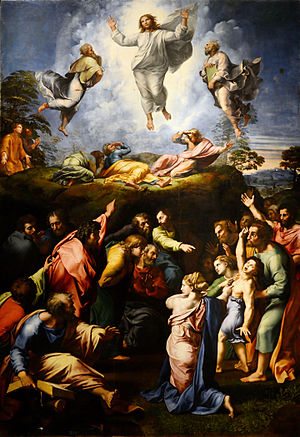
Study The Transfiguration by Raphael

Transfigurazione (Raffaello) September 2015-1a.jpg
Source: Wikipedia

We'll begin by asking if anyone can recall who Raphael is and when he lived (an artist during the High Renaissance.)

Then, we'll recall some of the characteristics common to the High Renaissance, such as:

  • perspective.
  • precise anatomical correctness.
  • authentic emotionality and expression.

We will also see if anyone cane name describe some characteristics of Raphael's individual style, such as:
  • clarity
  • rich color
  • effortless composition
  • grandeur

After that, we'll study the last painting Raphael painted - The Transfiguration - a painting that has been described as Raphael's most beautiful and divine and was commissioned in 1517 by Cardinal Giulio de Medici, who later became Pope Clement VII and currently hangs in the Vatican Museums.


To study the painting, we will examine it for 30-60 seconds. Then, I will remove the image and ask each child to narrate some of the details that they noticed.

Then, we will look at the painting again using this Youtube video or looking at a reproduction and reading a reflection of it found at Loyola Press.


Add Some Music Appreciation


Since we'll be talking about the Transfiguration, which happened on a mountain, we'll explore clips of classical music inspired by mountains, letting each child pick one title to listen to a portion of and chatting about whatever resonates with the children.

Chat about Poetry


Continuing with the mountain theme, we'll read a brief poem by Emily Dickinson entitled "The Mountain" and chat about any reactions the children have to it.

The Mountain 
by Emily Dickinson


The mountain sat upon the plain
In his eternal chair,

His observation omnifold,

His inquest everywhere.


The seasons prayed around his knees,
Like children 'round a Sire:
Grandfather of the days is he,

Of dawn the ancestor.


Create Mountain Artwork and Pray 


Finally, we'll create artworks of mountains using a Creating a Masterpiece Mountain Hike drawing project. (You could also choose a video from Youtube at the level of your children or simply create original artwork instead.)

If there is time, we will conclude by recalling that prayer is one of the pillars of Lent and, then, try out an imaginative prayer exercise from IgnatianSpritiuality.com.


I pray these ideas might help you and yours enjoy art, music, and poetry as you continue your Lenten journey.

Sunday, February 23, 2020

Enjoy Art, Music, and Poetry as You Prepare for Lent


It's easy to neglect the riches of art, music, and poetry as we move through the busyness of every day life and learning. Thus, I am always thankful when our AMP club gets together, since it encourages us to take some time for the arts.

I appreciate even more when a desire to live the 
liturgical year dovetails with our AMP plans. That is exactly what happened this week as we prepare for to enter into Lent.

If you'd like some ideas for sharing art, music, and poetry as you enter into Lent as well, perhaps the resources and ideas we used can help you.


Study The Fight Between Carnival and Lent

Begin by saying that you will be focusing on an artwork painted of a Dutch town. Ask if anyone knows where "Dutch" people and things come from ( the Netherlands). Then, find the Netherlands on a map or globe.

Pieter Bruegel d. Ä. 066.jpg
Source: Wikipedia

Invite children to share what they think they might see in a Dutch artwork. Then, without giving its title, study an image of Pieter Brueghel the Elder's The Fight Between Carnival and Lent from 1559 by having everyone examine it in silence for 30-60 seconds, looking at its details.

After 30-60 seconds have passed, remove the image and ask each child to narrate some of the details that they noticed.

Reveal the painting again, and a
sk if anyone has any idea what time period it comes from based on its characteristics.

Discuss the children's ideas, bearing in mind that the painting is from the Renaissance and some common characteristics of
Renaissance art are:


  • individualism: Artworks often highlighted individual people or the individuality in people. 
  • secularism - There were fewer church paintings. 
  • classicism - Some artworks showed classic Roman and Greek influence.
  • nature - Artworks often depicted the outdoors.
  • anatomy - Art focused on defined and precise human anatomy.
  • linear perspective - Art showed an appearance of things relative to one another as determined by their distance from the viewer
  • realism - Artistic representation aimed for visual accuracy.
  • depth - Light and shading were used to create a sense of depth.
  • symmetry - Balanced proportions were often included.


Include Some Music Appreciation


After chatting about the The Fight Between Carnival and Lent as an example of Renaissance art, suggest that everyone look at it closely once again, noticing more details and guessing at what the artwork's title might be. While doing so, as music appreciation, listen to a period composition or two.

One way to do this is with the following Youtube video. (Just preset the video to begin after the portion with the title showing so that you don't spoil the fun of having children come up with their own names for the painting.)


If using the Youtube video above, note that the music in it is composed by two composers, the first of which was a Dutch composer who was known for his church music and composed many Masses.

After the video concludes, chat about new details children noticed within the painting and what they thought of the music.


Connect to Faith


Ask if anyone might offer an idea for what the painting could be titled, then reveal it's true title
 and chat about Lent and Carnival / Shrove Tuesday / Fat Tuesday / Pancake Tuesday.

Watch the following 
Youtube video or look at the painting once more while reading this reflection from Loyola Press.


Pause for a moment to ask students to look inward and ask themselves what keeps them from following God? Invite them to think about this as they enter into Lent.


Transition to Poetry with the Symbol of Fish


Ask what the children know about Lent and how we observe Lent. Chat about ideas and, at some point, talk about the idea that a symbol often used in Lent is fish.

Chat about why we might be see the symbol of fish during Lent and at other times of the year. Children might point out that a fish is a symbol of Christ or that there are fish drawn on calendars to remind us to abstain. Let the conversation flow with their ideas.

Then, tell children that you will read some letter poems from a human to a fish and a fish to human which have little to do with Lent, but are interesting and fun poems.

Present "To a Fish" and "A Fish Answers" by Leigh Hunt.

Discuss any reactions the children have to each poem.

Wonder and Invite.


Wonder aloud about such things as:


  • How does the human feel about the fish?
  • How does the fish feel about the human?
  • What makes each poem a poem and not just a letter?
  • What poetic devices did you notice?
  • What imagery stood out to you?
  • What was humorous?
  • What did you like about each poem?
  • What do these poems speak to you about or make you think about?
  • What emotion do these poems show?

With older children, wonder how people may have looked upon Jesus during the time he was traveling and teaching and how he looked upon them... how each person at the for of the cross might have looked at Jesus and how he looked at them... how we look to God and how He looks upon us... 

If pairing your study of the painting and the poems as you think about Lent has made any connections for you, share them with the children.

Invite children to write their own perspective letter poems later about an animal, a symbol of Lent, Jesus' ministry and passion, etc.

Invite them to research more later about the Catholic rules of abstinence and why we can eat fish and reptiles during Lent, but not red meat or poultry.

If it did not come up during conversation, invite children to look into why a fish is a symbol for Christ later.  You might even point them to ideas from Catholic.com:


 "What did the fish represent? Above all, it was Jesus Christ. The dominant language of the early Church was Greek, and in Greek the phrase “Jesus Christ, Son of God, Savior” produced the acronym ICHTHYS, the Greek word for fish. A Christian poem of the second century spells the word with the first letters of each line. Thus, the fish is a simple creed: It professes belief in Jesus’ divinity and his identity as the Christ, the anointed Savior (see Matt. 16:16)." 


Create Fish Artworks


Finally create artwork of fish.

Like our AMP club did you might use a Creating a Masterpiece beginner drawing fish cartoon project. Or, you might choose an appropriate video from Youtube at the level of your children or simply create original artwork.


If, like us, you choose a happy-looking cartoon fish, ask children why we might have created such silly, smiling fish when discussing such a solemn time as Lent.


Tie into the idea that while we fast and sacrifice during Lent, we do so with a heart for Jesus. We do not moan, complain, and look glum. Rather, we sacrifice with inner joy and peace. Our fish artworks can remind us of this.

Finally, ask children to reflect on how we might wean ourselves from sin and selfishness throughout Lent through prayer, fasting, almsgiving... how we might better discern and live God's will for our lives... and how we might make His kingdom come first in our hearts.


I pray these ideas might help you and yours enjoy art, music, and poetry as you prepare and enter into a fruitful Lenten season.

Tuesday, October 22, 2019

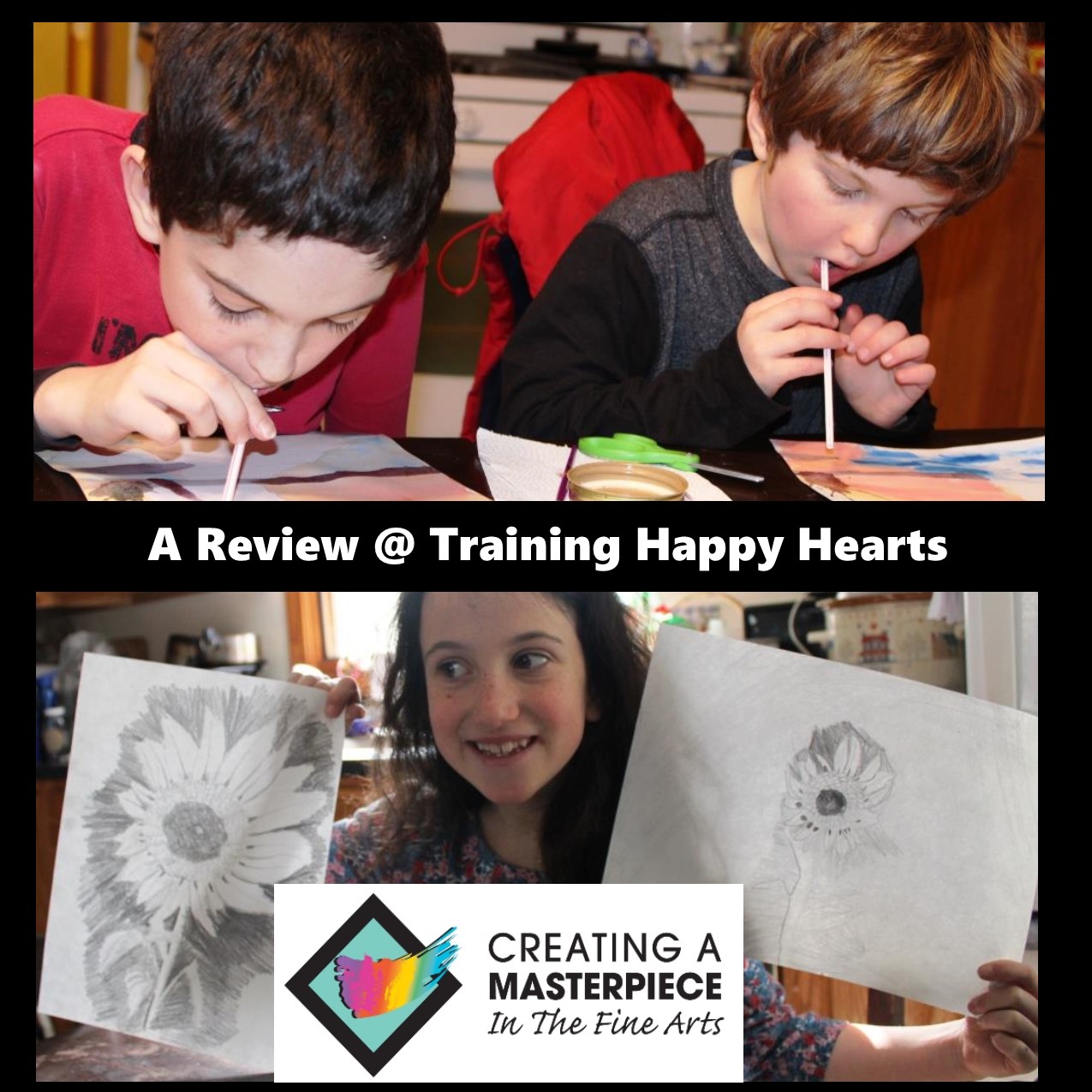
YOU Can Create a Masterpiece {A Creating a Masterpiece Review}

No artistic talent?  No problem!  The Drawing Program from Creating a Masterpiece can building your art confidence and skill in a single lesson - and, then, keep you creating more advanced artworks for weeks to come!


I say this, because I've experienced it.

In our home, we have me - Mom - a person who just never felt like I was any good at art.


Image may contain: drawing

Then, there is also my oldest son, who likes to make quick sketches and to draw fantasy characters, but who rarely stretches his skills beyond that without a push.


No photo description available.

After that, there is my daughter, who, in the past year, has begun to like drawing more and more and appreciates opportunities to draw on her own with the guidance of video lessons.


No photo description available.

Finally, there is my youngest son, who does not love drawing, but who participates when the rest of us draw, and, sometimes, draws on his own.


No photo description available.

(Okay, there is also my husband, but he's rarely home when we work on things like art.

So, yes, we are a family of not-so-practiced artists, yet, 
Creating a Masterpiece had us creating artworks together before.

A Prior Creating a Masterpiece Review


And, now, with our one-year subscription to the online
 Drawing Program, we surely have been improving in drawing skills and confidence while also learning about value, shading, and more.


A Bit More about Creating a Masterpiece


Creating a Masterpiece is a subscription-based, online program taught by master artist Sharon Hofer.

The 
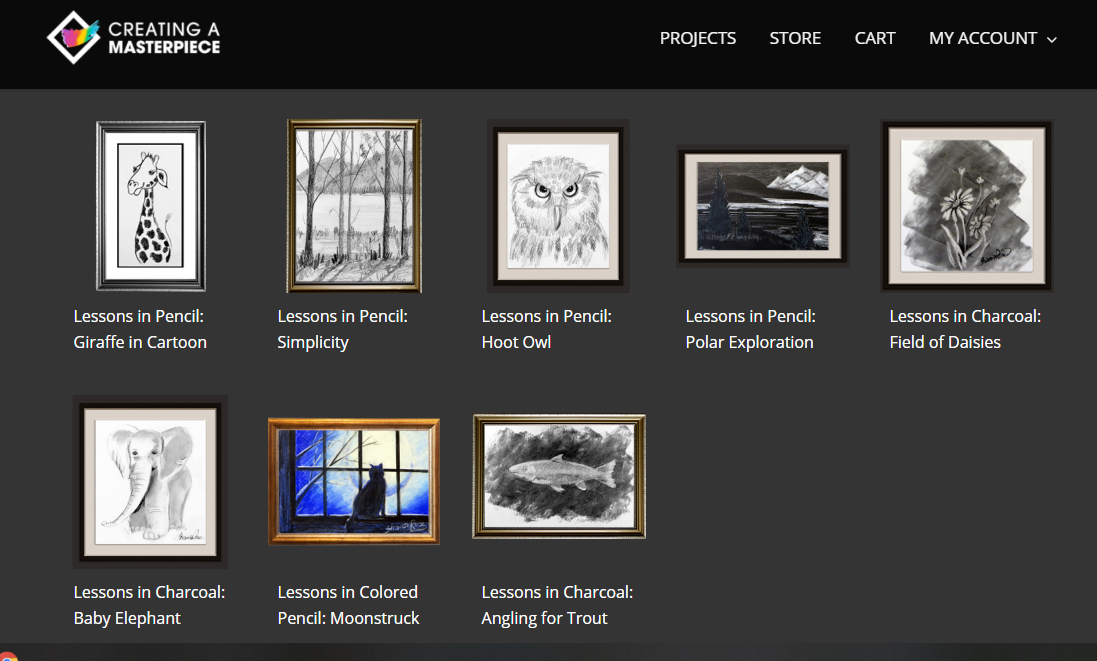
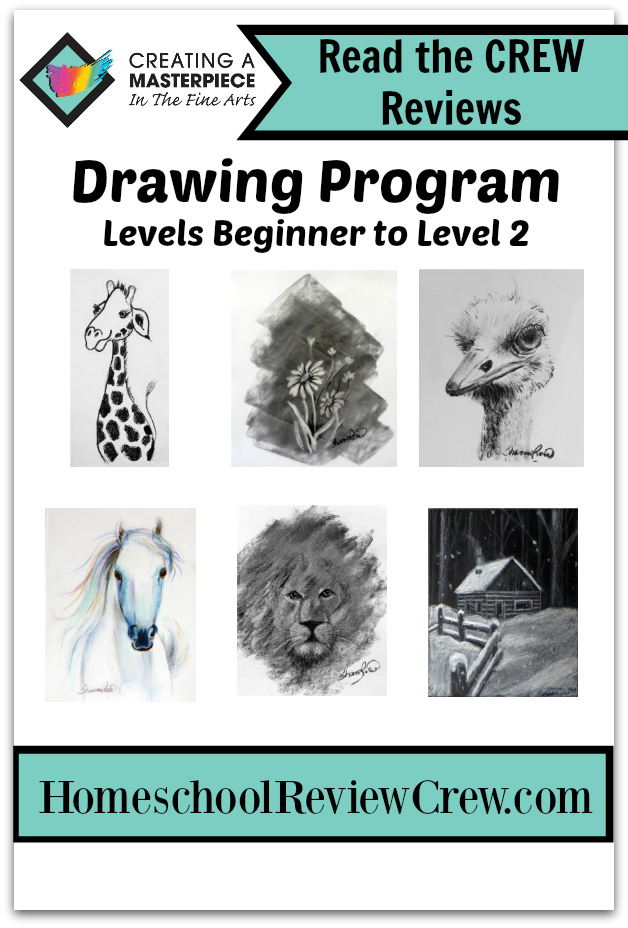
Drawing Program contains over 30 different drawing projects over the course of 48 lessons which teach you how to use colored pencils, charcoal, pencils, and other tools to create artworks with ease. 

Along with each lesson is a clear supply list, so you never have to worry about surprises and can gather your supplies before beginning. 

There are also sample highlights of each artwork, and, for some projects, samples of different students' works.


The actual art lessons come in the form of  series of short videos for each lesson, which can be completed all on one sitting, or can be broken up into 5-10 minute art lesson segments.


Either way, the teacher Sharon aims to bring out the artist in everyone and so teaches her lessons in a step-by-step way that even young children can follow along with.

Image may contain: drawing

(We know, because a rive year old friend joined us at times.)

Image may contain: drawing

That said, Sharon does not use childish gimmicks nor baby talk. Instead, she just clearly teaches you what to do first, next, and after, demonstrating each step while offering tips so that you can successfully create wonderful artwork at the level you are comfortable with.


The program has a Beginner Level, where you learn:

  • Beginning Value
  • Beginning Project Planning
  • Beginning Shading
  • Beginning Value
  • Beginning Highlighting
  • Beginning Proportions
  • Beginning Composition
  • Beginning Rule of Three


Level 1, which focuses you on:
  • Shading
  • Seeing and Incorporating Value
  • Two Point Perspective
  • Incorporating Velum into drawing


Level 2, where you explore:
  • Composition and Proportion
  • Recognizing and Incorporating intermediate values
  • Incorporating Lost and Found Edges
  • Using Highlighting for Emphasis
  • and much more!


...and Level 3, where you practice all the prior skills and also multiple point perspective.

Obviously, the skills taught at each level become more advanced, but students need not take the course linearly.  In fact, you can jump between levels, doing whichever lesson you like at your own pace - a feature I like.


What Did We Think...

When I asked my oldest child, 13, for his thoughts on the Drawing Program, he said:


No photo description available.


It is an online art program. For each project, you watch a series of short video clips which teach you how to draw things like animals, plants, eggs,... non-human things. 
The woman demonstrates step-by-step and you follow along. 

Image may contain: drawing 
In my opinion, it's a good program, but ... I prefer drawing things like elves, dragons, and maps. So, this not exactly my style of drawing. 
People who like realism -not fantasy or Sci-Fi - might like this program. I think it is good for ages 10-12.

My 12-year-old said:


Image may contain: one or more people, people sitting and closeup

I like Creating a Masterpiece. 

No photo description available. 

At first, I used it by myself and did the forest lesson. I liked that it was multiple short videos and the teaching was step-by-step.
 
No photo description available.

Since then, I have used it with my family. I have made a cartoon, the forest, an owl, and more.

It is a good program. I think people who want to learn independently and those that want a program to use with a small family group would like it.
I want to do more of it.


My youngest child, 9, said 


These classes are good. They are easy to follow and the projects are easy to draw. I like tweaking the projects a little bit like making a giraffe into a giant giraffe machine with a machine gun and cannon. 

Image may contain: drawing 

And, I turned my owl into an owl person.


 Image may contain: drawing
I want to keep using this until I get to the harder projects. 
I think this program is good for ages 5 or 6, mostly 6, to adults. My mom uses it, too.

I sure do use it - right alongside my children, learning with them- and, to tell the truth, if I had more free time, I might use it on my own, too. Why? Because I simply enjoy being able to become more adept at art through Sharon's easy teaching style and expertise. She truly gives me the confidence and desire to draw!


No photo description available.


Learn More


If you are looking for an easy way to incorporate quality, self-paced art lessons for ages 5 to adult into your day, Drawing Program from Creating a Masterpiece is worth considering. It is an excellent homeschool art curriculum!
Image may contain: tree

You can try a free sample project to see if you enjoy it as much as I do.

 Find all the reviews!
Find all the reviews!

You might also want to see what 70 Homeschool Review Crew families think of this online art program. Click on over to find all the reviews.
Connect on social media, too, using Facebook.


Crew Disclaimer

LinkWithin

Related Posts with Thumbnails