Showing posts with label Dyslexia. Show all posts

Monday, March 8, 2021

Love Gameschooling? Check Out the Reading Game {Review and Giveaway Link}

 DisclosureI received this product free through the Homeschool Review Crew.


As a home educator and tutor, I am always interested in quality resources to enliven lessons and strengthen reading skills. Thus, I was excited about the opportunity to review The Reading Game, 2nd Edition from Allsaid & Dunn, LLC


The award-winning 
The Reading Game, 2nd Edition was created by Kenneth Hodkinson - known for his time-tested Wordly Wise program - and works to help children learn 180 sight words and begin reading with them using a systematic, game-style approach.


The 180 words include words from the Dolch Word List for Pre-K through 1st grade and from the Fry List (the100 most commonly used English words) and are first presented to the child through color-coded, leveled Memory-Match game cards, and, then, included on captioned picture cards, and in specifically written illustrated readers.

How Do You Play The Reading Game?


You - or any parent, teacher, tutor, or older child that can read - plays Memory Match with your child using the first set of red cards (10 cards of five matching words). As you play, you read the words aloud so your child can both see and hear the words.


Then, once your child has mastered this first set of cards - demonstrating an ability to read them during the game without hesitation, the next set of ten cards is used for playing Memory Match.

Once the second set of cards is mastered, you give your child the red picture card labeled 1-2 and your child tries to read its caption. (The card contains words that have been learned.)

If your child struggles with the picture card, you celebrate whatever your child had success with, and, then, play more rounds of Memory with the first sets of cards to reinforce with your child each of the 20 words previously presented.


If your child succeeds with reading the captioned card, you can move onto playing Memory Match with red word card sets 3 and 4. Then, try picture card 3-4.

After that, continue on through red card sets 5 and 6, reads the last red picture card, and, move onto reading the illustrated red book called, Skunk.

Of course, do not do all of this in one sitting. Simply play at your child's pace, picking up each time where you left off last time.


Following this pattern through the red, orange, yellow, green, blue, and purple sets of playing cards and corresponding picture cards and books, your child will learn 180 words and read those words in sentences on picture cards and in stories in the books.

What a low stress, fun, and systematic approach to early reading for typical learners!

The game can also be helpful for children with dyslexia and can tie into a phonics-based approach. (To see example phonics patterns found in the book, you can download the Rules Booklet online - which also comes in print form in your The Reading Game box.)


Is your child ready for The Reading Game?


If your child is a typical learner who is familiar with letters and shows an interest in storytime by pretending to read or wanting words pointed out while reading, then your child is ready to try The Reading Game.

If your child is a struggling reader who shows readiness as above but tends to need a more explicitly phonics-based approach, then you may wish to use the game slowly in addition to more intensive phonics-based instruction, for as you can see from the word list of the first book, the program jumps quickly from V-C and C-V-C word patterns to other patterns, plus sight words.


How Did I Use The Reading Game?


I have a 10 year old who is a typical learner and was curious about the game when we first received it, so I adapted the game material use for he and I to use during a couple 1:1 learning times. He moved quickly through the game materials, but enjoyed his foray with them, saying:

This game is under my level, so we adapted it. My mom had me spell each word and make sentences with the word cards. She also had me read the picture cards and stories fluently with expression. I liked reviewing with this game and think it would help younger kids.


We sometimes still take the word cards out and pull random ones to create silly sentences and stories.

My 13-year old is a struggling speller who just began to blossom with reading, so I also adapted the game materials for her use similarly. She said:


I like how this program has cards so if you wish, you can play games with it. I also like how it has the picture cards and books. I think that it would be nice for younger children to be able to play.

She also noted when reading the books quickly with me for fluency and expression that "some words have a dot in the middle" and asked why. I had her guess: Students just learning to read sometimes get thrown by compound words, so the makers of the material must have decided to divide the words for easier reading.


I also used the game with two of my tutoring students, ages 7 and 9, that have dyslexia. Both of these students were thrilled to see me pull out The Reading Game and, immediately, began laughing and smiling as we played 1:1 Memory Match with it as directed in the game instructions, with the small addition of me suggesting that whoever finds a pair must make a complete sentence using the word before keeping the pair and going again.

One of the girls definitely needed me to explain/hint at some of the phonics needed to read some of the sight words, so, for example, for the word "they", I pointed to the t-h and said, "Oh, t-h says /th/ and e-y here says 'ay'. So, that's they." Or, "Mmmm, w-h says /wh/ and the a here says /ah/, so this is wh-a-t." Both girls, though, progressed and, so far, have been able to read red cards 1-2, 3-4, and 5-6 with some help and, by their requests, tackled reading Book 1, too.

Further, both girls LOVED the back-and-white photos on the cards - guessing at what the captions would say before they read them - and equally enjoyed the illustrations in the book.


I have also pulled sentences from the picture cards and book for the girls to use for copywork and dictation sentences.

The girls quite enjoy The Reading Game and, even though some of the words presented in it are truly challenging for them, happily persist, learning as we go. One of them saw the game on my table the other day and exclaimed, "Oooo, I love that game. Are we going to play it?" (Of course, we did.) The other always comments on the cute animal photos and illustrations.


Would I Recommend The Reading Game?

If you are a home educator, teacher, or tutor, I would definitely recommend this game as a well-made, simple way to teach or reinforce reading, pending on if you are dealing with typical learners or those with challenges.

I always appreciate games that can be used again and again and are not parent/educator/tutor intensive. This is definitely one of them.

The materials are well made, the box is sturdy, directions for play/use are clear and simple, and success has already been had with my students.

Although I was not able to play the game on a daily basis with right-level learner yet, I can see how playing a few minutes a day could get a child from playing with word cards to reading within a week or so. For, with my tutoring students, we progressed from cards to the first within just a few sessions.

Further, six staged sets of memory games, picture cards, and storybooks can be revisited with older/more skilled learners, with random cards being pulled for sentence and story writing challenges, the picture cards being used as visual prompts for independent writing.


Plus, for those that need data-driven/reportable proof of learning, you can find pre- and post-assessments and class recording sheets online. These can also be printed - or the back of the book word lists referenced - for a quick look at which words have been presented.

Learn More


If you are the type that likes visual examples of things, find video demonstrations of The Reading Game online

If you would like to see how other beginning or struggling readers have been enjoying some gameschooling and having chance to build
 confidence in reading through The Reading Game, click on over to the Homeschool Review Crew to find video, social media, and blog review from 25 families.


At the Homeschool Review Crew page, you can also enter to win one of 5 The Reading Game boxed sets that are being given away!

Finally, you can find The Reading Game on social media at


Thursday, March 5, 2020

Teach Children to Read with PRIDE Reading Program {A Review}

Disclaimer: I received a FREE copy of this product through the HOMESCHOOL REVIEW CREW in exchange for my honest review. I was not required to write a positive review nor was I compensated in any other way.


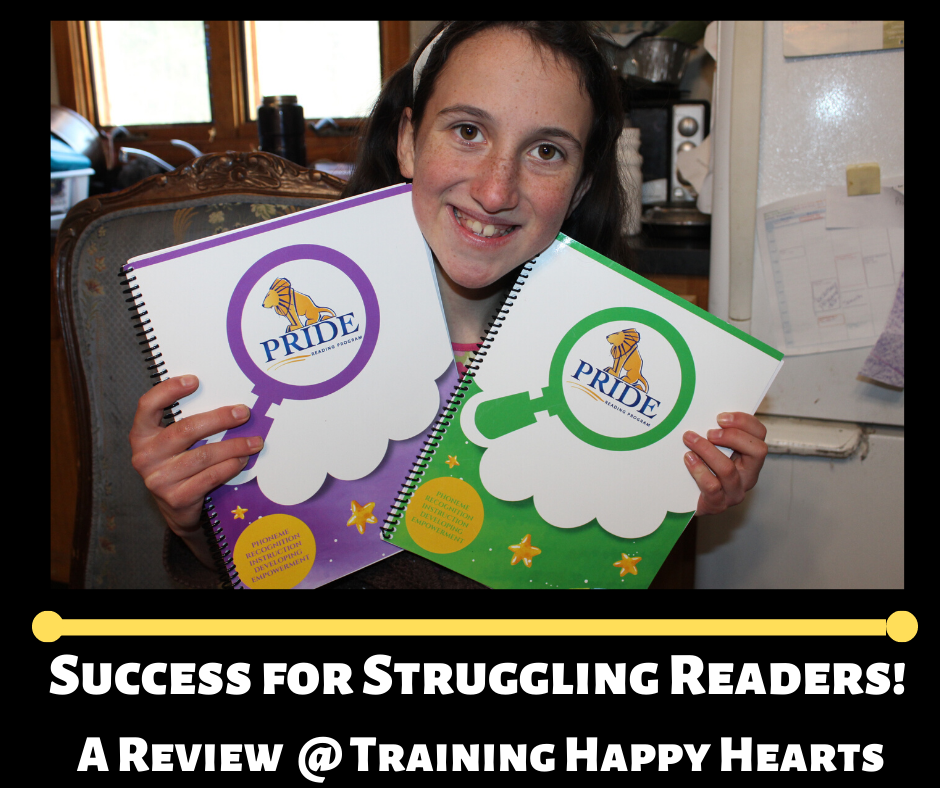
My daughter has been succeeding with the 
Primary Accelerated Review (PAR) book and purple PRIDE Reading Program Level 4 Kit!
{This post contains affiliate links.}

If you have a child just learning to read - or one who has struggled with decoding and encoding for some time, PRIDE Reading Program can help! 


My daughter and I have been using this effective structured literacy program regularly for over a month now and both agree that the program is exactly what its website claims it to be:

"an easy-to-use, structured literacy, Orton-Gillingham curriculum for children of all ages (that) uses engaging, multi-sensory methods to teach reading, writing, spelling, and comprehension."

Let me unpack that quote while explaining our experience thus far...


The PRIDE Reading Program is easy-to-use - and has GREAT Customer Service


Using the 
PRIDE Reading Program, takes only four easy steps.

1. Assess your child simply.

To begin the PRIDE Reading Program, you use a quick online or printed assessment in order to see where to place your child.  

For most children, placement will be at Levels 1-3. For my daughter, however, due prior experience with Orton-Gillingham programs, placement looked a bit higher.


Thus, I called customer service to ensure that I was about to place my daughter correctly. When I did so, a kind representative asked and answered questions about my daughter's prior experience, specific assessment test results, typical approach to learning, etc.

Together, we decided to start my daughter off with the green Primary Accelerated Review (PAR) book and, then, to move her to the purple PRIDE Reading Program Level 4 Kit. 

This has proven a wise decision, since the materials have worked well for my daughter, so I am grateful for the counsel of 
the PRIDE Reading Program's customer service!

2. Order your program kit.


Ordering is a snap online and, if our experience is anything to go by, your kit will come in quickly and will include everything that you need to teach, right down to a white board, markers, zippered pouch, and tote bag!

3. Complete the helpful PRIDE Reading Program training.

While you wait for your kit to come in the mail, you, as a parent/teacher, can take an easy-to-complete online training course that teaches you how to use 
the PRIDE Reading Program.

This training is FREE with your purchase of the program kit and ensures that you - or anyone who works with your child - can provide quality Orton-Gillingham reading instruction with no degree, certification, nor expensive training required!


The training course course is delivered as an 11 lesson, self-paced module that allows you to view video clips of live teaching sessions and asks you to take simple online quizzes to be sure that you understand the method and its use. 


4.  Start teaching with confidence and clarity!

Once you receive the physical program materials in the mail, you can easily access a scripted online teaching guide and begin to strengthen your child's literacy skills.

Step-by-step, 
the PRIDE Reading Program truly is easy to use.


But what is "structured literacy" and "Orton- Gillingham"?In a nutshell, Orton-Gillingham structured literacy is a method for teaching kids to read, write, spell, and comprehend that has proven especially effective with people with learning differences. To date, it is the best method we have found to teach my daughter with reading challenges how to read and spell.


In more detail, structured literacy  is an evidence-based, explicit, systematic, and cumulative approach to reading, writing, speaking, and listening which focuses on phonological awareness, word recognition, phonics, decoding, spelling, and syntax which you can read more about here.

Orton-Gillingham is one method of structured literacy that has been developed to teach non-readers and struggling readers how to read, write, spell, and comprehend using a multisensory approach.

The approach has been proven especially successful for children with dyslexia, auditory and visual processing disorder speech deficits, and other learning differences and is summed up well by this infographic:


You can learn more about the Orton-Gillingham method, get a picture of how a lesson works, and discover how the method is evidence-based at the PRIDE Reading Program website. 


Does the PRIDE Reading Program Work?


In my experience, the PRIDE Reading Program works just as it aims to - with ease of use, effective teaching techniques, at a self-set pace that works for you and your child! 

Does my daughter agree?


In a word, "Yes!", my daughter agrees that the PRIDE Reading Program works!

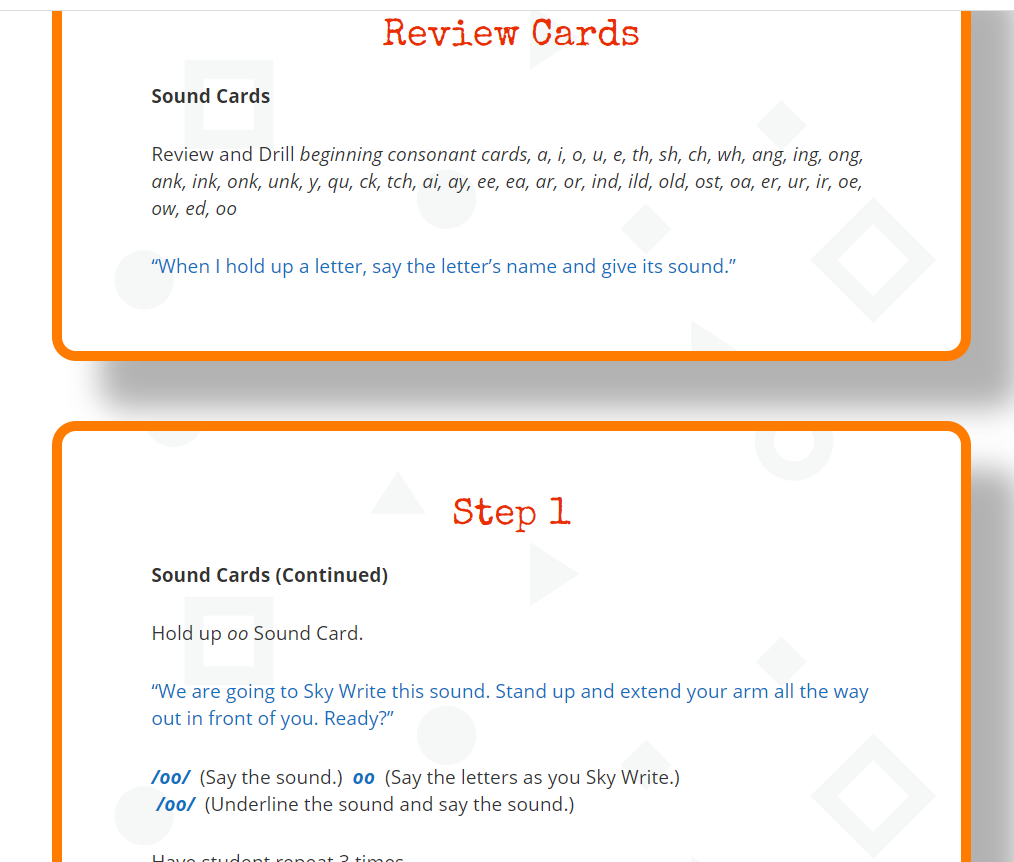
Over the past month or so, using sky writing, arm tapping, letter building, sound association, visualization, and more, she has been filling in gaps with short vowels, the FLOSS spelling rule, consonant digraphs, blends, long vowels, multisyllabic words, welded sounds (like "ang" and "ink") and sight words in regular 10'-60' 1:1's with me using the PAR book and has progressed on to learning and reviewing vowel dipthongs, 3+ syllable words, suffixes, and more using Book 4.

When I interviewed her for this review, this is what my daughter had to say:

I wanted (the PRIDE Reading Program) to help me read, because I am not very good at reading. I have tried many programs and wanted something easy to help me fill in gaps. 

We started with an assessment test online. It was okay, but my results were mixed because we have used other programs before. So, my mom called the company and we got a small book to use for review and another lesson book.
 

We got the green review book, the purple Level 4 book, a white board, a black and a red white board marker, a white board eraser, a cloth pouch, a reading tracker, a zippered pouch, letter tiles, a sound chart, letter cards with two cardboard packs, and a cloth tote bag to store it all.
 

My mom was able to access the Teaching Guide online.
 

When I saw all the materials, I thought, Wow. That's a lot of stuff and I had mixed feelings, because usually more stuff is more work and more brain hurt.
 

It actually didn't hurt that bad. 
 

We started off with the green book. What I liked about it is that there is a lot of white space per page. I also liked that the pages are not complicated. It is easy to follow and you got to the know the pattern of the lessons


I was able to complete the book with success. I may not know every word in the book, but I know a good proportion and filled in some gaps.


What I didn't like is the sentences that you read are just a bunch of random sentences that have nothing to do with one another. For example, one sentence was "Max can pat the cat," and the next was, "The bag has a tag." I think they do this so children cannot just guess what the next sentence will be about and so they can use target words, but I found it annoying.


The stories were better, and I understand the pattern they were trying to use with prediction in the beginning paragraph, visualization in the middle, and most important thoughts at the end, but there was a repeated grammar error that drove me insane. They used "did" plus a verb instead of the past tense.  I understand why they did that because they had not taught the past tense and past tense spelling can be difficult, but it made it sound like improper English. 


The word lists, though, I thought, were good. They had clean pages with white space so I could actually focus on decoding.


The Spelling Pages were good at the beginning, but, then, as the book went on, they were not as good because they always have the same amount of lines, but the number of sounds, words, and sentences fluctuates, so, sometimes there were not enough lines to write on.
  

We used the tiles at first, but, then, we transferred to just writing on the whiteboard, because the tiles take up so much more time, and I am capable of writing on the whiteboard, so I asked my mom if we could. I was successful, so she let me.
 

The cards are good. They are color coded and helped me review sounds quickly.

Overall, I am glad we used the green code. It gave me a more solid foundation to work on Book 4. 

I have used Book 4 a little but, too. It is a lot like the other book.

We can use it with flexible times and I think using it 15 minutes a day works great for me. I will probably finish Book 4.
I would recommend this to other people and these are the reasons why:
 

(1) I would recommend it to people who don't like busy pages, because, in other programs, they sometimes have the stuff you are trying to read and the parents guide on the same pages, and these are nice clean pages.
 

(2) I would recommend it to someone who does not have a certain amount of time they can spend on it a day - sometimes an hour, sometimes five minutes, because you can stop and start as you need.
 

(3) I would recommend it to parents who don't have a lot of background, because it is scripted.


I would not recommend it to parents who do not want to be on a computer, because the lesson plan only comes online. My mom got frustrated with that sometimes, because she wanted to do our lessons outside, but could not seen her screen. (If she bought a fancy phone, everything would be fine, but she refuses...) 

Overall, I think it was a good program. Thank you very much.

As you can see, my daughter had a lot to say about the PRIDE Reading Program and most of it was good. For a kid that has tried many reading programs and not always found success, this is BIG!

The PRIDE Reading Program has successfully helped my daughter and I get back into a habit of regular 1:1 literacy time with ease and success! I am delighted by this and encourage anyone that seeks am easy, effective, evidence-based approach to teaching reading to try the PRIDE Reading Program out.

The program does not have bells and whistles - and for kids like mine who don't like busy pages and are active in many activities - meaning that at-home, 1:1 lessons need to happen in short, steady, effective snippets, the PRIDE Reading Program is ideal!


Learn more and see what others think about the PRIDE Reading Program. 


Multiple families with kids of all ages and reading abilities reviewed the PRIDE Reading Program as part of the Homeschool Review Crew. Click through to find their perspectives.


You can also find PRIDE Reading Program on social media!

Tuesday, October 1, 2019

Develop New Brain Connections with Soundsory {A Review}


When your immediate family includes people with ADHD, sensory issues, dyslexia, and more and your extended family includes someone with a brain injury, the idea that the brain can rewire and heal is hugely encouraging.  Better still is when tools for helping the brain do just that come nicely packaged in an easy-to-use at-home format just as they do with Soundsory from Sound for Life Ltd.


What is Soundsory?


In a nutshell, Soundsory is a multi-sensory home-based program that is simple to use and works to improve motor and cognitive abilities.

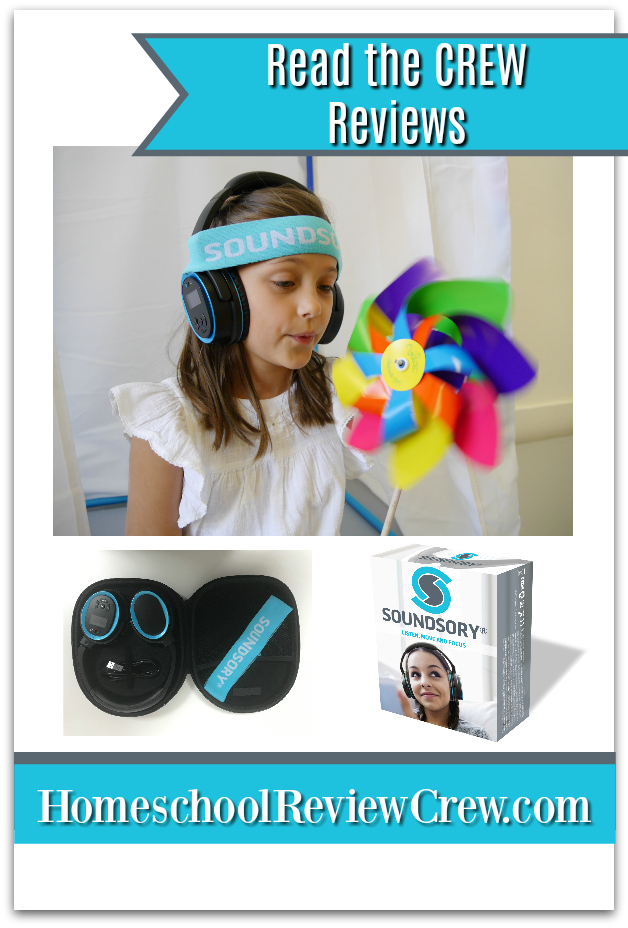
Basically, it is a special set of headphones with pre-loaded rhythmic music that you listen to for 25 minutes before listening to a additional five minutes of music while doing special exercises.
 

More technically, it is a specially designed program that keys into neuroplasticity - or the brain.s ability to rewire itself.

The Soundsory 
rhythmic music program in combination with its therapeutic body movement exercises are specifically designed to encourage the brain to change itself and create new connections. The program is also designed to stimulate the auditory and vestibular systems, helping you better integrate body position, balance and movement information within your brain.


The musical program is delivered on comfortable headphones that charge up when connected to your computer and then can be used for hours anywhere you like.  The headphones have a patented Dynamic Filter that captures attention and use air and bone conduction to stimulate the entire auditory system. (They can also be used as regular Bluetooth headphones with the flip of a switch.)


Meanwhile, the exercise piece focuses on body awareness and coordination, moving from primitive reflexes to repetitive complex movement - which sounds complicated, but is made easy through clear, short videos that demonstrate how each exercise is completed.

The entire program is based on scientific research and is also the subject of further research.

All that technical stuff aside, Soundsory is a program that can help improve your motor and cognitive abilities, and it is simple to use in 30 minutes a day over 40 days at a time without ever leaving your home!


Why Did We Choose to Try Soundsory? 


In 2017, we were blessed to review another product by Sound for Life Ltd called Forbrain, which is a headset that uses bone conduction and a dynamic filter to correct the way you hear your own voice, leading to better attention, concentration, and memory.

We have been pleased with our Forbrain headphones and, appreciating that 
Sound for Life Ltd produces quality products, decided to give Soundsory a try, too.


My daughter wanted see if 
Soundsory might help her with attention while I was curious if it might help her with her dyslexia. (My daughter is not aware of this, but I have read about how specific movement programs- and working to eliminate retained reflexes - can help people with dyslexia and so am hopeful that using Soundsory might eventually be another tool for her success.)

I also wanted to have the program on hand for when my older son is ready to try it out, since I believe 
Soundsory can help him with attention, sensory integration, and more, and I know that since the program is built into the Soundsory headphones with an online exercise portion available with a password, everyone in my family can use it.

How Did We Use Soundsory and What Did We Think of It? 


When we got Soundsory, my 12-year-old daughter was excited to try the program.  She said:

I wanted to see if it would work. (When I first got it,) I thought it was cool, but I did not like how you had to do the exercises right after listening to the first portion of music, because it was kind of hard for me to get to a computer right after to watch the exercises and that eliminated car rides, chore times... 


It was also hard because you could not do certain things when listening to the first part of the music - like be onscreen...I thought you could use it while doing anything, but you cannot. (Good protocol says you are not supposed to eat, drive, or be onscreens while listening.) 
So, I used the headphones towards the end of chore times and at night when all my other lessons were done. (When using them), I drew sometimes. Sometimes, I played board games, which I am not sure if you are meant to do, but it did not say not do, so I did. 
(When listening,) I liked certain songs more than others. Some of the songs I did into really like, because they did not have words, but had people chanting, and I did not really like that. I go for word or no word types of things, not chanting. But, most of the music I liked.
(So far), I have not noticed any big changes yet using Soundsory, but think there might be... More attention...maybe help me with academics. 
I want to keep using it, because I want to see if it can help me more. 
I also wonder if my brother could use it.  It could help him with attention, because he has a small attention span. 
And I wonder if A--- could use it. She has a brain injury and I think it could it help. 
People with focus problems could use it, too. 
The exercises reminded me of O.T. when my brother went to O.T. So, maybe instead of going to O.T., you could use this. 
I like it and will keep using it.  


I agree with my daughter on several points:


  • Soundsory integrates O.T.-like exercises and can easily be used for at-home therapy. I was impressed with how user-friendly the program is and how simple it made stimulating the vestibular and auditory systems.
  • It was sometimes a challenge to find the right times in our daily lives to use Soundsory, because we had to use it when there was 25 minutes of free time followed by five minutes that could be spent following exercises onscreen. This challenge, though, is just because of the way our life flows right now - crazily! That said, I recognize how it is far easier to use Soundsory than to go to therapies!  Indeed, I would have LOVED having this when I was at a stage earlier in our family life when I was running three different kids between O.T., speech, feeding therapy, and more. It may have helped reduce our need for some of the running around.
  • The physical exercises really did remind me of what my son used to do in O.T., and I could see how streamlined and well-chosen they were. I can definitely see why Soundsory is said to help with motor delays, balance and coordination, austism spectrum, developmental delays, sensory integration, auditory processing disorder, ADD, and ADHD.


I am pleased that my daughter wishes to continue to use 
Soundsory and am eager to see what positive changes happen over time as she does. I am also hoping my older son decides to commit to a 40-day period of using the program and am thinking of recommending it to a relation that suffered a brain injury.


 Read the reviews!
Read the reviews.


Soundsory Is Worth A Look!

I would recommend looking into Soundsory to anyone that is interested in user-friendly, at-home tools for helping cognitive and motor abilities. Some others on the Homeschool Review Crew are already having family members making awesome strides with the program, while others, like me, are pleased with the program so far and waiting to see how things play out.

This difference in results is not unusual, as I understand, since it is explained in the Soundsory FAQs that:

The brain needs a certain amount of repeated stimulation in order to develop new connections, reorganize itself and stabilize improvement. Some people see change within a few days, others after completion of forty days of the program. There is no way to know in advance the exact amount of time it will take.

So, in short, I cannot attest to seeing huge changes in my daughter yet, but I can say that I have experienced enough of Soundsory to understand that it is a well-designed, quality program and that I expect to see more pronounced results as we continue using it here. I can also say that you should read some of the other reviews because some people have had amazing results already with children and adults!

Soundsory from Sound for Life Ltd. is definitely worth looking into if you have people in your family that could use improved motor, sensory, and cognitive abilities.


CONNECT ON SOCIAL MEDIA

Tuesday, July 9, 2019

6 Reasons Learning Dynamics is a Great Tool for Homeschoolers and Tutors {PLUS a Coupon Code!}


Some links below may be affiliate links.


Use the coupon code THAPPYHEARTS for 10% off!

Whether you have a child who is ready to learn to read or one who is a struggling reader, the Learning Dynamics Reading Program by Learning Dynamics can help!


We received this structured, multisensory, phonics-based system for review, and since then, I have been using components of it successfully with my own children and with tutoring students.

In doing so, six things have really stood out to me about the Learning Dynamics Reading Program:


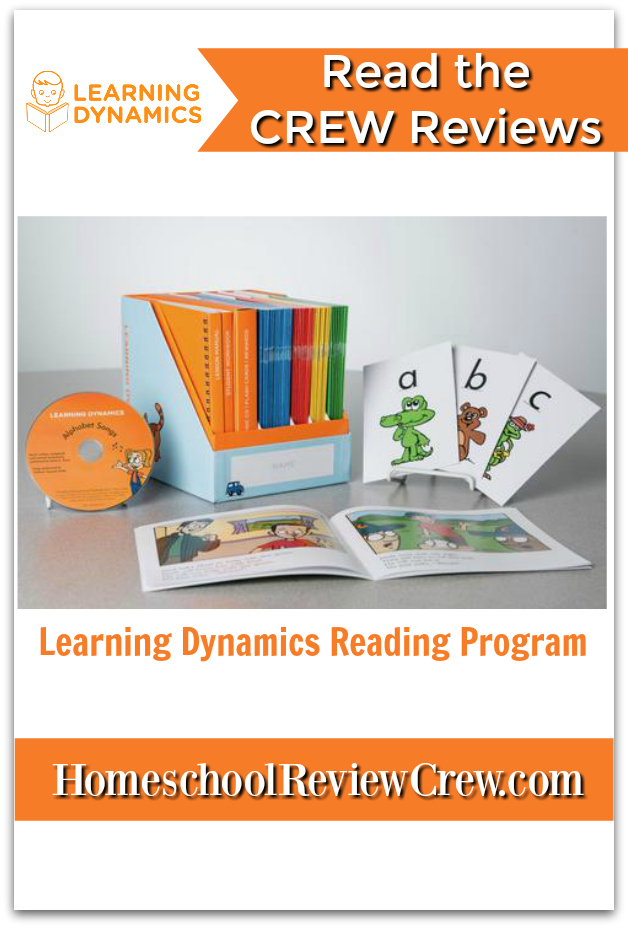
1. It comes in a sturdy little box that makes it easy to store, transport, and use.

Okay, I know packaging is not the first thing one usually thinks about when considering a new reading program, but, let me tell, you, the Learning Dynamics Reading Program package is such a well-designed one!

It immediately caught my kiddoes' eyes and made them want to dig right into the program, reading through the readers in the box during independent reading time and with me as a way to "fill in holes".  (My children are beyond the initial learning to read stage, but one likes "easy stuff" to read during solo reading times sometimes and another has dyslexia and appreciates decodable books that can help her fill in holes and gain confidence.)

The packaging also caught the attention of my tutoring students.

One saw the package on my table, and, although she was "beyond" the level of 
the Learning Dynamics Reading Program materials, she asked if she could read some of the readers.  So, of course, I let her, and she enjoyed them.  They are just so inviting with their four colors standing in the box.


Another tutoring student, who is older than the targeted age for the program, but has learning difficulties, liked the look of the box, too.

When that student saw it on my table, opened it with me, and dug into by request, he took to it right away, so I asked my own child if they'd mind if I used the Activity Book (which is something your child writes in) with him and they agreed.  So, he's become my primary user of the program while my own children - and other children who come to my house - enjoy the readers and other components.


There is something to be said about packaging that invites children to learn and acts as a handy way to store, transport, and grab-and-go with a program, and the Learning Dynamics Reading Program nailed it in designing theirs.

2. It has varied components to keep learners engaged (but not so many that Moms, Dads, and teachers go crazy!)


Learning Dynamics Reading System

Over the years, I have taught a lot of children in the United States and overseas, and one thing that I have come to recognize is that each student is truly different, so one size rarely fits all.

Thus, when I look at a new program, I appreciate something that can adapt to many types of learners - those who like repetition and those who like variety; those who tune into songs and silly stories and those who prefer visual stimulation; those who like things cutesy and catchy and those who like them straightforward and with plenty of white space... In other words, I like one program that can reach many students, even if it takes a little tweaking with some.

The 
Learning Dynamics Reading Program is such a program. 

In the weeks that I have been using it, I have found that it hits the mark for visual, auditory, and kinesthetic learners as well as interpersonal and independent ones. (Independent only for those who have already progressed with reading and are using program materials to "fill in" holes or practice skills.)

The bright, bold illustrations with expressive faces appeal to visual learners while the fact that the books are printed with a large, bold font and plenty of white space appeals to my child with dyslexia.

Auditory learners and those who like songs and ditties can appreciate the audio CD and also will benefit from the conversation and systematic teaching of sounds and blending that are a part of the lessons.


Kinesthetic learners get opportunities to write, color, match things, manipulate cards, and complete extra little fun activities as described in the concise, yet complete Lesson Manual

They can also play extra games with the flash cards if you know some, as I do.

Those who like cutesy things, stories, and rewards can have them.  Those that don't, can skip them.


The Learning Dynamics Reading Program offers enough materials to provide variety and to appeal to children with a range of learning styles, but not so many that it becomes tedious for moms, dads, tutors, or other teachers to keep track of them and use them.

Included in the program are:


  • a concise. spiral-bound Lesson Manual that allows you to open-and-go. 


  • 50+ full-color decodable Easy Reading Books that allow students to build a library while also developing stronger and stronger reading skills.


  • a CD with 34 learning songs.


  • an Activity Book/Workbook with simple activities to reinforce learning


  • cute little Letter Rewards.


  • a variety of Flashcards which can be used as directed in the Lesson Manual and can also be used for other games and activities.


These all fit neatly into the box the program comes in and can be tailored in use to your child's needs and likes.

3. The program can unlock reading within just four weeks.

The Learning Dynamics Reading Program was created to make teaching children to read easy and Learning Dynamics is so confident about the design and success of their program that they offer a 30-day money-back guarantee.

I don't think you'll need to use that guarantee, though, if you try the program, because it really is well designed so that you can bring a child in preschool through second grade from hearing sounds, to matching them to phonograms, to blending them to make words, to reading decodable books in just four weeks and, then, progress further with reading in subsequent weeks.

Enjoyable, 15-minute lessons work through a system of introducing an attainable challenge to your child, practicing it, having your child meet success and be rewarded, and, then, moving on with the traction gained from your child's growing confidence and skills.

In doing so, the program helps your child to: 


  • develop phonemic awareness (or, in layman's terms, the ability to hear, identify, and manipulate the sounds of language).
  • learn explicit letter-sound correspondence (which is essential for both reading and writing).
  • master frequent letter-sound relationships systematically (which is great for all children, but, especially for those with dyslexia like one of my own children, and, I believe, some of my tutoring students).
  • sound out words with letter-sound blending.
  • use decodable text to practice letter-sound relationships (and enjoy reading independently!).
  • read interesting stories to develop language comprehension (and chat about or narrate them with a parent, tutor, or teacher).

You can read more about how it works here and also in reviews from other Homeschool Review Crew Members who used the program with younger children.


I used components of it it with my eight (now nine) year old for review and fun and also with my eleven (now twelve - they both had birthdays during the review period) child with dyslexia so that she could fill in some holes and gain confidence. I also used it, primarily, with a nine-year-old delayed reader who I tutor and he is progressing nicely with it!

A friend of mine who just happened to have bought the program for her five year old around the time I began using it as a review, noted that we have the same program and said her five year old is enjoying and succeeding with it, too.

So, I truly believe t
he Learning Dynamics Reading Program works for young learners even if I am using it with older ones.  


4. It adapts well for struggling readers beyond the target age of pre-k-8 years.

As I have explained, I am using t
he Learning Dynamics Reading Program with older learners. 

With my own children, I pretty much let my eight- and twelve-year-olds read through all the readers on their own and occasionally read them to me. I also use specific lesson flashcards or books to highlight specific reading/spelling patterns as I note they need help/refreshers with them.

With my tutoring student, we do not use the music CD, but rather, I buzzed through the first lessons reviewing materials he had previously learned, and, then, slowed when we got to the first lessons that use the books.

Since then, I use the lessons pretty much as directed sans the CD and the rewards and picture flashcards.  Instead, I read the silly story that goes with each sound when the student is writing the phonogram for it.


We also use a notebook to play additional games with target words from the readers and tend to reread one or two books and tackle a new one each lesson.

We also use the flashcards to build words and play games.

It is working out quite well and we will stick with this program moving forward.

The readers engage and challenge my student and allow him to level up, gaining skill and confidence.


5. Anyone can teach it!

The Learning Dynamics Reading Program was created with parents in mind. It is designed in such a way that anyone can follow it with little to no preparation. Simply open the box, pull out the Lesson Manual, and follow the instructions in it using the included supplies and a writing utensil, and you're all set.

Each lesson is structured in an easy-to-follow manner with everything you need to teach a typical learner included.

You can see more about it here:


As for learners that need a bit of a different approach, the program is good for them, too. However, you might want to tailor and tweak it to meet a particular child's needs.

Being a long-time teacher (former classroom teacher, current homeschool parent, and long-time tutor), such tweaking comes naturally for me, and, I have found that I can do it very easily with almost no outside materials when using 
the Learning Dynamics Reading Program.  (Seriously, all I have used besides the lesson materials when teaching with the program are a small whiteboard, whiteboard markers, a notebook, and some gem stones.)

6. It is reusable!

Almost the entire program is reusable - the books, the flash cards, the letter rewards, and the manual.  The only piece that is not reusable is the consumable student workbook, but additional copies of that piece can be purchased separately for just $18.


That means you can teach many children to read with one program, or, like me, teach one and review skills with others.  

The lesson manual walks you through each step and the program has a 98% success rate and is backed by research from the Unviersity of Oregon and the International Education Institute.

It is simple, engaging, adaptable, multisensory, and great for more than one child!


We definitely recommend it!


It is obvious that we have liked Learning Dynamics here.  
My nine-year-old said:


I think this would be good for kids who are just learning sounds and reading. They are also good for older kids who have reading troubles. I liked reading the books. They are easy.

My twelve-year-old said: 


It is a good review of my skills. I read almost all of the books during my lesson times.


I don't really like the pictures, because they are so cartoony and I don't like cartoony, but they do have expression and tell the story, especially when the words in the early books are simple.

I would recommend this product to people who are just learning to read or who are having trouble reading. 
There is not much writing on a page, there is a lot of white space, and there are pictures. This can help kids with reading problems.

And, I've said a lot already in this review, but will sum it all up by saying the Learning Dynamics Reading Program is a well-designed, well-packaged program that can serve as an open-and-go way for any parent or teacher to help a young child learn to read or as a convenient and adaptable set of materials for a parent or teacher of a struggling reader to invite skill building and confidence.

I am glad to have been introduced to the Learning Dynamics Reading Program through the Homeschool Review Crew and have used the program regularly with kids since it arrived on my doorstep.  If you'd like to try it out, you can get 10% off by using the coupon code THAPPYHEARTS.


Connect with Learning Dynamics.


Crew Disclaimer

LinkWithin

Related Posts with Thumbnails