A Note of Explanation and Thanks Before Sharing the Free Book Study Filled with Academic, Enrichment and Sensory Ideas: I read this week that bloggers are supposed to disclose affiliate links BEFORE the links appear in their posts, not at the end of posts. I did not know this before, but want to comply now that I do. So, please forgive the fact that many of my posts will begin with a disclaimer now. I aim to blog with integrity as I share freely and, in doing so, earn a few dollars for my family! Along these lines, thank you for choosing to click through the A Gift of Gracias links in this post should you have any Amazon shopping to do today. Doing so costs you nothing extra while blessing our family with a small percentage of your sale.

This Tuesday our family will celebrate our 4th annual Lady of Altagracia Day, a day which I count as special since it marks the anniversary of our first liturgical tea. That anniversary, in turn, marks the beginning of our much-loved forays into beautiful faith-inspired picture books.
Oh how we have loved reading and re-reading the gorgeous book, A Gift of Gracias, year after year during our Lady of Altagracia celebrations!
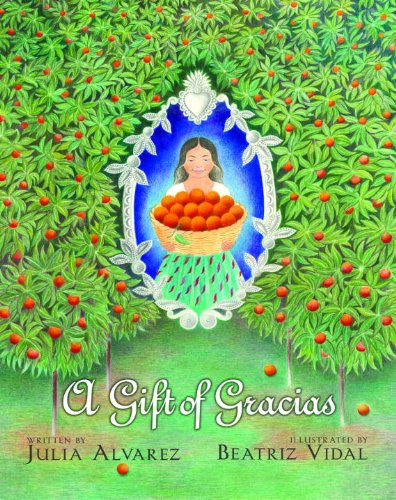

It is has truly become a family favorite for us, rich in inspiration for prayer, learning, fun and faith. Today, I thought I would share a huge list of ideas that might help you and yours treasure A Gift of Gracias, too!
The Story

In A Gift of Gracias, Julia Alvarez tells the legend of the Lady of Altagracia, a vision of Our Lady who is said to have appeared in the Dominican Republic in the early 1500's. In Alverez's telling, a young girl named Maria is inspired by Our Lady of Altagracia to help her poverty-stricken farming family.
After the family's olive crop fails, Maria fears that they will have to leave their farm. However, when Maria's father returns from the city with oranges from his hometown of Valencia, Spain, Our Lady of Thanks enters Maria's dreams and inspires her to ask her family to plant the orange seeds. Maria shares her dream with her family, and, together, they begin planting seeds, offering thanksgiving as they do. Soon thereafter, the family farm is transformed into a rich orange grove, where later, the stars on an image of Our Lady of Altagracia twinkle brightly enough for the family to pick a huge orange crop throughout a night, thereby saving the farm.
The Illustrations

Beatriz Vidal used watercolors and gouache to illustrate A Gift of Gracias with warmth and cultural charm. My children and I often pour over the illustrations in the book as we read it, pausing to discuss what picture clues tell us about Maria's life and culture; noting how we might imitate some of the elements of art we notice Vidal used so well; or just, genuinely, enjoying the simple splendor of each page of the book.
Faith and Virtues Connections
Our Lady of Altagracia Day, or our Lady of Thanks Day, is celebrated in the Dominican Republic every year on January 21, and an image of Our Lady of Altagracia there has had the privilege of being crowned twice during papal visits: once on August 15, 1922 during the pontificate of Pius XI and, again, on January 25, 1979, during Pope John Paul II's visit to Santo Domingo, where he personally crowned the image with a gold and silver tiara, as a gift to the Virgin, the first evangelizer of the Americas.
The author's note at the end of A Gift of Gracias briefly explains the background of Our Lady of Altagracia's background as well as the approach the author Julia Alvarez chose in weaving legends together to tell her own Lady of Altagracia story. The University of Dayton's Marian Pages offer more details about Our Lady of Altagracia.
The A Gift of Gracias book itself offers a variety of direct faith and virtues connections:
- Honor Our Lady by creating a Liturgical Table display.

- On the first page of the book, Maria anxiously awaits her father's return. As Christians, how do we anxiously await reuniting with our Lord?
- On the fourth page of the story, Maria lays in the dark whispering, "Remember my gift, Papa." Do we ever lay in the dark whispering to anyone who is not present or that we cannot see? Isn't prayer just a conversation with our unseen Father?
- Think about the relationship of Maria, her family and Quisqueya. What bonded them all together? What virtues do they show and share?
- Our Lady comes to Maria in a dream. Can you think of Bible stories when angels came to speak to people? Can you think of more modern stories when folks have been spoken to through dreams and apparitions? What are these? How did each story unfold? What virtues did the people who were being spoken to demonstrate?
- Maria obeys Our Lady of Altagracia's prompting to say thank you as she plants the orange seeds. How can we show obedience and thanksgiving as we go about our daily tasks?
- Maria's father always asks her what he can bring back from the city for her. What sorts of gifts might you ask for, or give, someone to show your love?
- Maria whispers, "Gracias, Alatagracia," as she concludes picking oranges. She, then always keeps Our Lady at her side. How can you keep Our Lady ever-present in your own life? What prayers can you say? What sacramentals might help?
- The author of A Gift of Gracias traveled to a chapel to ask for help before writing the story. Do we pray before beginning new endeavors? Where are some places we can feel close to our Lord? Our Mother?
Curriculum and Activity Prompts
A Gift of Gracias is rich in inspiration for Academic and Enrichment pursuits, such as:
Art:
- In the opening pages of the book, Beatriz Vidal depicted, "The orange sun...sinking below the horizon" on Maria's farm in the Dominican Republic beautifully. How might we illustrate a local sunset?
- How might you illustrate a robe twinkling with hundreds of small suns as the robe of Our Lady of Thanks did in Maria's dream. Could you create one embroidered cloth it? A cut and paste project? Quilting? Watercolor? Collaging? Or some other way?
- An image of Our Lady was "as if painted on (Quisqueya's) cloth." What can you paint on cloth?
Cooking (Multi-Disciplinary)

- Do a Power Foods Lab in conjunction with reading the book, exploring oranges as a power food in order to make a number of items.
- Note all of the different verbs used instead of a simple "said" in the text? How can you use, without overusing, varied speech tags when writing to add interest and detail to a story?
- What new-to-you words can you find in the story? What words that you already know were used particularly well in bringing the story to life for you?
- Many beautiful similes and metaphors are used in the book. Can you find some? Can you create any yourself? If you were expressing how someone's face glowed, how else could you describe it other than, "his golden face glowed like an indoor sun"? Why was that description perfect for how Quisqueya's face glowed in the story?
- Metaphor is also used well in the text. For example, "the branches had woven a roof hung with hundreds of small suns." Can you draw an image of what the orange grove may have looked like? Can you create metaphors about your yard or a favorite outdoor locale?
- What do the words finca, bandidos and muchas gracias mean? What language are these words in?
- Do you know other foreign words?
- How can an author weave foreign words into a book, offering context clues as to what they mean?
History / Culture / Geography:
- Maria's father introduces her to oranges, a food that she is not familiar with, but which comes from Papa and Mama's hometown, Valencia, Spain. What other now common foods were once imports to the Americas? What foods native to America are now common in other countries?
- The illustrations throughout the story give clues to what Maria's lifestyle was like. How does her home differ from yours? What is her kitchen like? What clues can you find in the illustration of it about what people ate, how they cooked and how they stored food?
- Quisqueya, Maria and Maria's family had a special relationship. What were the variety of relationships between native peoples and Europeans like in the olden days?
- Quisqueya refers to the lady how has taken care of his people for years. He saw his people's powerful Mother of the Earth in the image of Our Lady of Altagracias. How do native beliefs and Christian beliefs differ? how are they the same? How did the Christian faith spread throughout the Dominican Republic and other areas?
- Our Lady of Altagracia is celebrated in the Dominican Republic. Where is the Dominican Republic? What is life like there?
- Maria's parents came to the Dominican republic from Valencia, Spain. Can you find Valencia on a map? Can you trace routes that early settlers may have taken from the Old World to the New?
- Oranges, trees, bags or oranges and more. Can you count them?
- Find the illustration of Maria in the cart with the bags of oranges. Can you estimate how many oranges might be at the top of all the bags together by counting those only in one of the bags and then using multiplication to figure out the total of oranges at the top of all of the bags?
- Quisueya and Papa received oranges in exchange for helping unload fruit at a market. What is this system of payment called? What are other modes of exchange that have been used throughout history? What types of payment are used today?

- Our Lady of Altagracia's image has many stars. Discuss stars and other geometric shapes. Create some using paper, magnet rods and balls or other hands-on items. (You might even use these shapes to decorate a feast day table, as we did in 2011!)
- Our Lady of Altagracia is said to have appeared in the 1500's. How many years ago was that?
- The illustrator depicts the different stages of the orange grove's growth all on one page. What is the life cycle of an orange? Can you illustrate it or describe it in your own way?
- In the story, the orange trees grow in a matter of months instead of years. How long do orange trees really take to grow? How long do other food-bearing plants take?
- The stars on an image of Our Lady light the orange grove as Maria and her family pick their huge crop of oranges. Explore what makes stars, the life cycle of a star, etc. For little ones, sing your own versions of Twinkle, Twinkle Little Star to describe scientific facts about stars.
- Oranges can make a great tool for experimentation. Think about questions and explore them using the scientific process. for example, do unpeeled oranges sink or float? How about peeled ones? Why?
- How did the author immediately engage us in the story? What makes a strong start for a story?
- Julia Alvarez explains in the Author's Note how she incorporated inspiration from her own life, from history and from legend to create Our Lady of Gracias. How can you weave inspiration from a variety of sources together to create your own stories?
Practical Life:
- Peel and juice oranges.
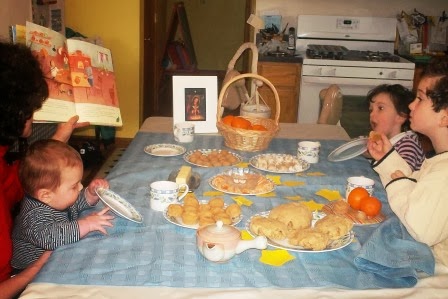
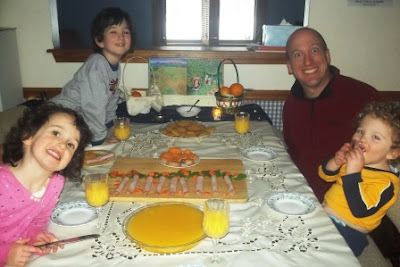
- Make some of the menu items from our original Lady of Altagracia tea menu or last year's.
- Plant seeds of some sort.
In my opinion, no book study is complete without some sensory savvy connections. Some ideas and opportunities for sensory input connected to A Gift of Gracias are:
Auditory:
- Characters in the book call loudly, call softly, whisper, wonder and more. Practice voice modulation and expression in imitation of these portions of the book.
Gustatory:
- Maria found that oranges tasted sweet "like sunrise, tingling inside her mouth". What do they taste like to you? Do a food study of different familiar and unfamiliar foods and describe their tastes. Try tasting some with a blindfold on.

- Explore oranges consumed in different ways: as a juice, sliced into small pieces, eaten in sections, mixed into salad, etc.
Olfactory:
- As maria explored the orange, she noticed that, "It smelled sharp and fresh, like tickling inside her nose." How would you describe the smell of an orange? How about that of other foods? Enjoy smelling different foods. Try doing so blindfolded, describing the smells and guessing what the foods are.
Proprioception:
- Pile pillows high and then climb up on them, enacting Maria visually searching for her father in the opening pages of the book.
- Place a large number of ball pit balls or other spherical objects in high places throughout your home. Give children a bag or laundry basket and ask them to go "pick the oranges".

- Prepare foods with a variety of textures for hands and tongue to celebrate Our Lady of Altagracia Day.
- Make a sensory bin using a blue-to-black media for the sky and different textures of objects for stars. or make one with a "soil" media, "oranges", etc. (Perhaps draw inspiration from our apple picking bin.)
- With a group, play pass the orange, passing an orange or small ball from person to person without using any hands. (Under the chin works well!)
- Stars shower down onto Quisqueya's blanket and capture the image of Our Lady of Altagracia. Create paper stars and have children toss and catch them. Encourage large movements and turning.
- For a feast of color and visual tracking, super-size the concept of marble painting by orange painting!
- Play "I Spy" with the details in A Gift of Gracias's illustrations.
Other Times the Story Could Be Shared
Although January 21 is an ideal day to share A Gift of Gracias, the book would make a great fit at other times, too. For example, when:
- exploring Marian apparitions.
- studying about the Dominican Republic.
- doing a food study on oranges.
- focusing on virtues, such as obedience, faith, trust, and, of course, thanksgiving,
- talking about farming and crop rotation.
- studying legends.
- seeking inspiration for watercolor art works.
I would love to hear about how your family uses A Gift of Gracias or celebrates Our Lady of Altagracia. I would also like to know if others find books study posts like this helpful, and, if so:
Please don't be shy in letting me know how sharing what we do here can best bless your family!
- What books, themes, feast days or holidays would you like me to share about next?
- Would you prefer future book studies be shared in long-post form like this or as a brief post with a printable that you could click on to get the full book study?
Please don't be shy in letting me know how sharing what we do here can best bless your family!

(If you receive this post via email and cannot see the linky, be sure to actually click over to the blog to read browse the rich catalog of ideas there.)
*Again, as always, we thank you if you choose to click through the affiliate links in this post to make a purchase (or do so with other affiliate links on this site). Doing so does not cost you anything, but it may help us earn a small percentage of your purchase price to continue training up our children. Thank you!


