Showing posts sorted by relevance for query The Critical Thinking Co.. Sort by date Show all posts

Wednesday, November 9, 2016

Who Knew Sentence Diagramming Could Be So Easy?

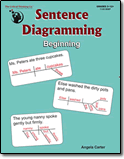
I've been pleased with resources from The Critical Thinking Co.™ in the past, so I was happy to have an opportunity to review their Sentence Diagramming: Beginning, geared for children in grades 3-12+. 


Coincidentally, when the opportunity for the review of Sentence Diagramming: Beginning came up, I had been thinking three things:
  1. We could use some new-to-us lightweight, open-and-go resources to enhance our ELA and math skills while on-the-go between all the classes, clubs, and commitments that take us out each day this late fall.
  2. My oldest is more than ready to begin mastering grammar.
  3. Maybe I should start introducing grammar more consistently during my children and my together time studies.

You've got to love it when what you're thinking and what comes your way coincide so well. 

Sentence Diagramming: Beginning Makes Things Simple
 

I was delighted to discover how simple it is to slip the slim 72-page softcover Sentence Diagramming: Beginning book into our family's bags when headed out the door and how equally easy it is to open it up and teach my children bite-size lessons using it.  The first time we used the book, I simply introduced all my children to simple subjects and main verbs with sentences like "Artists draw." while waiting for the kids' parkour class to begin.  In minutes, all three of my children (ages six to ten) were able to grasp what a simple subject and a main verb are and how to diagram a sentence that contains them. 


Orally, my children described errors in diagrammed simple sentences from Lesson 1 and, then, took turns diagramming other sentences and creating parkour-related sentences to match pre-drawn diagrams like these in
Sentence Diagramming: Beginning:


In a very brief time, each of my children mastered the first lesson.

One Book - Multiple Children


Later, as our sentence diagramming lessons progressed in the same familiar pattern of a brief explanation, followed by error correction exercises, diagrams to fill in for prewritten sentences, and diagrams to fill in for original sentences, with increasingly complex sentences, of course, my oldest was ready to move at a speedier pace than my youngest.  Thus, 
I took advantage of the generous reproductions permissions offered by The Critical Thinking Co.™ , which allow individuals to make copies for one family or classroom, in order to allow my oldest to work at his own pace while keeping our copy of Sentence Diagramming: Beginning clean for his younger siblings.  (I just love it when I can use ONE product with MULTIPLE children at the same time or in subsequent years as needed.)

Before long, it became apparent that my oldest did not need to do every exercise in the book to "get" how to diagram:


  • Simple Subjects and Main Verbs
  • Direct Objects
  • Adjectives
  • Adverbs Modifying Verbs
  • Predicate Adjectives
  • Predicate Nouns
  • Prepositional Phrases (Adjectival)
  • Prepositional Phrases (Adverbial)
  • Compound Subjects
  • Compound Predicates
  • Compound Direct Objects
  • Compound Predicate Adjectives and Nouns

In fact, although my oldest son had never tried nor seen sentence diagrams before we cracked open
Sentence Diagramming: Beginning, we quickly found him ready to begin the review at the end of the 12 lessons of the book. Clear explanations and familiar patterns to exercises helped him meet with fast success which gave him confidence and had him saying the book should be used by everyone. 

No kidding.  That's what my 10-year-old said.  In fact, when I asked him to write a quick paragraph for me with his thoughts for this review, he wrote:

Sentence Diagramming is as easy as pie.  I like doing it.  I like it because it is so easy.  I think it is not important to learn, but it is a good thing anyway.  I am good at it.  To sum it all up, I think it is good for everyone.
Now, clearly, my boy could use some further help with fresh similes, sentence variety, supporting ideas, and the like when writing paragraphs.  However, despite my son's developing writing skills, his feelings about Sentence Diagramming: Beginning are obvious: The book helped quickly and easily understand sentence diagramming, and he thinks it can help others, too.
I would agree.  Going at a slower pace, my daughter and youngest son are also benefiting from the simple explanations and exercises in
Sentence Diagramming: Beginning and I am thankful for the ease of this resource.   It has, indeed, proven to be a (literally) lightweight resource we can take with us to advance my oldest's grammar skills at his own pace while working with my younger children together at their own pace, in an open-and-go manner. 

Worth Considering
 

If you've been thinking of giving sentence diagramming a try with your own children and would like a tried-and-true resource for doing so, I would definitely recommend Sentence Diagramming: Beginning.  You can find SAMPLE PAGES online, too, to help you see if the resource will be as good a fit for your homeschooling needs as it has been for mine.
 
 Learn More

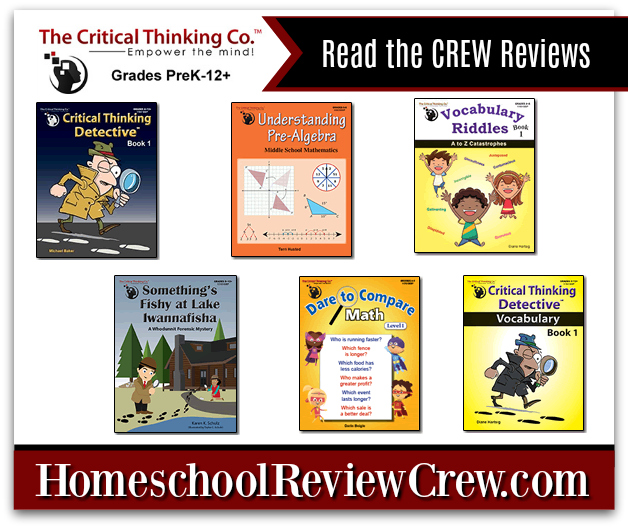
Eighty-five Homeschool Review Crew families reviewed one of the following products:
    Language Arts {The Critical Thinking Co.™}
    Language Arts {The Critical Thinking Co.™}
    Language Arts {The Critical Thinking Co.™}


    Language Arts {The Critical Thinking Co.™}

Links to all our reviews can be found by clicking through the banner below. 


Language Arts {The Critical Thinking Co.™}


Language Arts {The Critical Thinking Co.™}


If you have young children, be sure to click on over to read about Reading, Writing, and Arithmetic Before Kindergarten.

Crew Disclaimer

Wednesday, November 11, 2015

2 Ways Not to Use The Basics of Critical Thinking {A Review}

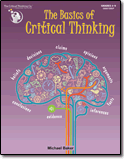
I am always impressed with products by The Critical Thinking Co., so when we were offered a chance to review The Basics of Critical Thinking I was delighted. 


Critical thinking is a skill that I think many in today's world sorely lack.  It is also something I thought my oldest child would enjoy studying on his own. 

My assumption was wrong.  My approach to using The Basics of Critical Thinking was erring, too.
 

It IS Reproducible!

First, between the time when I was offered the review and when the book came in, life got harried.  So, I forgot that I had been told we could copy the book for use with more than one child and, then, failed to notice the permissions written inside the book, which allow for up to 35 copies a year for use by a single family or classroom.


So, my advice #1:  Do not have your child write in the book right away.  Unlike me, copy The Basics of Critical Thinking before using it!  It is a quality resource which can serve subsequent children or a co-op class quite well when copied.


The Basics of Critical Thinking is designed for children at a fourth through ninth grade level.  The 246-page, soft-covered book is laid out with full-color illustrations, a child-friendly balance of white-space, and wide ruled lines for filling in written answers.  It breaks the basics of critical thinking own into 20 easy-to-digest pieces which are presented in bite-size exercises.  It also contains a pretest and posttest.  Perfect for a semester-long study at home or for a co-op class!

With such a user-friendly design and approach, then, what could possible cause me to have a second piece of advice about what not to do with this resource.  Well, desire for my son to work independently coupled with my lack of forethought about his distaste for writing.

Consider Your Child's Strengths and Play to Them


Do you remember how I said life was hectic when the book came in? 

Well, it was, so instead of getting my son excited about the book and considering his strong distaste for writing, I simply gave him the pretest, then went voer it with him, sat with him through the first lesson, made sure he "got" how to use the book, and then began putting the use of the book on our weekly S.K.I.L.L. T.I.M.E. + assignment sheets for him. 


Because my son and I have an agreement that if he finishes his S.K.I.L.L. T.I.M.E. + work responsibly, he can earn time online to use as he wishes, my boy dutifully completed 10-15 minute periods using The Basics of Critical Thinking the book without complaint, and, spelling and punctuation aside, without many mistakes, too.  Periodically, I paged through the book to see how he was progressing, noticed the seeming "success" of pages completed with suitable answer and left things at that. 

Easy-peasy,somewhat enjoyable independent study in critical thinking for him and 1:1 time with his siblings or with housework for me, I thought.

I thought wrongly, however. Come to find out, I was failing to use my own critical thinking, parenting, and educating skills well.  My son's seeming diligence and lack of loud complaint did not equal enjoyable independent study for him. In fact, when I asked him about the book as  sat down to write this review, he did not miss a beat before speaking with his typical candor: "It is hard and I hate writing, so I don't like to use it."


Ouch!  Mama fail!  I should have checked in earlier with him on this and also should have done some together orally.  Still, maybe he liked part of it and will want to continue it, I thought.  So, aloud, I said, "Okay, I know you don't like writing, but was there anything you did like about the book?"

At that point, my boy gave me one of those looks only a nine-year-old trying not to say anything "bad" might and simply shook his head with a curt, "No."

I wonder if he even learned anything as he worked through the first half of the book, I thought.  So, paging through the 68 pages of The Basics of Critical Thinking that he's completed, I asked if he might, without looking over my shoulder, tell me what he knows about each of the topics he has covered in the book so far. He offered the following:

 
  • Critical Thinking is when you think hard about something and make a decision...
  • Decisions are when choose what to do or what to think.  Conclusions are when you come up with something that you think is going to happen or when you make a choice that you've decided...
  • A belief is something we think is truth.  A claim is something we say or write is true. You have to make sure you understand what the claim is about... 
  • Evidence helps you decide if something is true and false.  We need to find evidence and then put it all together to decide is we think something is true or false... 
  • Inference is believing something after thinking about evidence... 
  • A fact is something that is true.  An opinion is something that might be true...
  • A truth is something that has been proven true.  A probable truth is something that might be true but is not definitely true.  There is evidence to make you believe it is true, but it is not definite...
  • Something that is false has been proven to be untrue. Something that is probably false is something that is most likely false, but that has not been proven false.  So, it could be true...
  •  Venn diagrams help you see differences and similarities...
  • And and or connect logical statements...

Then, as my son went off to do his own thing, I thought, Whew!  At least he can spit out some definitions and concepts. I also formed advice piece #2:  Do not give this book to someone who does not like workbooks nor writing and expect it to be an enjoyable, independent study.  Instead, move through the book orally and pair it with games and other activities.  I so wish I had done this.  Had I, my son would have benefited from the wonderful presentation and exercise of the basics of critical thinking that the book offers instead of begrudging the fact that we received the book for review. 

Live and learn.

That is what I am doing, so it will be a bit before my son begins the rest of the sections of the book: 


  • Advertising
  • Agreements and Contracts
  • Common Errors in Reasoning
  • Arguments
  • Valid and Invalid Arguments
  • Fallacies
  • Analogy Argument

Plan Your Approach 


Since I cannot undo what I have already done, I have decided to move forward with what I can do: planning an approach that will work before tarnishing such a quality resource again by throwing it at a child without considering the child's strengths.

What is my plan?


  1. Do penance by erasing as many of the 68 pages that my son completed (thankfully mostly in pencil), so our copy of The Basics of Critical Thinking will be photo-copy ready in the future since photcopying is allowed  by the initial user of the product.
  2. Squirrel the book away where it won't be seen for a while so my son's association between it and his negative feelings about writing will subside.  (I truly believe it was the writing and the lack of connection with me that shaped his feelings about this book.)
  3. Re-present the materials to my son, my daughter (who will be the "right" age  for it in a year), and, perhaps some co-op friends in a year or so in an interactive way with an opportunity for oral answers, since doing so would play to my children's strengths (as opposed to throwing the wonderful "baby" of this book out with the "bathwater" of "I don't like to write and prefer to have social lessons".)
  4. Perhaps design a co-op course around the book.  For, yes, despite my son's current distaste for the The Basics of Critical Thinking, I can see him (and his buddies) loving it as part of a group study in the future!  In fact, the more I looked at the book as I went to write this review, the more I potential for a superb group study I saw once life has room for such a thing.
  5. Let others know about this resource (thus, this review and future word-of-mouth), since it is a quality one.  Well-designed, straight-forward and friendly for "workbook kids", it can work as an enjoyable independent introduction to Critical Thinking (even if it did not here).  It can also work as the core of a group study, which it will make its comeback doing here.
Learn More

Take a peak inside the book!


The Critical Thinking Company Review

See what 100 Schoolhouse Review Crew families thought about
The Basics of Critical Thinking  and the following other resources:

Families each selected one of these products to try out!


Get social with The Critical Thinking Co. on:


Crew Disclaimer

Sunday, March 15, 2015

Testing a Boy who Does Not Take Tests {A Math Analogies Review}

Are you interested in making your children better problem solvers?


I am.  That is why I was happy to be offered a chance to review Math Analogies Level 1 by The Critical Thinking Co.  For, even though my husband and I are not proponents of test-taking (which is what I previously related The Critical Thinking Co. name to), we value analytical skills, reasoning and problem-solving skills highly, and, as we looked over what
Math Analogies Level 1 promised, we felt the product would encourage such skills.

We were not wrong.


What is The Critical Thinking Co.?

Critical Thinking Company Review

The Critical Thinking Co. has been around as a family-owned business since the 1950's and is well-known as a trusted producer of materials that help children to improve critical thinking skills.  

They currently offer over 150 national award-winning books and software products in the areas of math, reading, science, social studies and writing.  These products aim to develop students' critical thinking skills for success in life and, as might be expected, higher test scores.

What is Math Analogies Level 1?


Critical Thinking Company Review

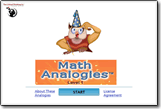
Among The Critical Thinking Co.'s software download products is Math Analogies Level 1, a product our oldest son just finished using.


This product currently sells for $6.99 and requires
a Windows 8/7/Vista operating system, 1 GHz or faster CPU, and 512MB of RAM to work.  (It will not work on Mac OS X, but an iPad version is available.)

In a nutshell, the program is a straightforward one that presents 152 analogies for students in grades 2-3 to master over four attempts.  These problems center on:


  • Algebra
  • Data Analysis and Probability
  • Geometry
  • Measurement
  • Numbers and Operations

Our Experience


When we first received a link to download
Math Analogies Level 1, we easily downloaded the program onto our family laptop, listed our son as a user and helped him understand what an analogy is by clicking on the obvious words, "How to Solve and Analogy" that came up on the program screen and can be found in a free online demo.

Once our boy, who had hitherto never seen an analogy, understood what an analogy is and how to approach solving one, we simply let him go to town with the program at his own pace.

One hundred and fifty-two problems proved a lot for our son to focus on right away, however, so he did not complete his first attempt at all the analogies in one sitting.  Rather, after about 10 minutes, he simply moved onto off-screen pursuits.


I was not sure how the program would handle being abandoned part way through a series of problems like that and was happy to discover that the next time our son logged on, the program simply picked up where her had left off.  In fact, it did the same for all four attempts our son made at mastering the 152 problems over the course of several sittings.  That was a handy feature!


It was also helpful for me to simply observe my son at work during his Math Analogy Level 1 times.  

As I watched my son approach the analogies, and sometimes helped him by offering guiding questions when he asked me to do so, I noticed both strengths and weaknesses in his current math knowledge as well as in his problem solving skills.  I also marveled at the way his mind worked to solve problems which included skills and topics we have never formally gone over.  

Indeed, Math Analogies 1 proved an interesting "test" of knowledge and skills for a child that rarely takes any sort of formal evaluation.  Better still, it did not feel like a test to him, but rather a challenge!

Within the six week or so review period, over the course of several 10-20 minute sessions and four overall attempts, our son met the challenge of mastering all 152 problems with 100% accuracy.

Now, I can erase him as a user and, when my daughter is ready, set her to challenge.  For,
since Math Analogies Level 1 is a downloadable program, once you purchase it, you own it forever. That means that after completing four attempts at mastering the program's 152 problems, you can use it again with the same child or with other children.  For me, with three children, that is a bonus!


Final Thoughts 

Would we recommend Math Analogies Level 1? 
You bet we would.

Granted, when I asked my son for a quote about Math Analogies Level 1 for this review, he said, "It was not horrible and it was not great.  I learned a little."  However, I know his experience was better than his words imply.   My proof?  This:


That is my boy cheering just after he mastered the last of the 152 analogies presented in the program on his fourth attempt to do so.


It was so fun to see his victory call!

It was also telling to see which problems challenged my boy the most.  In fact, I found myself using the "click to review" to click through all the problems he attempted and to note which ones he initially answered incorrectly.  Doing so illuminated what topics we might include in some upcoming focus lessons and hands-on activities soon.


I did, admittedly, wish I could just pull up a report of the missed problems instead of having to click through all 152 to find them.  I also wished that the program would present similar, but not exactly the same problems, during subsequent attempts.  Further, I would like to be able to use the program concurrently with more than one user, instead of having to wait until one user completes the cycle of 152 problems before beginning a second user on it.

These wishes aside, I found that Math Analogies Level 1 is an effective tool for practicing problem solving skills and encouraging higher order mathematical thinking.  It is also an excellent value for families with multiple children.  For, even though it cannot be used concurrently by more than one user, it can be used by multiple users in succession, giving families more bang for the buck.

The program is not flashy, fancy or filled with handy user options, but it is what it purports to be: an engaging
program that helps students break problems down into their component parts in order to come up with solutions.
Learn More

Want to see if Math Analogies Level 1 is right for your child?  Try a FREE DEMO.

Interested in other products?  Read what 100 Schoolhouse Crew Review families thought about The Critical Thinking Co. products.  Each family reviewed one of these products:


Critical Thinking Company Review


Want to connect with The Critical Thinking Co.?  Find them online at:


How have you even empowering your children with critical thinking and problem solving skills lately?  
Crew Disclaimer

Wednesday, June 6, 2018

Straightforward Pre-Algebra Your Whole Family Can Use {A Review + Coupon Code}


When we were given the chance to review Understanding Pre-Algebra from The Critical Thinking Co.™, I was pleased, because we are always looking for a right-fit math resource for one of my children and are also seeking a pencil-and-paper one to balance online learning for another child. Understanding Pre-Algebra looked like it might fit the bill for both of them.

I was also excited, because
The Critical Thinking Co.™ has a generous permission policy that allows the original owners of materials to copy them for use within one family or classroom.  I just LOVE this copyright policy as it allows me to use a single resource with all three of my children in tandem or succession - a perfect policy for homeschool families with more than one child or for homeschool parents that teach co-op classes.

What is Understanding Pre-Algebra?

Understanding Pre-Algebra, which is available in print or as an e-book, is a hefty 442 page softcover work text aimed at students in grades 6-8, which teaches the math concepts and critical thinking skills necessary for future success in Algebra 1.  It is standards-based and organizes concepts into a logical order that aims to solidify specific concepts as prerequisites to other ones, helping students grow in confidence and skill as they make their way through connected learning.

Word problems within the book are taught using charts and tables, so students learn strategies for solving them instead of being asked to just figure things out on their own.

The book takes students, concept by concept, through understanding of:

  • number families (natural, whole, integers, prime, etc.)
  • working with integers
  • working with rational numbers 
  • ration, proportion, and percent
  • algebreic expression
  • equations and solving word problams
  • inequalities and applications
  • understanding square roots and irrational numbers
  • two dimensional geometry
  • understanding volume and surface area
  • graphing on the coordinate plane
  • transformations and congruency
  • understanding functions
  • probability and statistics 

Of course, if you have not been doing a lot with math lately, some of these terms might not be so familiar anymore, and, that's okay!  The book has that covered through then inclusion of a handy glossary as well as highlighted boxes throughout the text.

It also includes a formula reference sheet and a table of square roots.  Plus, of course, there are pages with the answers to all of the problems presented in the book.  (These pages show JUST the answers, not the way the solutions were figured out.)

Pages are perforated, so students who need to see just a little at a time can easily remove the pages they are working on, or so parents can rip out the solution pages.

Each chapter has a review and there is an included final exam as well. 

All this adds up to a single-book, straight-forward, clear resource for learning Pre-Algebra as a full year course.  It also means that those who are using a different curriculum - online or in print - can easily use this book as a secondary source, quickly turning to pages that present ares students need more practice or a different explanation of.

The simple organization of the curriculum is definitely a plus.

How Did We Use It and What Did We Think?


My rising sixth grader was the child who wished to try Understanding Pre-Algebra as she had become enamored with an Algebra book her brother used before, but found it a little too difficult.  So, she thought this Pre-Algebra book might be just right.

Even though
Understanding Pre-Algebra is written in such a way that a student could use it independently, since my daughter has dyslexia, we opted to use the book together.  So, we set a timer and dug in to Chapter One for 15 minutes with success.

By our third or fourth 15-minute session with the text, however, we both agreed that my daughter's foundational elementary learning of arithmetic had not fully prepared her for
Understanding Pre-Algebra yet, so we decided to table our use of the book until a future time.

When I asked my daughter what she thought about the pages she did use, she said:

I like how much white space each page has.  I also like how the things they want you to focus on are highlighted.  The explanations were clear and there were not too few or too many problems.  I think I might want to use it in the future.


I also asked my oldest son, a rising seventh grader, to try Understanding Pre-Algebra, because both my husband and I agree that, although my son would rather simply do math online and in his head, he needs to do some with paper-and-pencil.  The main math curriculum he has been using online has become an "easy button" for us, but, we have noticed it is too easy in that it does not cause our son to think, strategize, process and remember math as well as we would like him to do so.

Thus, we asked my son to start using
Understanding Pre-Algebra for 15 minutes at a time independently.  He complied, but not happily, since he does not like workbooks for math.

When I asked my son for his thoughts on this book, he said:

I don't care for it, because it is a workbook.  I prefer online learning, which is better for me.  This workbook seems pretty much the same as any other math workbook.  It teaches you, then you have to do problems, and there is writing. I don't like writing.  Typing is faster, so maybe I would like this if it was an online workbook that auto-corrected one problem before giving you another.


If I had to say three positive things about it, I would say:
  1. I only have to do it for 15 minutes at a time.
  2. You can copy it so your sister and brother can use it, too.
  3. It made me aware of things I did not know.
I know Mom is going to make me use this sometimes still and that she is going to do it with me.

Yes, my boy is pretty blunt and, yes, he is correct.  We will continue to use this book in conjunction with other math resources and I will begin using it alongside him for a while.

The reason we will use the book despite my son's aversion to workbooks is that my husband and I are not seeing enough fruit from my son's past year of mostly online math learning and both like the clear, incremental way
Understanding Pre-Algebra presents math

The reason I will use the workbook alongside my son as we move forward  instead of asking him to continue to work on it on his own is because it has become apparent to me that my son lacks the study skills and stamina necessary to work through more difficult math on paper, and, so would do better with me giving him some immediate feedback and reminders to focus until his math mind and ability to work independently develop further.

So, overall, I am happy we have had the opportunity to review

Understanding Pre-Algebra

Though it proved above my daughter's level, we both saw how it could work for her in the future when her foundational skills are stronger, and though my son did not favor it, my husband and I agree that the curriculum is sound. 

We plan to continue to use this resource as a supplementary resource for my son to work his math skills and his stamina with pencil work.  We also believe this book will be an ideal fit for my youngest child - who is only in second grade right now - but already shows signs of being more of a "workbook kid" that would appreciate the straightforward approach of
Understanding Pre-Algebra.

The fact that
The Critical Thinking Co.™ allows a family to copy the resource for every child's use, then, is great for us!

BONUS - A FREE OFFER!

Would you like FREE Critical Thinking Puzzles?  Sign up now at
https://www.criticalthinking.com/toscrew to get Critical Thinking Puzzles delivered weekly to your inbox weekly. Choose PreK – Grade 8.  (A $75 value.)

FREE SHIPPING AND COUPON!

Get FREE SHIPPING + 15% off any size order at The Critical Thinking Co.™  using the coupon code: TOSCREW18, which expires 12/31/2018.


Learn More

Read all the reviews!

One-hundred Review Crew families checked out learning materials from the The Critical Thinking Co.™Click through to access all of our reviews about:


You can connect with The Critical Thinking Co.™ on:
Crew Disclaimer

Friday, June 12, 2020

Enjoy Problem Solving with Logic and Math {A Review}


Disclaimer: I received a FREE copy of this product through the HOMESCHOOL REVIEW CREW in exchange for my honest review. I was not required to write a positive review nor compensated in any other way.


The world surely needs more people who can work through difficult problems and use logic, so I always appreciate resources that can help my children develop such skills.

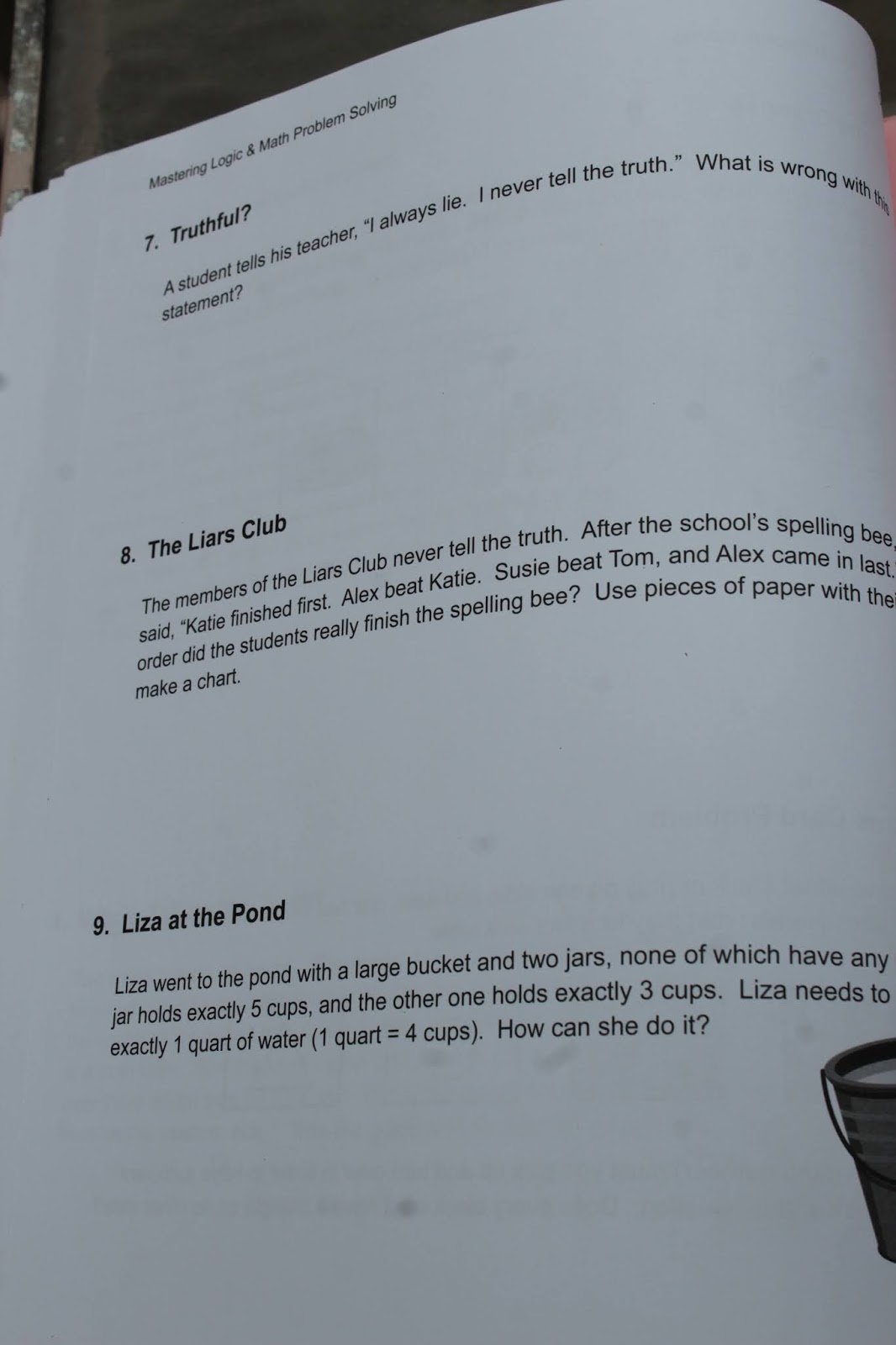
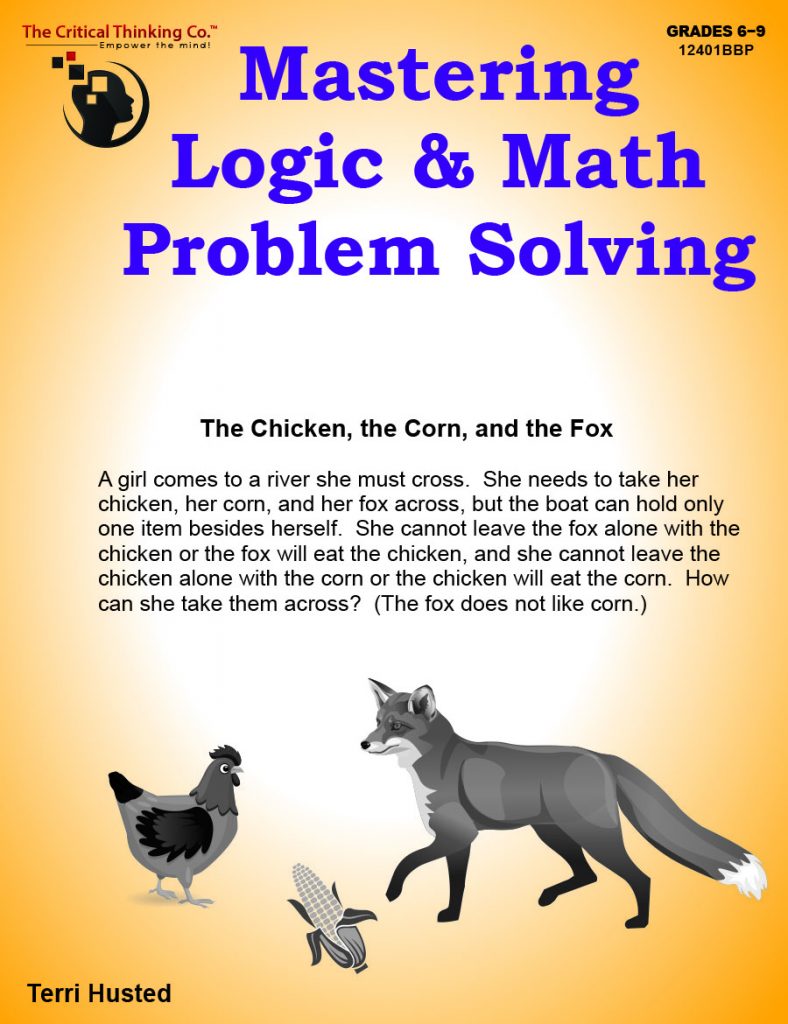
Mastering Logic & Math Problem Solving by The Critical Thinking Co.™ is just such a resource!


What Is The Critical Thinking Co.™ and Mastering Logic & Math Problem Solving?


The Critical Thinking Co.™ is a family-owned business that was established in 1958 and now offers 600 titles in reading, writing, math, science, and social studies which aim to help students achieve success in life through developing critical thinking skills without drill and memorization.
One of the many helpful resources they offer is 
Mastering Logic & Math Problem Solving by The Critical Thinking Co.™, which is a 180-page softcover workbook that is designed to help students in grades 6-9 sharpen critical thinking skill through solving problems using logic and math.

The book is also available as an e-book.


The bulk of the workbook contains problems across a variety of topics:
  • Multicultural Logic Problems
  • Fun With Classical Brain Teasers
  • Number Theory Problems
  • Problem Solving with Sets
  • Ration, Proportion, and Percent Problems
  • Algebra Word Problems
  • Geometry Word Problems
  • More Algebra Word Problems
  • Probability Word Problems
  • Topology Word Problems

The book also offers:

  • an introduction that explains what problem solving is and how to help student with it
  • ideas for using the book with individual students, in groups, and in a classroom

  • general problem-solving strategies
  • answers/solutions

  • a printable rubric and portfolio pages
  • bonus activities

It is a wonderful collection of puzzles and problems that offers flexibility to use with individuals, small groups, or an entire classroom in a sequential order or by type of problem.


How Did We Use Mastering Logic & Math Problem Solving?


My soon-to-be-10-year-old, just-13-year-old, and I used Mastering Logic & Math Problem Solving by The Critical Thinking Co.™  together as a group or during 1:1 times. Sometimes, my husband joined us, too.

We started with Multicultural Logic Problems and Classic Brain Teasers, some of which we were already familiar with, but most of which were challenging for my children (and, sometimes, husband and me!)

Generally, I challenged my youngest child, middle child, or both together with a problem and let them work at it until they got it or reached a frustration level that was escalating too much. Then I offered a hint or called a break.

When my children solved problems quickly, we sometimes did more than one in a row. Other times, a single problem took more than one session together to solve.


As we worked, at times, there was discussion, laughter, and positive creative thinking. Other times, to be honest, there was frustration and quarreling.

Such frustration and quarreling, of course, was challenging, but it was good, in a way, for it made me recognize how much more I need to work on virtues in our household and how much more I need to emphasize that "we can do hard things" and that "hard" does not equal "bad".

For, most certainly, as I used this resource, I recognized just how frustrated and ornery one of my children can get when presented with a problem that is not easily/quickly solved. I also recognized just how creative and outside-the-box that child's thinking could be - almost too much so in the case of this resource, since, in trying to come up with solutions to the problems, that child often tried to add elements to the clear storylines presented in the book that diverged a bit too far from the intent of the problems.

When that child did so, I ended up restating/reclarifying what I felt were clearly presented parameters and reigning the realm of possible solutions back into ones that exercised logic or math rather than far-fetched storytelling.

This did not always get met with the best of attitudes, but it was all a part of the learning, and I appreciated how this resource did not just do what it sets out to - offer a wide variety of problems to be solved using logic and math - but also highlighted some areas of character growth that we need to work on here.

What Did My Children and I Think?


One of my children said:


To solve the problems... we sketched out on paper, used implements, and actually did things, like the cup one.

In the future, I would like to use the book, with just myself or maybe one other person (my mom), not with other people in my family, because one of my siblings that I do it with gets frustrated and mean, and I prefer quiet when I work things out.

I would recommend this book to people who need help with logic. W
hen I did it with just my mom, I liked it.

My other child said:

The first time I used the book, it was a torturous time, because I could not figure the problem out. The next day, I had figured the problem out and challenged my dad to it. Then, we tried a few more problems. Sometimes, I hated it. Sometimes, I liked it. 

Personally, I liked the resource and would recommend it, because:

1. It offers a wide variety of problems to encourage critical thinking. The classical brain teasers, problem solving, algebra word problems, geometry word problems, age problems, probability word problems, topology fun word problems, and more in this resource encourage you to analyze, think aloud, pause, rethink, etc. until solutions are found.

2. It highlights skill areas to grow in. People can do hard things. They can disagree but still be kind. They can be confused and push through. They can use different methods to come up with similar solutions or similar methods to come up with different solutions. They can strategize, visualize, verbalize, and work together or alone... and they can realize that doing all this need nor bring the nasties out. This resource not only highlighted for me and mine problem solving skills we could work on, but also where we could grow in character and virtue.
3. It offers meaningful math. Although we have not gotten to the latter portions of the book, even in the first few chapters, practical applications of math and logical patterns were used. I have also looked at the later chapters and see how more traditional math applications play in. 

 
4. Flexibility is inherent in the resource. A generous copyright allow purchasers to reproduce the resource for a family or classroom use. Also, the workbook can be used individually, in groups, or in a classroom in order or cherry-picked to supplement other learning. 
5. Parents can use it with no prior experience. The Introduction Teacher Notes, Answer Key, and Appendix material all ensure that any parent can use this resource easily with their children. 
6. It focuses on skills our world needs. Few problems in life have cut and dry solutions and so an ability to analyze, think of all possibilities, and, then, use logic to come up with answers is important. This resource offers kids opportunities do do this.  
7. It is not busy. Pages within the resource are not overly busy and have plenty of white space, which is helpful for kids with ADHD, dyslexia, and sensory issues. (We face all of these things here.)

Obviously, then, even though one of my children did not always favor this resource, I found it had merit and would recommend it to others with middle school age children. (Just be prepared for some behavior bumps if your child is easily frustrated or going through some tweenrage times.)

Learn More

We have used and appreciated other resources from The Critical Thinking Co.™ and you can browse our other reviews from this vendor here.

You can also click through here to find links to 65 video, social media, and blog reviews from other Homeschool Review Crew families who have recently tried out:


And, of course, you can connect on social media:

LinkWithin

Related Posts with Thumbnails