Showing posts with label St. Maximilian Kolbe. Show all posts

Sunday, August 13, 2017

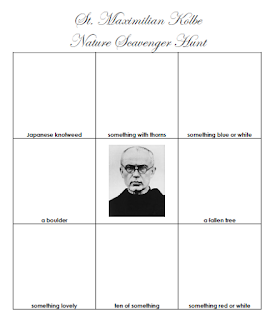
Get a FREE St. Maximilian Kolbe Nature Scavenger Hunt Printable!


Last year, I shared 4+ Sensory-Smart Ways to Learn about St. Maximilian Kolbe and mentioned an idea for a scavenger hunt that I had after reading about the symbolism of the reliquary used for the St. Maximilian Kolbe relics my children and I were able to venerate


{Disclosure: Some links which follow are affiliate ones.}
 
This year, I thought I would create a new FREE St. Maximilian Kolbe Nature Scavenger Hunt printable based mostly on St. Maximilian Kolbe's life as told in the Loyola Kids Book of Saints, which I plan to reread to my children before going on our nature walk.  


In case you do not have time to get the book, however, I included a page of discussion points with the scavenger hunt so that you can easily retell parts of St. Maximilian's story on your own:


  • Japanese knotweed: Father Maximilian started a Catholic magazine and newspaper that reached hundreds of thousands of people in just a few years. He, then, traveled to Japan to start another even though he spoke no Japanese.   (If you do not have Japanese knotweed in your area, just cross this one out and put something else that might remind children of Japan or the far east in this box.  Something hair-like: Fr. Maximilian grew a long beard before traveling as a missionary to Japan as a long beard was respected there at the time. Later, he has his beard shaved off and some of hi whiskers are now included in reliquaries.
  • Something with thorns: In 1939, Nazi invaded Poland and began a thorny occupation. Because Fr. Maximilian was an outspoken priest, the Nazis wanted to shut down his popular magazines. So, they arrested and imprisoned him briefly in 1939. Then, in 1941, they arrested him again and sent him to Auschwitz in Poland, where he became prisoner # 16670 and later died. 
  • Something blue or white: In prison, Fr. Maximilian wore a blue and white uniform and lived in a large, cold building where he slept on a board.
  • A boulder: Fr. Maximilian was forced to do hard – and sometimes horrifying - work, like carrying boulders, moving large trees, and carrying dead bodies to ovens where they would be burned. 
  • A fallen tree: Fr. Maximilian was starved and beaten in prison. Once, a guard strapped a plank to Maximilian’s back and made to run. When he collapsed, he was kicked and whipped. 
  • Something lovely: Despite hardships, Fr. Maximilian never stopped loving God or others. He persisted in prayer through sad, desperate situations and tried to help other prisoners.
  • Ten of something: When a prisoner escaped, Nazi prison guards decided other prisoners would be punished to discourage other escape, so they selected 10 prisoners who would be starved to death. 
  • Something red or white: One of the prisoners cried out, “My poor wife and children! I will never see them again,” whereupon Fr. Maximilian said, “I would like to take the place of Sergeant Gajowniczek.” So, Fr. Maximilian and nine others were taken to a cell to starve to death. After several weeks, only four men – including Fr. Maximilian – remained alive. At this point, the Nazis gave them injections to kill them. Fr. Maximilian died on August 14, 1941 at age 47, a martyr pure in his love for God. This fulfilled a promise he had made Our Lady when he had a dream as a child in which she held out a red crown and a white one to him, asking him if he was willing to accept either of the crowns – the white one meaning he should persevere in purity and the red that he should become a martyr. He said he’d accept both. 
  • Saint Maximilian (free space): When Fr. Maximilian Kolbe was canonized a saint in 1982, an elderly Sergeant Goajowniczek, his wife, and his children were present in St. Peter’s Square. God’s love – as shown through St. Maximilian Kolbe – had saved his life. St. Maximilian put love before even his own life.

Also, as you can see in the discussion points, I have included an alternative for Japanese knotweed in case you don't have any in your area.  In the FREE printable pdf, there is a second scavenger hunt sheet with this alternative on it.

In the boxes on the scavenger hunt, children can make a sketch or write a verbal description of what they found.  You can see my Saint Anthony Nature Scavenger Hunt post to get a visual of how they might work.


More Liturgical Celebration Ideas for This Week


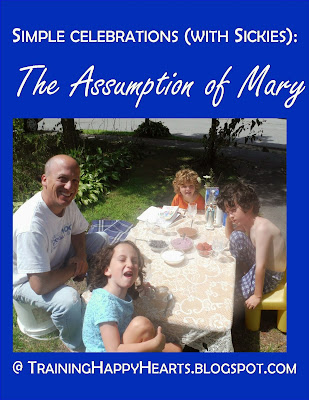
Click through any of the images or text below for my ideas and inspiration about St. Maximilian Kolbe and the Assumption of Our Lady (which is August 15.)


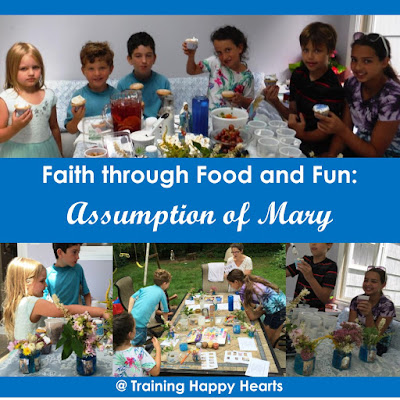
http://traininghappyhearts.blogspot.com/2017/08/celebrate-assumption-of-mary-with-food.html


http://traininghappyhearts.blogspot.com/2015/08/plan-for-assumption-day-playdate-round.html

I'd love to see snapshots of your nature walk if you go on one.  I also welcome your ideas for living the liturgical year with children.

Sunday, July 10, 2016

Experience the Testimony of Saint Maximilian Kolbe


This past week we did not get to experiencing all of the sensory-smart ways I had brainstormed for learning more about Saint Maximilian Kolbe.  However, we did enjoy some reading, chats, and activities, which culminated* with Mass and veneration at Our Lady of Perpetual Help, where the Pilgrimage of the Relic of St. Maximilian M. Kolbe had stopped.  (*I use the word "culminated" loosely as there will surely be more study and learning about Saint Maximilian Kolbe to come.)

What a beautiful church Our Lady of Perpetual of Help is.  From the outside, it looks like a simple church.


Inside, though - wow!  As soon as my children and I stepped inside we thought, in my son's words:

This is amazing!  It was gorgeous.  There were statues and paintings everywhere.  The painting of Jesus resurrected and the people just looking up at him, staring in awe.  It was so impressive.  So pretty.


I did not take a ton of photos inside, because I did not think it would be appropriate to keep snapping photo after photo during veneration time, but I did take a few so that my children could better remember our experience, and so that we could continue chatting about the symbolism we had seen and the stories we had heard in the coming weeks, using the photos as a starting point.


My youngest was obviously exhausted when we were at Mass and fell asleep.  He woke as veneration began and was bleary eyed when his siblings took him up to the reliquary to look for the first class relic beard hairs within it.


While there, we
noticed some of the symbolism of the reliquary:
  • a base shaped like Poland, where Saint. Maximilian Kolbe was from
  • thorns to represent the atrocities committed during the occupation of the Third Reich
  • the lily bursting forth fro the thorns represents purity
  • the tulip represent matryrdom (and, together with the lily, represent love triumphing over hatred)
  • a knotted cord represents the vows of chastity, poverty, and obedience taken by all in the Franciscan order, including St. Maximilain Kolbe

We also noted the colors of the flowers by the altar - red and white - and talked about how these are the same colors as the crowns young Raymond Kolbe (which is what Saint Maximilian Kolbe was called as a boy) said he would accept from Our Lady.  As the story goes, one night, Our Lady appeared to young Raymond in a dream.  She was holding both a red crown and a white one and asked which he would accept.  The white meant her would persevere in purity.  The read meant he would become a martyr.   Raymond said he would accept both, and, indeed, through his life and death, did just that.

Plus, we examined the painting that was near the relic and connected it to what we know about Saint Maximilian Kolbe. The children noted that:
  • In the background there are smokestack sand fences, reminding us of the prison camp Saint Maximilian Kolbe was imprisoned in
  • The prison uniform he holds has his prisoner number on it.
  • His habit speaks of his calling as a Franciscan priest.
  • He holds the crowns he accepted from Our Lady.


Nearby were images of the Divine Mercy and Saint Faustina, so we chatted about those, too, and prayed at the side altar where they were.

Before we left, a sweet Franciscan sister gifted each of us with a Miraculous Medal.  The children took these up to the Saint Maximilian Kolbe relic, prayed, and touched them to the relic.  Yep, at that point, as had happened during  several points when I walked into the church, when I gazed at the artwork, when we celebrated Mass, when I looked down at the sweet face of my sleeping youngest,... tears brimmed in my eyes.  So much to be grateful for.  So many mysteries and graces.  So many blessings.


Life gets busy - very busy - and there are choices to made each day to move towards God or away.  I am grateful for the examples of saints who show us, time after time, how to move toward our Lord.  I am equally thankful for those who currently accept calls as nuns and priests, praying for us and shepherding us.  Likewise, I am thankful for ministries like Our Lady of the Angels that enrich us with experiences such as being able to experience the
Pilgrimage of the Relic of St. Maximilian M. Kolbe

Experience the Church and Pilgrimage Virtually

If you
would like to take a virtual tour of Our Lady of Perpetual Help, please view images of beautiful artwork in a slide show on the Our Lady of Perpetual Help website.

If you would like to learn more about the Saint Maximilian Kolbe relic or find out if it will be visiting you soon, check out the 2016 Pilgrimage page.


You can also view a video talk that explains Saint Maximilian Kolbe's story:


May love continue to triumph over hatred and may all of us in our troubled century listen to the testimony of Saint Maximilian Kolbe that love without limits is possible.


Saint Maximilian Kolbe, pray  for us.

Sunday, July 3, 2016

4+ Sensory-Smart Ways to Learn about St. Maximilian Kolbe


I learned this week that a church not too far from us will be hosting the Pilgrimage of the Relic of St. Maximilian M. Kolbe this coming week, so I hope re-arrange our schedule in order to bring my children to either a prayer service, Mass, or veneration at the hosting church. 

Whether we are able to work such a visit into our schedule or not, I plan to focus this week's faith-learning time on St. Maximilian Kolbe, whose feast day is coming up on August 14.  I've come up with seven sensory-smart ways to share ore about St. Maximilian M. Kolbe with my children and thought you might be inspired by them, too.  Of course, I'd love to hear about your favorite
St. Maximilian Kolbe prayers, activities, resources, ideas, and links, too!

{Disclosure: Some links which follow are affiliate ones.  Should you click through them and make any purchase, we may receive small compensation at no extra cost to you.  Thank you for supporting us in Training Happy Hearts.}

 
~1~
Taste Saint Maximilian Kolbe's Geography


My children know very little about St. Maximilian Kolbe, so we will likely begin our study about him with a reading and prayer from the Picture Book of Saints which focuses on him.  Within this reading, there is mention of some of the places St. Maximilian Kolbe lived: Poland, Japan and India.  Thus, as a part of our ongoing gentle geography studies, we will likely locate these places on a map and, then, to tickle our gustatory senses, we may plan some simple Polish, Japanese, and Indian dishes into our weekly meal plan.  We will also chat about how blessed we are to have ample food to eat and what we can do for those that do in conjunction with discussion about how St. Maximilian Kolbe often shared his food with other prisoners at Auschwitz and, ultimately, suffered starvation.


~2~
View Saint Maximilian Kolbe's Life


I am not sure my younger children are ready for the heaviness of learning too much about Nazi prison camps, but I think my oldest (who happens to love audio-visual learning) can handle it, so we may watch a short video about Saint Maximilian Kolbe together.  I have this one bookmarked, but welcome your suggestions, too.


Please do share your favorite titles and ideas for learning about Saint. Maximilian Kolbe.  Also, be sure to see if
the Pilgrimage of the Relic of St. Maximilian M. Kolbe will be close to your area soon, too.

~3~
Love Like Saint Maximilian Kolbe


We will also read the story about Saint Maximilian Kolbe in the Loyola Kids Books of Saints, which ends with asking readers to think of hard steps taken to live in difficult situations.  I am thinking hat after chatting about the story and the question it concludes with, we might get some proprioceptive input in by lifting, bending low, and reaching high to collect and deliver donations for those in need.  Or, we might focus on tactile or visual input with a "loving others" artwork that the children can help envision and create.

~4~
Sculpt or Scavenge for Saint Maximilian Kolbe Symbols

Source:  Our Lady of Angels Province


As I read about the reliquary used for the pilgrimage, two connected learning-and-sensory activities popped into my head.  The first is to engage the tactile and visual senses in sculpting symbols related to St. Maximilian Kolbe's life.  The second is to use our visual, vestibular, and proprioceptive senses with an outdoor scavenger hunt related to St. Maximilian Kolbe - finding a thorn bush to symbolize the thorny occupation of Poland, a white bloom to represent purity, a red bloom to represent martyrdom, something hair-like in nature to remind us of St. Maximilan Kolbe's beard, Japanese knotwood to remind us of a country the saint had once lived in, etc.

~MORE~
Connect Kids to Learning About St. Maximilian Kolbe

As I read Word on Fire's 9 Things to Know about St. Maximilain Kolbe yet more ideas came to mind.  However, I know we'll be too busy this week to weave many of them in.  Still, I thought I'd share my quick thoughts in case any spark a learning experience idea for you:
  • Engage the visual sense in making red or white crowns or visions of Mary paintings.
  • Enjoy STEM activities.
  • Tour a printing place, radio station, or movie studio.
  • Make cards for the imprisoned.
  • Share food with the hungry.
  • Get involved with the works of an organization that supports families, prisoners, journalists, political prisoners, drug addicts, or pro-life activities -- all things St. Maximilian Kolbe is patron to.

Undoubtedly, there are plenty more resources, ideas, and sensory-smart activities that can engage children in learning more about Saint Maximilian Kolbe.  I would love it if you'd share thoughts and links!  Also, do check if the Pilgrimage of the Relic of St. Maximilian M. Kolbe is headed towards your area as well.

LinkWithin

Related Posts with Thumbnails