Showing posts with label Piano. Show all posts

Saturday, July 19, 2014

At-Home Piano lessons with Practicality, Promise and Portability {A Review}


As a desire to learn how to play piano has been ignited in our whole gang here, we were super-excited with the opportunity to receive a lifetime subscription to the Complete Set of Books from HomeSchoolPiano in exchange for an honest review.


What is Homeschool Piano?


HomeSchoolPiano is just what our family can use and perhaps what yours can, too!  

Seriously.  

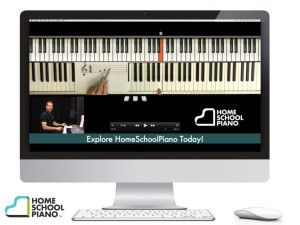
It is an online program that offers up to five family members an opportunity to learn piano at home at their own pace through video-based lessons that typically run under ten minutes each.

Homeschool Piano Review


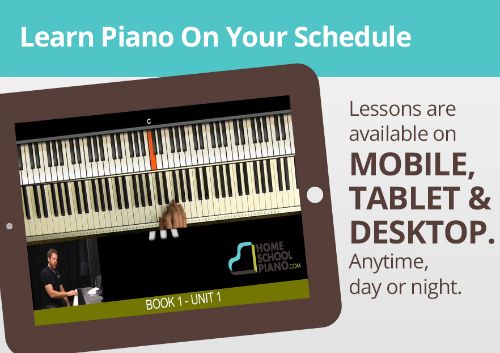
These lessons can help kids and adults alike to learn piano from a beginner level or beyond at any time of the day or night as long as you have a 49 key keyboard or piano and a computer, tablet or similar with reliable internet connection.  (For those who are unable to watch the videos online, there is a link that allows you to download mp3 files for audio and mp4 for video, but I cannot attest to how that goes...)

Happily, HomeSchoolPiano is affordable as well.

There are two payment options for the same fabulous unlimited life-time access to HomeSchoolPiano along with all bonuses (downloads, jam tracks, sheet music) for up to 5 students:


1.  The Success Package (a single payment of $299)


2. The Payment Plan (3 monthly payments of $99.97 per month):


What does the Complete Set of Books include?
Homeschool Piano Review


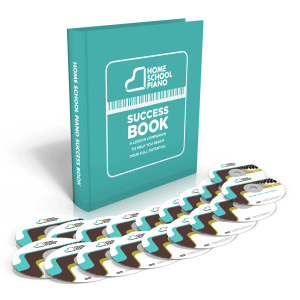
When you sign up for HomeSchoolPiano Complete Set of Books, you receive online access to:


  • CorePiano (for absolute beginners):  This section contains over 30 lessons where you will learn things like how to sit at the piano, how to play the notes (through the grabbing technique) and basic music theory.  It is a great place to start if you have no familiarity with the piano, or, if like us, you want to solidify what you already know.


  • Book 1 (for beginners):   This books teaches you how to read music and create your own music.  (That's right, it encourages skill and personal creativity.)

  • Book 2 (for the beginner to intermediate students):  This book continues, of course, from Book 1, offering more about rhythm, technique and music reading.


  • Book 3 (for intermediate level students):   This book, likewise, expands on earlier skills and offers lessons on how to create piano arrangements and to become a well-rounded piano player.  (I cannot say much about it yet as none of us are at that level yet!  However, we know we'll get there through the convenience of lifetime access in 10-minute or under segments!)

Each book contains six units, with each of these units containing seven 5-10 minute or so lessons.

Homeschool Piano Review
 

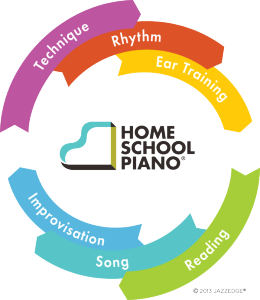
These lessons are built around a 6-step cycle that touches on all of the nine National Standards for Music Education and provides a well-rounded musical curriculum.

  • Technique
  • Rhythm
  • Ear Training
  • Reading Music
  • Song
  • Improvisation. 

More importantly to me, (since I am not huge on standards-based curriculum) is that the approach makes it easy for students to understand and apply what they are learning, and, thereby, facilitates growth in piano playing fun and expertise.


In short,  HomeSchoolPiano - Complete Set of Books means piano for kids, piano for Mom and piano for Dad in increments of time and skill that can fit easily into the seasons of life!


Our Take


When we first received access to HomeSchoolPiano, I created logins for each person in my family and, then, we all sat down under one login to begin the first Core lessons together before bedtime, taking turns at the piano.

We all decided we liked the program and will use it to further our personal music and piano abilities, but only one of us decided to do that right now:  Nina.  

(Daddy has been working overtime and wants to use the time he is at home for sleep or excursions.  Mommy is trying to spend less time online when the kids are awake and the kids keep outlasting her at night so her plan to learn piano at night has been foiled.  Luke, unfortunately, lost most of his computer privileges for the summer and has been using what time he is allotted for another purpose.  Jack has been on a Lego kick when we are home and, to be honest, being summer, we are not home much)

I am okay with the fact that only Nina is utilizing the program at present though. In fact, I am actually thrilled.  It offers her something she loves that is "just hers" for now and sets her up for "teaching" us (along us learning ourselves from the videos, of course,) in the fall. 


And, oh does Nina love the piano and her ability to be independent with it! 


Even independent outside as the photos sprinkled throughout this post attest.

For Nina also loves to be out of doors and HomeSchoolPiano offers a win-win solution.  

On the day pictured, I helped Nina take the keyboard, laptop and a stool outside, where she happily and intently experienced lessons.


As she did so, I was reminded of a number of things about HomeSchoolPiano that make me smile so far.  Among them are:

  •  Portability:  Even though we have no tablet, we do have a laptop, an extension cord and a keyboard set up that is not tough to move about.  That means we can take lessons outside or even on a trip to see grandparents in the coming year. 

  • Independence!  Once logged in, my children can handle lessons on their own.

  • Continuity (and Review): It is easy to pick up where you left off with lessons, but also easy to go back and review if there has been a lag between lesson times or if you simply want to go over something again.  Further, the lessons are well-laid out in digestible increments so there seems little chance any of us will miss any foundational skills before building further ones.
 
  •  Convenience:  Although I think developing in-person connections with locals is vital, our family simply cannot budget time nor money right now for piano lessons times five (or even times two or three for that matter.)  Further, because we are currently in a season of homeschooling that is more out-and-about schooling than actually being-at-home schooling, I appreciate the convenience of any of being able to learn piano in ten minutes or under day or night.

  •  Unity:  Since we are all using the same program at our own paces, we can all help and encourage one another - and sometimes even share time on the same lessons (whether as a review or a peak ahead.)

  • Training and Inspiration:  I appreciate the balance of typical music training and creative inspiration.  With encouragement to vocalize, improvise and master piano skills.

  • Accountability:  Although grades are not a focus in our home, personal accountability of some sort is important in life.  I like that there are online quizzes to help us all be honest with ourselves about how we are doing

  • Relaxed Learning: In an ideal world, there would be daily time, or at least regular time, each week to learn piano (and to pursue the gazillion other interests and commitments we have).  In reality, our family tends ti dive into things in spurts.  The fact, then, that we have lifetime access to HomeSchoolPiano allows us to learn completely without pressure as opportunity and interest allow.

For our family, HomeSchoolPiano - Complete Set of Books offers practicality and promise for our piano-learning desires.  Nina is progressing and becoming the "expert" among us.  The rest of us began to progress, but also had the freedom to put that progress on hold until fall.

Learn More

Homeschool Piano Review


Visit HomeSchoolPiano on:


See how other members of the School House Review Crew have been enjoying HomeSchoolPiano.


Click to read Crew Reviews

How would unlimited lifetime access to piano lessons bring delight to your home?  Have you found other ways to include music in your learning and fun?
  
Crew Disclaimer

Monday, February 24, 2014

Enjoy Piano Lessons at Home – A KinderBach Review

Do you have a young child interested in learning how to play the piano?  Are private lessons outside your home (or expensive ones at your home) not an option for your family?  Do you want to subtly integrate a variety of developmental skills into music lessons at home?  Would you like to discover if your children enjoy learning piano before investing in a “real piano” or an expensive weighted keyboard?  Then, let me tell you about an awesome online piano program that my children and I have been enjoying since January as part of the Schoolhouse Review Crew:  KinderBach!


KinderBach is an online music program for children ages 3 to 7 (although that didn’t stop our 8 year old nor me – a 40-something-year-old – from enjoying the program, too!)  In fact, all three children and I tend to use The KinderBach Online Piano Lesson Membership with Teacher Corner as together-time during our daytime play-and-learning periods and our post-dinner intentional family times.  

Regardless of whether we use it during our focused learning times or our family fun times, KinderBach is a hit here!

What is the KinderBach Online Piano Lesson Membership with Teacher Corner?

Kinderbach Review

It is six levels of engaging music education for young children, ages 3-7 years old, but can be used with children slightly younger or older depending on the child and the family circumstance.


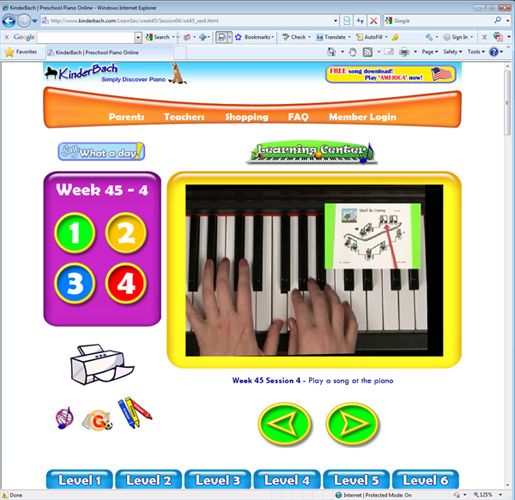
That education is presented through about 22 hours of video and accompanying interactive fun pages that are broken down into short segments so you can do one mini-lesson at a time, in about 5-10 minutes, or a marathon on days your children are up for that!  (The sessions are broken down into weekly units of four sessions each, but since it is an online program, you can go at your own pace!)

My oldest eagerly awaits to see if Miss Karri will tell him to use a rhythm instrument again.  I have been surprised with how engaged our 8-year-old has been with KinderBach lessons.

Within each of the approximately 240 sessions, Miss Karri, the energetic and clear video teacher, introduces young children to a wide variety of music skills with the help of the the keyboard characters (cute cartoon characters that help children remember things about the piano keyboard).  Together, Miss Karri and the keyboard characters gently teach preschoolers (and early elementary-age children) how to:

  • play simple songs
  • identify music direction
  • master new rhythm notes and their beat value
  • maintain proper hand and finger position for the music scale
  • read staff notes by pattern for voice and keyboard.

Kinderbach Review

With membership, you get:

  • access to all web lessons by computer, Android Tablet, Kindle Fire, Nook or iPad.  (We used only our computer) 

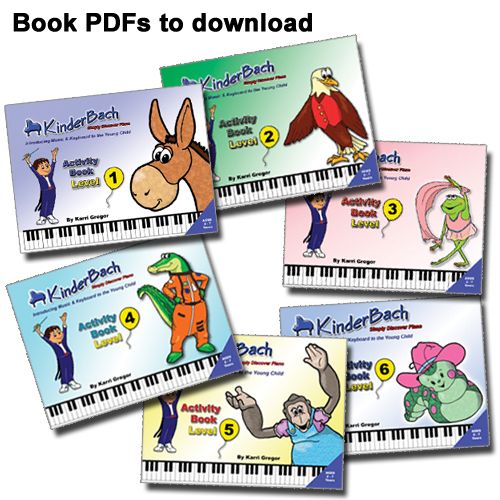
  • accompanying pdf activity pages for students

  • $400 worth of instant-access Teacher Corner materials that can help you supplement video lessons or teach the same materials on your own without the videos if you wish (which is handy for teaching group lessons or just for taking a break from screen time)

  • Audio MP3s for all six levels of KinderBach lessons

  • downloads of storybooks, coloring pages and song books

Kinderbach Review


Besides computer access for the videos, of course, to take full advantage of KinderBach, it is helpful to have a printer, colored pencils or crayons, scissors, printer paper, cardstock, something that can be used as a rhythm instrument, and, of course, a keyboard of some sort.  In all honesty, a "real piano" or expensive weighted keyboard are not needed.  Children really can learn and enjoy with KinderBach with an inexpensive "play" keyboard.

Our Experience with KinderBach

From the first evening we used KinderBach, my children were drawn in not only by the music, but by Dodi, one of the keyboard characters.  In fact, they were enjoying themselves so much during our post-dinner family time with KinderBach that they asked me if they could do "one more session".  Who was I to say "no"? 

You do not need a keyboard for the first few sessions of KinderBach, but my children wanted to take out the small play one we had.  Also in this picture, you can see an orange New Year's clacker that the kids used to dance and play rhythm along with the lessons and a high-low coloring page that the children did along with an on-your-feet hi-low activity.

And, who was I not to learn that my children would always ask for "one more session"?  By our second day experiencing KinderBach lessons, I realized that since each session is short and engaging my children will inevitably ask for "more" each time. Henceforth, when planning our KinderBach times, I learned to say we will do x-amount of sessions, but to plan to actually do x+ 3 or 4.  That way, the kids and I experience a win-win-win:  I manage our time; the kids hear me say "yes" to their requests; and we all get a bit more music education in.

My two younger children are enthusiastically practicing rhythm here with a KinderBach online video.  (Forgive the bathing suit on my little girl.  She had been playing "Wonder Woman" just prior to our lesson.  (But isn't it great that when you do online lessons, you can do them in jammies and costumes as our snapshots evidence!?)


Some days I plan for only one session, and we do two, thereby completing a half a week's worth of lessons.  Other days, when we have the time and the children wish to, we do stretches of several weeks of lessons at one time.  And, that, I think is a boon of KinderBach: It is flexible!  

We can easily fit KinderBach lessons into our weekly rhythm without hopping into the car, worrying about scheduling or, as sometimes is the case with young children, dealing with the behaviors that spring from wanting more time or less time with an activity at any given moment.   In a home with a sensory kid and a handful of strong, busy adult and child personalities, this flexibility is key.

It may be difficult to see in this snapshot, but the activity page the children are doing  is on "loud" and "quiet" sounds.  I love that lessons gently highlight such developmental skills such as auditory discrimination and early learning topics such as opposites.


Another boon of KinderBach as we experienced it is the breadth of learning inherent in it.  Not only do KinderBach lessons teach the piano and music lessons one might expect, but they incorporate a variety of early development skills and objectives while doing so.  Some of the things the "teacher side" and "special needs parent" side of me has noticed in the well-planned KinderBach lessons are:

  • encouragement of fine motor skills through coloring, cutting, pasting, finger plays and more

  • auditory discrimination exercises

  • work with opposites

  • storytelling

  • physical exercises and movement breaks that encourage proprioceptive input and total body response

  • short, focused lessons

  • opportunities to plan and execute (in each week's lesson introduction, Miss Karri says what will be needed for the lesson.  Children can gather these materials before beginning, which provides a simple, but effective opportunity to practice planning and preparation.)

Here, my youngest is practicing his fine motor and coordination skills by cutting out "stations" to place above sets of three black keys while Big Brother checks if Little Brother has put the stations in the "right" places.  (Again, pardon the realness of our snapshots.  As is obvious from my son's face and shirt, we'd had defrosted berries at our meal before this lesson.  And, once more, can I say I love the convenience and ease of at-home lessons.  Our youngest washed his hands, but wanted to change his top and wash his face after KinderBach lessons.  Since our piano lessons are at home, this was no problem!)
Plus, of course, every KinderBach lesson includes sound music theory and piano lessons presented at a pace and with a nature that make them effective for young children!

A Balanced View

The kids and I have been loving KinderBach for the past six weeks and fully intend to learn and play more throughout the remainder of our six-month membership, and maybe longer.  The top three things I like about KinderBach, if they are not obvious already are that:

  • Lessons can be done at home, at your own pace with flexibility.

  • Activities included in the lessons are engaging and well-balanced and incorporate more than just music skills.

  • I can learn right along with my children.  (I have always wanted to learn to play the piano, and, although if I were to take online lessons for just me I'd probably pick something a bit more "grown up", KinderBach lessons are still teaching me a few things alongside my kids!)

My daughter, randomly dressed a a princess, happily practices "Chug, Chug, Chug", an original KinderBach song.

On the flip side, I can see a few potential drawbacks for some families in using KinderBach:

  • Children who already have some experience with piano may find the lessons too "slow" at first and those on the upper end of the targeted age range may find them "babyish" (although my 8-year-old has not).

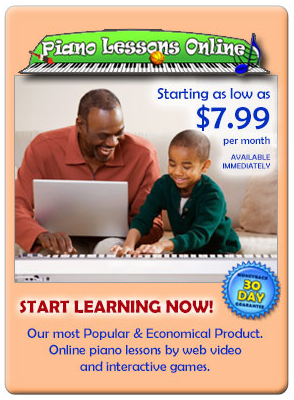
  • The current introductory price of KinderBach membership, which is $95.88 a year, or $7.99 a month, may be hard for some families to budget for.  (However, considering there is no gas to put in your car and more than one child can use the membership, it really is a bargain!)

  • Some children may wish to play familiar songs right away.  (KinderBach eases children into song playing and begins with songs specific to the keyboard characters that familiarize children with the piano keyboard as opposed to beginning with teaching typical familiar children's ditties.)

My Bottom Line

If you want a gentle, engaging introduction to piano for your youngsters and the convenience of lessons at home (or even on the go if you have an iPad, Kindle or Android Tablet), KinderBach is well worth looking into!

KinderBach can be effective for homeschoolers, afterschoolers, co-ops and teachers of small group lessons.  My children and I have been thoroughly enjoying our membership and encourage others to give membership a try for free with the try-before-you-buy option at the KinderBach website or to jump right into reasonably-priced paid membership starting as low as $7.99 per month.

http://www.kinderbach.com/shopping/shop_lc.html

Want to Learn More?

To learn more about KinderBach, you can find them at:

  • Twitter: @KinderBach

Kinderbach Review

And, if you’d like to hear what others think about Kindebach, please click on over to read any of 90 or so honest reviews at the Schoolhouse Review Crew page.

Click to read Crew Reviews


Do you have specific questions you'd like me to answer about our KinderBach experience?  Just ask.  Or, have you used KinderBach, too?  Feel free to share them in the comments.
Crew Disclaimer

LinkWithin

Related Posts with Thumbnails