Showing posts with label English Language Arts. Show all posts

Wednesday, April 13, 2022

Fix It! Grammar Gets the Job Done! {A Grammar-in-15-Minutes-a-Day Review}


Disclosure: I received this complimentary product through the Homeschool Review Crew.

If you've got a student who needs to bone up on grammar, vocabulary, and writing, but is not an English aficionado, Fix It! Grammar by the Institute for Excellence in Writing (IEW) can help.

My eldest son is not a fan of English these days and needed as pain-free a push as possible to:

  • improve his grasp on grammar.
  • focus on expanding his vocabulary.
  • and encourage him to write legibly and well by hand.

So, when I saw an opportunity for us to review the latest edition of IEW's Fix It! Grammar, Level 5, The Frog Prince, I jumped at the chance.

In the past, an older version of Fix It! Grammar's, Robin Hood had been working well for my son until he lost his copy of the student book, got out of the habit of using the program, and threw his focus into other studies and projects. So, I knew the format of the fourth edition Fix It! Grammar books could work for us if I could just get my son to buy in to putting effort in.

Praise God! I gave enough of a carrot for my son to try The Frog Prince (telling him he could be done with grammar if he finished the book) and the ease and efficiency of the Fix It! Grammar program has been doing the rest.

This Grammar Curriculum Works for My Son!


Here is what my son had to candidly say about his experience with The Frog Prince  so far:

All high schoolers have that one subject they struggle with. For me that is English. I have tried multiple different approaches to studying the subject, few of which have been effective long-term for me. 
When my mother saw the review for IEW’s Fix It! Grammar, The Frog Prince, she decided to accept it. I had no say in the matter, which was probably for the best since I do not like English these days. 
As my mother handed me The Frog Prince, she told me to do it, and I would be done with grammar for high school. So, after some short-lived obstinance, I gave in and started working through the book. 
Even though I was not enthusiastic about working on English, I soon grew to appreciate how little effort I had to put in while still getting effective results. With just about 15 minutes a day, I was improving enough to get my mother off my back about how bad my English skills were, which was a sweet relief. In fact, I would even spend longer on some days just to get ahead. 
It has worked beautifully since Fix It! allows for self-pacing. All I had to do was complete editing a section on my own.


Then, during a 1:1 lesson, my mother would go through and check it. After that, I would copy the piece with correct spelling, grammar, and such. 


I have also learned some interesting vocabulary while using the book, which is a nice thing to be able to flex on my friends. 
Overall, I would say Fix It! Grammar has allowed me to do what I like to do: control my lessons and pace myself. It is easy to use and works well. I would definitely recommend it. 
My only complaint is that the version of The Frog Prince used is not the original, but one obviously adapted for this curriculum. You can not win them all I guess. 
Anyhow, that's all I have for today. Until the next time my mother decides to make me write a review...

As you can see, even though my son is not an English nor a review-writing enthusiast, he can see the merit of IEW's Fix It! Grammar, Level 5, The Frog Prince. What a victory!

Fix It! Grammar's 4th Edition Makes Language Arts Even Easier than Earlier Editions Did!


I like the fourth edition of Fix It! Grammar even more than I liked earlier editions of the program. The new editions have larger fonts, more white space, and more examples on the Learn It pages than prior editions Student Book pages did, which is something I always look for since my second child benefits from white space and larger fonts!


Each "day" of the lessons also has its own page now with a handy checklist at the top, a large-font passage to edit, and lines for rewriting the passage right on the page. This makes the proven method of Fix It! Grammar even more user-friendly for students. (Prior editions, as you can see in the side-by-side picture below, had passages for each day of a lesson week on the same page.)


There are also some fabulously user-friendly features in the new 205-page, lay-flat, spiral bound, softcover 
Student Book design which make it even better:

  • an instruction page.
  • a clear scope and sequence that shows which weeks introduce and reinforce specific concepts
  • a vocabulary chart.
  • a table of contents.
  • teaching pages.
  • pages where students read, maker, fix, and rewrite passages.
  • an appendix with the complete story.
  • appendix pages where students can collect lists of strong verbs, quality adjectives, and -ly adverbs.
  • appendix pages to help identify and review pronouns, prepositions, conjunctions, clauses, phrases, and sentence openers.

I liked
 Fix It! Grammar student books before, but now am even more impressed by them!

The 4th edition Teacher Manual is also well-designed. It corresponds page-by-page, lesson-by-lessons with the Student Book and includes everything a parent - or self-correcting student - needs to correct each lesson quickly.  It also includes information for downloading other free resources and contains a full Glossary. So, wh
ether you are an English lover or not, you can easily use the Teacher Manual with success.

In addition, you can get thirty full-color, laminated, Fix It! Grammar Cards, which we also received. These support the Student Book by highlighting key concepts and can be used by students who like flashcards for quick reference, memory, and games. A digital list of games and activities for the cards can be accessed online. 


My son chose not to use the cards, but I have looked them over and plan to use them with my middle child when she is ready for them since she tends to like flashcards and games. They will be a handy, fun tool to use with her.

What I Appreciate about Home Learning with IEW's Fix It! Grammar


IEW's Fix It! Grammar, Level 5, The Frog Prince is a clear win in my home! My son appreciates that it is self-paced, easy, effective, and - as he so bluntly put it - gets me off his back. 

I like that, as Fix It! Grammar always has, the fourth edition works as an off-screen, open-and-go, full-year grammar curriculum that can be done in about 1/4 of an hour a day. I also love the new design of the curriculum which makes it even more user-friendly than prior editions. 

IEW has most certainly taken a good thing - its 
FIX IT! Grammar curriculum - and made it even better with its 4th edition. Whether students re just starting out with grammar or are at higher level, I recommend Fix It! Grammar. With six levels of user-friendly options this homeschool curriculum can help students at varying levels to learn grammar in context, improve editing skills, and transfer grammar and vocabulary concepts to improve writing.

Learn More

You can find our past IEW reviews by browsing here


Also, be sure to click over to the Homeschool Review Crew to find links to current blog, video, and social media reviews from families that have recently been using Levels 1-5 of the six-level Fix It! Grammar program.


You might also want to connect with the 
Institute for Excellence in Writing (IEW) on social media.

Wednesday, July 3, 2019

Build Fluency in 10 Minutes a Day with Dyslexia Gold {A Homeschool Crew Review}


Some links may be affiliate ones.

If you have a child who is struggling with reading, the
 Dyslexia Gold Full Bundle from Dyslexia Gold may be just what you need to move your child toward fluency. It is the only reading program I know of that works on vision problems while also targeting phonics, spelling, and even times tables.

When used for 10-15 minutes a day, 5 days a week, 
Dyslexia Gold can help improve reading fluency by 12 months in just 10 hours through teaching phonological awareness and providing vision training games that exercise the eye muscles.

The games help with convergence insufficiency and can help people that suffer from visual stress and Irlen syndrome. (The program does not help with 
strabismus.)

This excited me when I was offered a chance to receive a family license and lifetime subscription to the Dyslexia Gold Full Bundle for review, because I have a 12-year-old that has struggled with reading for years who I believe has visual processing issues and a 9-year-old who is more or less at typical age level with reading, but can always use some strengthening and "hole-filling" with skills.

Both my 12-year-old and my 9-year-old showed improvement while using 
Dyslexia Gold, and I found they have great customer service, so I would definitely recommend the program to others.

My (Pleased Parent) Experience with Dyslexia Gold


When the opportunity to review Dyslexia Gold came up, I was excited. For, as I previously mentioned, I have one child who is a "prime candidate" for visual and reading help and another who can always use skill building, so the promise of fast, steady progress toward fluency and at-home vision training was quite appealing to me.

On the first count - the fast, steady progress toward fluency - I will admit that we ended up being unable to use 
Dyslexia Gold in the most recommended way - for 10-15 minutes, 5 days a week - so we did not see the skyrocketing progress others have.

Health issues, car issues, computer issues, a sudden trip to see relatives, and more precluded us from being as consistent with the program as we would have liked to have been so far. However, as we all know, that can be the real life of a homeschooler. So, what I loved about 
Dyslexia Gold was that it offered flexibility and forward movement. Even when we used it a lot some weeks and a little other weeks, my children progressed when using it.

It also allowed flexibility in that my children could use most of the program independently so long as we had working computers with internet access, so, they did not need to wait for me or for other materials. (There are special glasses that are sent when you buy the program, but those came quickly and were super easy for the kids to grab and go with when using one particular part of the program.)


Moreover, I appreciated that 
Dyslexia Gold helped me strike "look into visual processing testing and therapy" right off my current task list. I have long wondered if part of my 12-year-old's reading difficulties stems from visual processing, but had neither the focus, time, nor money to seek further help with it - and also have a child that is often anti-appointments and prefers to do things independently at home with Mama at home. 

Dyslexia Gold offered us tools, then, to help my daughter with visual training without having to go see a specialist, go to appointments, or leave the comfort of home. So far, so good with that. I plan to have my daughter keep working as slowly as she finds comfortable (and life allows) yet still steadily through the eye exercises.

I also will have her keep working the other parts of the program.

And, while doing so, I will be confident that whenever I have questions, I can contact 
Dyslexia Gold and ask about them.

More than once during our review period, I wrote to 
Dyslexia Gold to ask about specific things - such as changing the accent for the audio portion of the program, figuring out how to exit portions of the exercises, and changing skill levels - and each time they responded promptly and helpfully. To me, customer service is huge, and Dyslexia Gold demonstrated they provide great customer service.

I am quite pleased with our experience so far. The program is suiting our needs and our ever-changing, ever-busy lives. It works for us and with our need for flexibility. So, it's a win for us.


(The only thing I would like to see added to the program is a parent dashboard to more easily access all the different available reports. For, while the reports are easy enough to get to by clicking through different parts of the program on the children's log-in, it would be convenient to have one singular place to access all reports.)


An Interview with my 12-Year-Old about Dyxlexia Gold


To find out if the program was a win in my daughter's mind, too, I interviewed her for this review:

What is Dyslexia Gold?

Dyslexia Gold is an online reading program that helps people dyslexia and those who are like them. It works on Engaging Eyes, Fluency Builder, Spelling Tutor, and Times Table Tutor.


Why did you want to use this program?

It looked helpful - like a solid program that I could work on independently.

Were you able to use it independently?

Yes, but Spelling Tutor I sometimes need my parent for.

How long have you been using it?

I've been using it about three months.

How long do you use it each time you use it?

It depends on the day. Sometimes, I work on it for 10 minutes, sometimes up to 30. Sometimes, I do five minutes in the morning and five minutes in the afternoon.

So, is it flexible?

Yes. You can just get on it and get off it. With Fluency Builder, it will save where you are in the lesson. Not all online programs do that and I like it.


Please tell me about Fluency Builder.

Okay, Fluency Builder's lessons are a little longer than the rest of them, but, within each lesson there are mini lessons.

So, some of the activities in it are learning sounds, matching words to words to words with the same sounds within them, popping the sound you are working on as a fast game, being read words and trying to find them and click on them, and, then, at the end of a lesson, there is usually a short story that you read once to decode it using a special box with harder words you can click on to hear.  Then, you read it again for fluency and it is timed to see how fast you are.

I used this part probably the most often and it was okay. I feel like I am improving.

Next up is Engaging Eyes. Would you please tell me about that?

Yes. Engaging Eyes has more sections than I realized at first.


When you click on it, it has Target Practice. You need 3D glasses that are sent to you with that. During this game, you have a thing that turns around and shoots, and, it can go up and down, and there are targets around it at different heights in the 3D. So, then, you try to shoot the targets.

It was okay, but, after a little while, the 3D effect stopped working for me. That usually happened around Lesson 8 for me.

At first I didn't know how to escape it, so my mom emailed to ask and they said hit control escape. It worked. I want to give everyone a heads up on that.

Yes, and remember, when I emailed them, they explained how your eyes are getting stronger. So, we won't give up. We'll keep working on the Target Practice. 
Yes.


And other things?
Yes. Whack an Alien is another game. There is a moon ground. Aliens pop up and you shoot them. You are not meant to move your head, just look, so it helps you train your eyes to move across a page without moving your head.

This one, I liked, but I felt like it got long sometimes.


Then, if you click on "All Games" there are more games.


There is Speed Fix. In it, it starts out with a blank background with animals going up and down side to side really fast with music. Then, later, there are clumps of letters that go across the screen and you are asked if you have seen specific letters.


There is also Eye Tracking, which I just started playing for the very time. You click on the space bar when you see a certain letter.

Do you like Engaging Eyes?
Yes. I think it helping my eyes with tracking letters and reading words on a page.


Let's talk about the different sections. Can you tell me about Times Table Tutor?

I can, but I only did a few lessons, because I was using this program for reading.

Okay. Tell me what you know about Times Table Tutor.


So, in the beginning, they had all the times tables for a certain number and made sure you knew them, then you moved on. Then, at the end of the lesson part, you did them mixed up so you could not just remember what spot they were in like you can with some programs.

Times Tables Tutor was not bad. It was like an online worksheet to be honest with a little bit of game.

Do you think it would help any specific kinds of kids?

Yes. Kids that don't like visual clutter and don't mind "this is the times table- what's the answer kind of thing?"

I did only do the first few lessons, though, so it might get more engaging later on.


Could you tell me about the Spelling Tutor?

Well, we found that it was more that the parent or teacher needed to be there to check your work, and I wanted to be independent with this program, so I didn't use it much.

It was not a bad part of the program, but my mom and I wanted this program to be something I could do on my own for now, so I didn't concentrate on the spelling.

Can you tell me about what you did do with it?


With this part of the program, what was good is it started out very simple and the lessons were short.  (I really like short lessons, because long lessons boring.) It also had audio portion that reads things to you and that is helpful.

Would you like to use Spelling Tutor in the future?

Yes, but I would not like to use it quite as much as the other program. Maybe once or twice a week in the fall.


What do you think about Dyslexia Gold overall?

I have improved using it and will keep using it, because it is nice to have something I can do by myself without worrying about needing someone else.


Would you recommend it?

Sure. I would recommend it to kids who need help with reading or something to help review and fill gaps.


My little brother uses it, too, and has improved.

Little Bro's Quick Thoughts


As you can see, my daughter appreciated the independence that 
Dyslexia Gold afforded her in building her skills and exercising her eyes, and, in the future, she plans to keep using Engaging Eyes and Fluency Builder while also working with some of the parts of the program that she did not spend as much time on yet.

Her little brother also piped up with his thoughts about 
Dyslexia Gold:

I liked all of the all of it... all the games.

I used Fluency Builder and Engaging Eyes the most. In Engaging Eyes, I liked to play Target Practice and Whack An Alien. They were fun and Mom tells me they help train my eyes even though they're already trained. 


I will probably keep using the program and would recommend it.

Learn More


The 
Dyslexia Gold website has oodles of clear information about what the program offers, the science behind it, some sample pictures and videos, and more.  So, be sure to check it out.

You can also connect with Dyslexia Gold on Facebook.


To see how different families with different ages and stages of children have been progressing with 
Dyslexia Gold, read the reviews of the Homeschool Review Crew families that have been using Dyslexia Gold.

Crew Disclaimer


Wednesday, August 2, 2017

An Effective Manipulative for Learning Grammar? You Bet!

When I heard about an opportunity to review the English Grammar Teaching Method using English on a Roll, I was intrigued.  The program is used by parents, teachers, tutors, volunteers and therapists with students ages 5 through adult in order to teach individuals and groups:
  • Beginning Reading (K-4)
  • Literacy
  • Special Education
  • English as a Second Language 
  • Adult Education 

That's a wide range of ages and learning atmospheres - all of which I have been involved in. 

Thus, I was curious to see how
English on a Roll would work for our homeschooling efforts (which include teaching a beginning reader, a child with learning challenges, and a child with attention issues) as well as how I thought it might work for ESL and adult education, both of which I have taught or tutored in the past.

What's Included?

English on a Roll

Included in
English on a Roll are:  
 
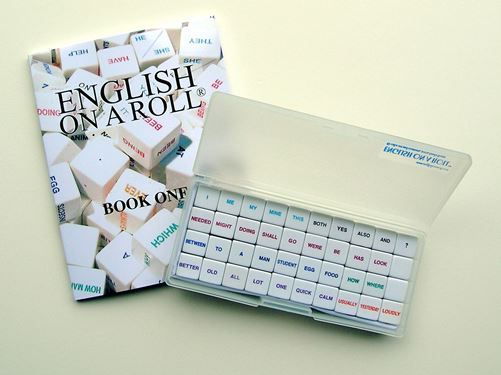
  • 40 durable, solid plastic cubes, 38 of which are engraved with color-coded groups of related words and 2 of which are blank cubes for customizing - These cubes are designed to be used in  by one to six students at a time, ideally, which is great for large homeschool families or small co-op classes.

  • a sturdy plastic container for the cubes -  The cubes fit a bit snugly in the container, which, happily, means you don't have to count them at the end of a lesson to be sure they are all there! It also means that it may be difficult to pluck individual cubes out of their container.  Luckily, the container comes with a tip: close the container, turn it upside down, and open it so that the cubes rest on the lid.  Then it is easy-peasy to pick just the ones you want to use for a particular lesson.

  • blank labels - Two of the cubes, as I mentioned earlier, are blank.  Blank labels allow you to easily customize cubes with additional vocabulary.

  • a 150-page instructor manual - This manual is written to be used by anyone who has a command of the English language, so novice teachers and practiced ones alike can guide students in learning using the cubes.  The manual includes a handy quick-glance cube guide chart as well as easy-to-follow lesson plans for 37 grammar points.  Each of these lessons includes a highlighted box that tells you what you'll need to prep the lesson (which cube to pull out, what reproducibles to copy, etc.), notes for teaching, and what vocabulary is used in the lesson.  Then, there are clear instructions for teaching a targeted concept, engaging in conversation and/or games, and following up with written exercises (that can also be done orally).

Lessons are written for classroom use, but are easily adaptable to a homeschool setting and - wonderfully - contain reproducible materials with copyright permission for a single family or classroom.
How Does
English on a Roll Work? 

Basically,
English on a Roll asks students to manipulate 40 color-coded cubes to build phrases and sentences which target fundamentals of English grammar.  In doing so, each major learning style - tactile, visual, and auditory - comes into play

Because lessons use color-coded dice in game-like activities, tactile learners benefit from the program.  Further, word cubes unlock grammar success for reluctant writers who can "write sentences" by selecting, turning, and lining up cubes instead of always having to laboriously put pen to paper when learning to "write". 

Color-coding of word types on the cubes, as well as simple diagrams on the reproducibles within the 142-page instructor manual, help visual learners.

Auditory learners can benefit from the game-like activities and conversations inherent in the lessons.
English on a Roll, then, simultaneously keys into three main pathways to the brain - tactile, visual, and auditory - in order to help students enjoy and retain learning.

That enjoyment part is big, too! 

Because
activities within English on a Roll lessons have a game-like quality to them, students tend to enjoy learning and be more willing to practice concepts over-and-over.  Such repetition is a significant factor in the acquisition and retention of language - especially for young natural learners of English as a first or second language as well as for struggling learners.

In using
English on a Roll with my children, I have witnessed:
  • improvements in spelling of words on the cubes
  • "ah ha" moments of clarity about grammar concepts
  • increased retention of grammar-specific words 

More important (to me!) than all that, I have also seen my children's brows knit in focus and their faces light up with laughter as we make up games and silly sentences using the cubes.

I have also thought, more than once, what a great tool this would have been for me when I was teaching ESL in Japan for five years, for some of the early lessons, I felt, almost targeted ESL learners more than native speakers - but were still useful for my native English speaking kids - and all lessons would have bee useful for my former ESL students.

Likewise, I have thought about how helpful
English on a Roll would have been when I was tutoring an illiterate adult some years ago.  She enjoyed games, and we often used cut up index cards in our lessons.  I believe she would have welcomed the English on a Roll cubes and the lessons that go with them.  Indeed, I feel they would have helped me to teach her to read and write with greater fun and quicker retention.


What the Children (and I) Thought

From the first day I introduced
English on a Roll  to my children through every subsequent lesson we've used the kit for, one of my children or another has laughed or had an "ah ha" moment.  To me, that is success!

Granted, with some of the first lessons, I initially thought, This concept is way too easy and might bore them.  However, they liked using the engraved dice, so I was able to use the early lessons just to get the children used to the format of the lessons and, for one child, to practice spelling of basic words.

Then, as we progressed, each of my children solidified basic grammar concepts and word spellings.


When I asked each of them for their thoughts for this review, my seven-year-old said:

I don't like that you have to write, but I like making sentences with the dice.  I like rolling the dice and reading the words on them.  I make kind of silly sentences.

He did, enjoy getting silly with the cubes building sentences.  He also managed the actual pencil-to-paper writing - even if he didn't enthusiastically relish it.  The brevity and focus of each written exercise made them "okay" for him.


My ten-year-old struggling learner (pictured above after proudly spelling words from the cubes without looking at the cubes) said:

I like having the dice to roll.  I also like how different types of words are in different colors.  It helps me remember which is which - where they go in sentences.

It's fun when we roll the dice and try to make sentences out of the words. 

The worksheets are okay.  I don't love them, but I don't mind them. I am able to read and spell some words better.

Anything that gets her saying "I like" about English Language Arts and has her saying she could read and spell better is a win for me!


My oldest, at eleven and with attention issues, said:

I like the dice, but I don't like the box they put them in.  It's hard to open. 

I like how the dice are all multi-colored.  I did not know it meant anything at first, but then Mom showed me and I learned the colors showed what each kind of word was.
The dice make it just a different way to do lessons.

For him, routine and structure are necessary, but not always liked.  Novelty, on the other hand, is often devoured.  So, the fresh way of studying using the cubes caught my oldest's attention, while the short, focused structure of lessons kept him learning.

Learn More

My three children with three very different learning abilities, styles, and needs have each benefited from
English on a Roll.  Perhaps your child will, too. 

If you want to "try
English on a Roll before you buy"? You can access a pdf of the first ten chapters of the Book One Instructor's Manual for FREE

If you'd like to see the dice in actions?  Take a peek here:


If you'd like to see many photos of the kit in action as well as to hear how forty Homeschool Review Crew families have been using it, just click
through the banner.


English on a Roll {Reviews}

English on a Roll

You can also find
English Grammar Teaching Method on Facebook.


Do you have a kinesthetic, visual, or auditory learner who could benefit from multi-sensory grammar lessons?  How about a child who enjoys learning through games and short-focused activities with built-in review?  Then, English on a Roll might be for you!


Crew Disclaimer

Friday, August 26, 2016

There Is So Much You Can Do with Can Do Cubes


I love, love, love practical, hands-on tools for literacy and learning and appreciate them even more when they are solidly made with beautiful natural materials. Thus, I was delighted by the opportunity to review Can Do Cubes from jollyliteracy.com (just2ducks LLC).
 
What Comes in a Can Do Cubes Package?


I was thrilled when my Can Do Cubes arrived, and I realized how well packaged the cubes are and just how many helpful goodies came with them.  In one sturdy cardboard box, I found:


  • 1 Tray of 27 Cubes in Stage 1 which present the simple alphabetic code:  These finely polished, laser-engraved, 1-inch wooden blocks contain one spelling for each of the 44 different sounds that make up the English language.  Six number one cubes include the letters t, p, s, n, i, and a.  Three number two contain c, c, ck, e, h, and r.  Three number three contain m, d, g, o, u, and l.  Three number four contain f, b, ai, j, oa, and ie. Three number five cube contain ee, or, z, w, ng, and nk.  Three number six cubes contain v, oo, y, x, ch, and sh. Three number seven cubes contain th, qu, ou, oi, ue, and er,.  And, three number eight cubes contain ar, ve, se, ce, ge, and y.  As children learn the sounds on each numbered set of cubes, they quickly begin reading and writing a growing number of words using a synthetic phonics approach.  (Synthetic phonics is basically learning to decode and encode words using the smallest sounds a word can be broken into.  So, for example: th-a-t as opposed to t-h-a-t and c-oa-t as opposed to c-o-a-t).


  • 1 Tray of 30 Cubes plus 2 cubes connected with a string to represent split digraph sounds in Stage 2 which present the more complex alphabetic code:  These cubes show variations of the 44 different spelling sounds, capital letters, double letters, punctuation, and split digraph cubes.  Twenty blocks containing spelling variations have one sound per block.  (See the middle block a the beginning of the video above to see how that works.) There are also blocks with double letters (ss, ff, mm, ll, rr, zz, ertc.), blocks with the capital letters, punctuation blocks and blocks connected with string to use for split vowel digraphs (a-e, e-e, i-e, o-e, and u-e).
  • Two Handbooks (one for Stage 1 and one for Stage 2):  These small spiral-bound booklets are chock-full of great information, that take parents through how to use Can Do Cubes with those who are not yet reading, those learning the alphabetic code,  and those that are ready for more advanced phonetic learning including vowel phonemes, split digraphs, consonant phonemes, double consonants, capital letters and punctuation.  A wide variety of games and activities are included, as are plenty of examples, which makes using the cubes easy and effective.
  • a DVD with an Interactive Demonstration for Sounding Out Letter/Sounds Presented by Debbie Hepplewhite, who is a synthetic phonics consultant:  This DVD also offers segments demonstrating how to teach using Can Do Cubes, explaining why synthetic phonics work, and more.  Plus, if you pop it into a computer, you can access PDF files of handbooks and charts in case your paper copies get lost or ruined. 


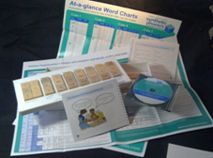
  • Three Wall Charts:  Two are At-a-Glance Word Charts for Stage One cubes which offer new phoneme/words to be presented and show which cubes will be used with each new set of phonemes and one is a Synthetic Phonics Overview Chart, which contains phonemes that are heard, the simple code for the sound, and the complex code graphemes used for that sound.  
  • A CD of the Teacher’s Guide and Template Book:  The CD contains a complete workbook in pdf format with teaching instructions for Phonological Awareness, Phonemic Awareness, the Alphabetic Principle, Blending, Segmenting,Dictation, Handwriting, and High Frequency Words.


Better still, because the box was not too large, I was able to easily carry all the materials from our learning shelves, to other rooms in our home, to blankets outside, to our minivan, and even into waiting areas at appointments, so my children and I could use our Can Do Cubes wherever we happened to be going.  For me - someone for whom "home"schooling may be a misnomer - this was an unexpected bonus. 

Most multi-part, hands-on tools get cumbersome to carry about and keep organized, and, so, they get relegated to home use only.  The fact that Can Do Cubes are packaged so conveniently allowed me to keep them on hand sometimes even when we were out and about this summer.  Hoorah!


How Did We Use Our Cubes?


The beauty of Can Do Cubes is that they can be used in so many ways.  They are designed to be used seamlessly with the Jolly Phonics and Jolly Grammar curriculum that I reviewed the other day, but also can be used equally well as an independent literacy tool or as a complement to almost any phonics program, spelling curriculum, or early literacy efforts.


The first time one of my children and I used our Can Do Cubes, we simply explored them as a stand-alone tool.  I had brought them along with us on a day when one child was at summer camp and another child ended up hurting her leg and, thus, needed to hang with me inside.  So, we pulled up some floor space at a visitor center and simply explored the cubes - reading and spelling simple words with them.
After that, my youngest and middle child sometimes used the cubes in conjunction with Jolly Phonics and Jolly Grammar lessons.  All three of my children and I also used our Can Do Cubes for a variety of games. And, my children used them independently to work on spelling.


All of us appreciated how well-made the blocks are - smooth and sturdy, feeling good in our hands - and how easy they make segmenting and blending sounds.  The video below gives an idea of how this works.


Why I'd Recommend Can Do Cubes


Jolly Phonics and Jolly Grammar Review
 
I truly appreciate the thought that went into designing Can Do Cubes and am excited to continue enjoying them with my children's phonics, spelling, reading, and writing work.  I also know that our Can Do Cubes will be finding their way into my tutoring bag as so many struggling learners that I work with appreciate concrete tools for kinesthetic learning. 

It's amazing how beautifully made synthetic phonics blocks can energize learning.


Can Do Cubes are simple, yet engaging - perfect for tactile learners since the engraved letters can be felt.  They also work well for kinesthetic learners, who will enjoy manipulating the blocks to segment and blend.

Because the cubes are made of polished wood (as opposed to obnoxiously colored plastic), they would work well in Montessori-inspired homeschools and classrooms.  


Because Can Do Cubes focus on synthetic phonics, they are, in my opinion, so much more helpful than typical movable alphabets, magnetic letters, etc.  They can truly help developing readers and spellers unlock improved literacy skills.  I am witnessing that happen in our home as I weave the use of Can Do Cubes in with our other literacy endeavors - and even our catechism ones.  (Note the word in the image above, which was spelled after we had been doing some First Reconciliation and First Holy Communion Prep.  He was so proud of making a four letter word all by himself without anyone giving a suggested word to spell.)


Learn More


Jolly Phonics and Jolly Grammar Review

You can head on over to
jollyliteracy.com (just2ducks LLC) to find loads more information, some helpful Parent and Teacher Resource Freebies, and information about Jolly Phonics and Jolly Grammar, which I reviewed the other day.

You can also find
jollyliteracy.com (just2ducks LLC) on Facebook, Twitter, and Pinterest.


Can Do Cubes

Also, Forty Schoolhouse Review Crew families
were blessed to try Can Do Cubes. Find links to all their reviews by clicking on the banner.

Crew Disclaimer

LinkWithin

Related Posts with Thumbnails