Showing posts with label Pre-Engineering. Show all posts

Thursday, March 21, 2019

Combine STEM and ELA with a Full Year of Design Challenges {A Review}


If you're looking for an easy way to tie STEM and ELA together while offering your children a wide variety of creative problem-solving and design challengesSTEM Activities, Full Year of Challenges with Close Reading by Tied 2 Teaching could be just what you are looking for!

This handy resource - which my children have been tackling challenges from - offers a wide variety of activities to engage students of multiple ages and abilities.

What is STEM Activities, Full Year of Challenges with Close Reading?


STEM Activities, Full Year of Challenges with Close Reading is bundle of 70+ STEM challenges which dovetail purposefully with close reading activities and allow children to work literacy skills along with science, technology, engineering, and math ones.

The resource is designed for children at a grades 3-6 level, and, after using it, I would say that it hit the mark with the close reading activities but that the actual STEM challenges could easily adapt to a wider age range.

The challenge files, when I unzipped and downloaded them, showed up in an alphabetical order; however, they can also be grouped by month in order to correspond to holidays and seasonal themes.


  • 100th Day of School STEM Challenge – SPAGHETTI TOWER Design Challenge
  • Marshmallow Snowman Challenge
  • CIVIL RIGHTS MONUMENT Design Challenge
  • Sled Design Challenge
  • Valentines Day STEM Challenge – Cupid’s Bow Design
  • Groundhog Day STEM Challenge – Groundhog Burrow Design Challenge
  • Valentines STEM Challenge – Love Bug Design Challenge
  • Presidents Day STEM Challenge – Lincoln’s Cabin Challenge
  • St. Patrick’s Day STEM Challenge – Build a Leprechaun Trap
  • Basketball Tower STEM Challenge
  • St. Patrick’s Day STEM Challenge – Build a Rainbow Bridge
  • New Hat for Cat Challenge Read Across America STEM
  • Jelly Bean Tower Challenge
  • Easter STEM Challenge Design a Carrot Carriage
  • Earth Day STEM Challenge – Design Something Useful
  • Earth Day STEM Challenge – Upcycled Birdhouse
  • Design a New Droid
  • Paper Airplane Design Challenge
  • Pipe Cleaner Challenge
  • Lighthouse Design Challenge
  • Foil Boat Design Challenge
  • Giant Pyramid Challenge
  • Steamboat Design Challenge
  • Zip Line Design Activity
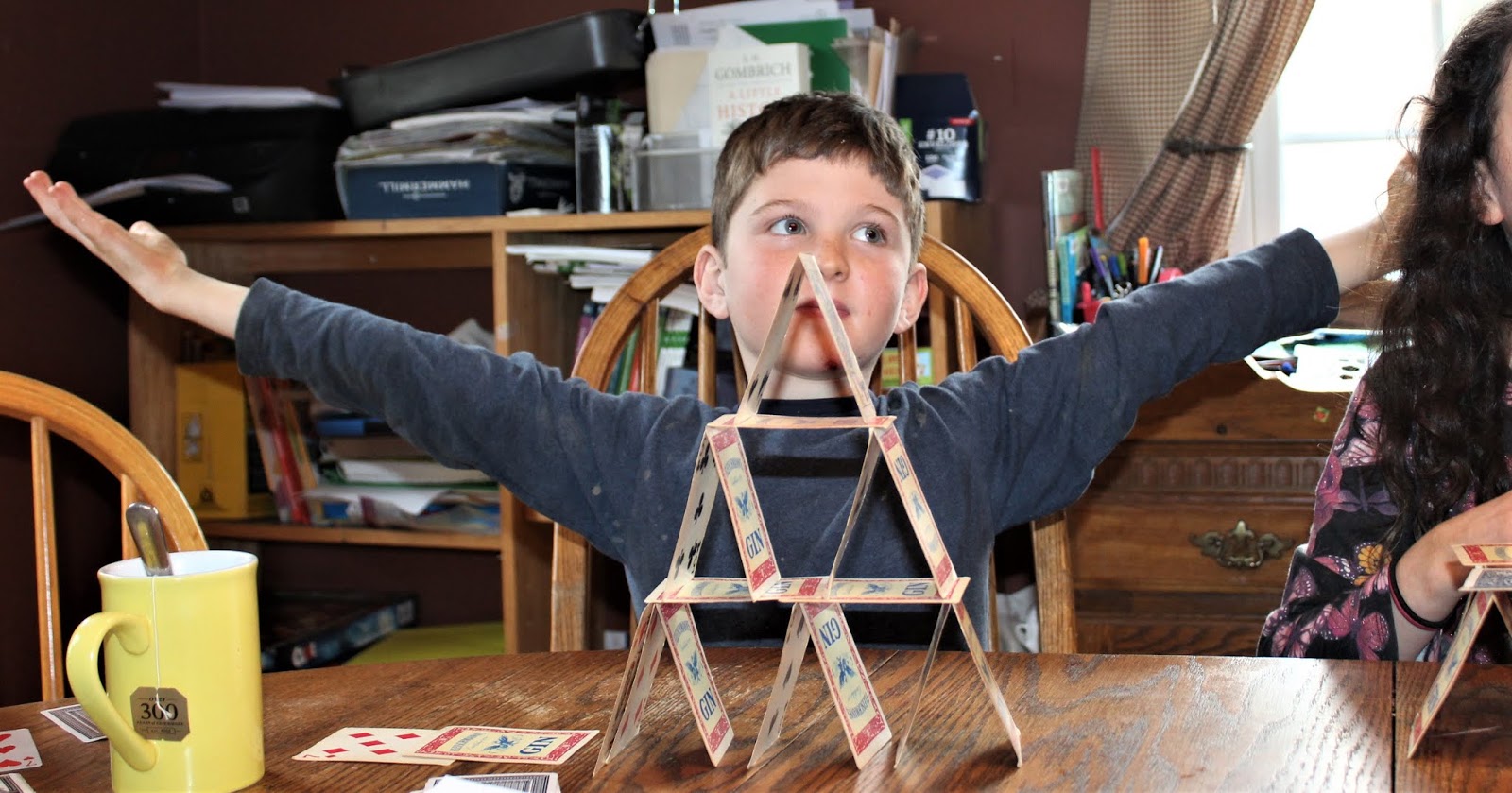
  • House of Cards Challenge
  • Doghouse Design Challenge
  • Alien Spacecraft Challenge
  • Airplane Design Challenge
  • Building Block Tower Challenge
  • Index Card Skyscraper Challenge
  • Paper Table Challenge
    BONUS Building Block Challenge MEGA PACK
  • Apple Boat Challenge
  • Pencil Tower Challenge
  • Totem Pole Challenge
  • Balloon Tower Challenge
  • Spider Web Design Challenge
  • Witch’s Parachute Halloween STEM Challenge
  • Sugar Cube Arch Challenge
  • Parade Balloon Challenge
  • Thanksgiving Table Challenge
  • Cranberry Tower Challenge
  •  Pilgrim Shelter Challenge
  • Cardboard Reindeer Challenge
  • Funky Christmas Ornament Challenge
  • Straw Christmas Tree Challenge
  • Christmas Tree Tower

ADDITIONAL STEM CHALLENGES

These groupings can make for fun calendar tie-ins. However, since  each challenge stands alone and the skills and knowledge explored in one do not consecutively build into the next, you can really approach the challenges in any order you wish. 

This is what we did - pulling challenges out based on interest, the supplies we had on hand, etc.


Does It Require a Ton of Supplies?


Because this resource is purchased online and delivered as a compressed zip file, you will, of course, need a computer to purchase, download, and save your bundle.

Then, you will also need a computer to read the challenges themselves along with the passages on Wonderopolis that are used for close reading.

If you prefer not to have your child onscreen, however, you can print out the Wonderopolis texts and select pages from the pdf challenge packets to print out, too. 


In each packet, there are about 18-20 pages, on average, but you need not print every page out. Rather, you can pick which of the differentiated pages will best suit your child and, then, print just those.

Besides a computer and printer, you will need different supplies for each different challenge, but, most of these things are things you'd already have around the house - tinfoil, playing cards, pennies, pencils, paper, books, recyclables, etc. - or things you can easily and inexpensively purchase - balloons, marshmallows, etc.

Some challenges do require a relatively more expensive item - plastic building bricks - but many homeschoolers have these, so, if you don't, you could always ask to borrow some, or you could purchase a knock off brand or the main brand secondhand. (Or, skip the challenges or use an alternate item to do an inspired challenge.)

Really, the supplies are not burdensome at all and, because the challenges promote creative problem-solving, in my opinion, if you don't have a specific suggested supply item, you can just swap out something else.


What Was It Like to Use?

We received STEM Activities, Full Year of Challenges with Close Reading as a link to download a compressed ZIP file or PDF files of each of the STEM challenge activities.


Inside each individual challenge activity file, we found a title and link to an online reading passage (with a QR link, too, but we don't know how to use those.)


That title/link took us to a page on a site called Wonderopolis where we could read more about the subject of the challenge. (The reading passage could also be printed from the Wonderopolis site, but we chose to read from the screen.)


Within the file there was also a printable with questions pertaining to the Wonderopolis article, which, with the first two challenges we did, I encouraged my children to complete. In doing so, I noted two things:

  1. The close reading questions were varied and well written - with some that just pointed toward direct comprehension and some that required a bit more thinking (depending on a child's level).
  2. Worksheets like this are NOT my children's style, but are still a good exercise for them every once in a while, and, I know, would be just up the alley of some other children I know.


So, with these things in mind, even though part of the initial appeal of this resource for me was the way it marries ELA and STEM skills, I decided, for the sake of sanity and interest level in my home, to forego "requiring" the Wonderopolis passages and close reading worksheets after the first two challenges we did, but am still happy to have them as they can inspire discussion and also be cycled back into life and learning at another time.


Then, after completing the close reading pages during our first two challenges, we read the challenge pages and picked at least one design challenge printable for each child to fill out.  


Unfortunately, we chose the house of cards challenge for our first challenge, but I did not realize our cards were simply too laminated and new for the houses to be built with ease.


That made for some frustrating challenge time - but also got creative thinking flowing.

The frustration with slippery cards then led to less than best attitudes with filling out the design challenge forms.


Oops!  Mama fail!  Seriously, MAMA's - not the products. The actual challenge was well written and could be fun!


How do I know?


On another day, my daughter asked if she could challenge friends to an impromptu redo of one of the challenges we'd done at home, and, when she described them to a friend's mom, that mom got some older playing cards out and the kids went to town.


Hoorah!  


Victory!


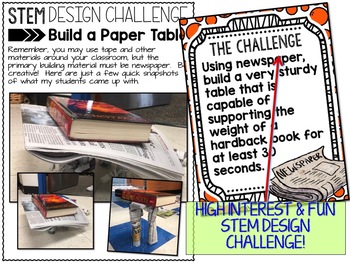
The second challenge we chose was to make a table out of newspaper.  However, since I had no newspaper on hand, we just used recycled paper.


Again, my children were not as interested in the reading or the filling out of worksheets as some other children might be - although I still asked them to do so to honor our review commitment - but they did enjoy the challenge.


Some of them tried to make tall tables:


Other shorter ones:


And one super short one:


But strong, too!


In fact, my daughter then decided to extend the activity to see how many books she could stack on her table before the table completely folded in, allowing a book to touch the real table beneath.


I love when natural inquiry flows like this!

And, with that in mind, I decided to let natural inquiry take over for future challenges.  

Instead of me requiring reading, writing, etc., I am opting to let my children browse the challenge files themselves and to explore as they will with them from there.

That's what happened with the tinfoil boat and penny challenge!
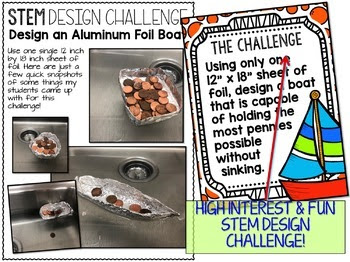


One son saw a picture of the challenge and asked if he could do it - right then and there. 


Then, another child asked to join in.


Both had fun and kept exploring!


Later, my children asked if we could try more challenges with friends - competing with them in a friendly way.  Of course, I said we can look into it, but, I also explained that we cannot share the actual bundle we have due to permissions.  We can certainly recommend it to others, though!

Do We Recommend It?


STEM Activities, Full Year of Challenges with Close Reading by Tied 2 Teaching is a well-thought and presented resource that adapts easily for different ages, abilities, and interests while encouraging children to get hands and minds busy with STEM and ELA.

As written, it would be ideal for students who use a traditional approach to learning - with readings and worksheets - but who also benefit from breaking outside the typical box to do some hands-on creative problem solving.

It also can work well for more interest-led or relaxed learning styles - like those in my home.


Besides the physical supplies for each challenge (like tinfoil, pennies, balloons, etc.) everything you need for each reading, writing, thinking, doing, AND reflecting lesson is right there - printable or accessible on computer - so you do not need to do any planning or prep beyond picking a challenge, gathering supplies, and printing whatever pages you wish to.


Also, as I already noted, the challenges are designed to align with specific holidays and seasons, so there are easy tie-ins built in - or, like us, you can pick challenges based on interest or what supplies you have at home.


Within the challenge files there are photos for the creations other children have made, too, so you will have ideas to work from or can show your children the ideas if they get stuck or want to compare their own ideas with someone else's.


So, with this resource, you "get it all" I'd say:


  • specific, well-designed curricula for those that like that
  • flexibility for those that like to pick, choose, and adapt
  • STEM and ELA focus
  • "book" (or rather computer, printable, and pencil) learning opps
  • experiential/hands-on learning opps
  • the ability to use and re-use materials at your child's different ages and stages
  • creativity, fun, and inspiration

With all this in mind, I wholeheartedly recommend STEM Activities, Full Year of Challenges with Close Reading by Tied 2 Teaching to anyone who wants a clearly designed, easy to use set of design challenges to inspire fun and learning!


Learn More


I was looking at the STEM Activities, Full Year of Challenges with Close Reading page when preparing for writing this review and noticed the bundle is currently half off, so if you are thinking about purchasing it, now is the time!


You can connect with 
Tied 2 Teaching at:


Find the reviews.


Would you like to see a larger sampling of the challenges offered?  Take a peak at reviews from 70 Homeschool Review Crew families.

Crew Disclaimer

Thursday, April 6, 2017

When My Son's "Problem" Becomes Your FREE Printable Lego Mini-Challenge Cards

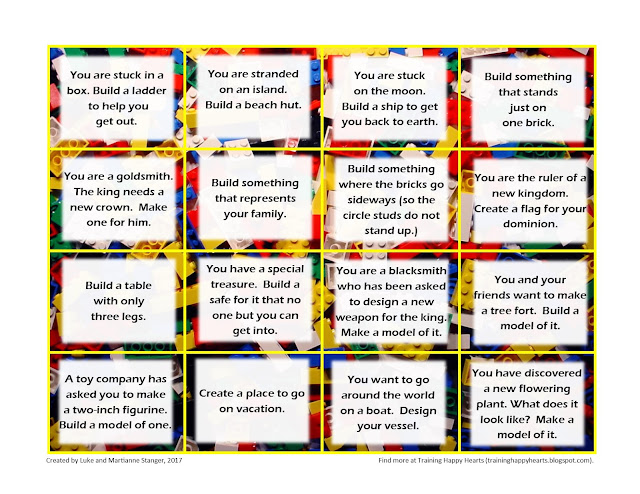
Do you have eager brick builders in your home that enjoy making Lego creations?  Then, you make like the FREE printable Lego Mini-Challenge Cards the my son came up with for a Show-n-Tell Brick Builders course that he's helping me teach at a local co-op. 


Some of my son's mini-challenge ideas are quite simple, such as:


Build a bridge.


Others are more complicated, such as:


You are a goldsmith.  The king needs a new crown.  Make one for him.


All are aimed at getting a child's brain thinking and hands building right away.

My son and I hope you enjoy these Mini-Challenge Cards. We also hope that, if you have a moment, you'll read on to discover the "problems" which prompted the cards, and, if you like, leave a comment for their main creator - my oldest son - who would love to hear what you think about his work.

How Our Co-op Planning Challenges Led to Mini-Challenge Cards


Two weeks ago,
as a part of a commitment to help me plan, prepare for, and teach two spring co-op classes, my son finished making some Mini-Challenge Cards with the help of his sister's laminating and cutting efforts.

Although the cards are simple, the road to their creation had a few bumps, which required problem solving and a growing
repertoire of skills.
The problem solving began months ago, when I was coordinating our spring co-op, looked at the registration list, and realized:


Uh oh. My boy is not going to be happy.  He is the only boy even close to his age signed up and, so far, there's it not a single classes that would be even remotely interesting to him.

As co-coordinator for our local spring co-op, I had to think quickly about solutions for this potential problem, and since positive problem solving is something I've been working on with my oldest son, I decided to enlist his help.

"Son," I began while we were on a walk by ourselves one evening.  "I know you love co-op..."

"Yes..." my son prompted me to go on.

"Well, I have some good news and some bad news about the spring."

"What?"

"Co-op is going to run again, but your closest friends won't be able to come, and you'll be the only boy your age."

"I thought that might happen," my son responded.  He knew that two of his closest friends are now involved with an all-year academic co-op and another boy his age had had to drop out of our enrichment-based co-op in the fall. 

After a sigh, my son went on.  "No kids my age... What classes are being offered?"

In response, I began listing different parent names and the classes that they had suggested so far. With each course title I spoke, I could see my son's shoulders slumping further and his walking pace slowing. 

As I expected, none of the courses other parents were planning to teach sparked any interest in my son.  Still hopeful, I asked, "So, what do you think?  Would you like to take any of these?"

A dejected, "no" was my son's response, followed by a brighter, "Could I teach a class instead?"

A smile played at the corners of my mouth, since I had had this very idea myself.  "Perhaps, Son.  I think you could, but you're not that much older than the other children.  Do you think that you teaching a class by yourself would work?"

"Yes!"

"Really?"

"Well, I could help teach."

"That could work."  I smiled. "Is there a class you'd like to assist with?"

"None of the ones you already said," my son responded.

"Well, then, we have to think of some solutions," I suggested.

No reply came from my son, so, after a stretch of silent walking, I said, "If you do not want to help with any of the classes that others are teaching and you don't want to take any, what should we do?"

Footsteps continued to fall.

"As I see it, we have three choices at this point.  We could find something you want to teach.  I could teach a class you want to take.  Or, we could bow out of co-op this spring and pick up with some other things we've been wanting and needing to do."  (In all honesty, I had one other choice in mind, but I wasn't about to speak it yet.)

My son then weighed each of the ideas I had offered, immediately nixing the last one after saying he would not want to spoil things for his younger siblings by being the reason we took a break from co-op.  He knows they like it and wants to them to continue enjoying it.  He commented further that I do a lot for co-op and that he would not want to take my help away from the group by requesting that our family no longer participate. 

"But, I really don't like any of the classes, Mom."  He continued walking. 

Half-teasing, I then suggested, "Oh, I have another idea, you could bring some things to do and use co-op time as a study hall..."

We both laughed at this idea.  Quiet study?  During co-op time?  Seriously?  That would not be my son's style.

Negative pensiveness broken by laughter, my son smiled again.  "What are you teaching, Mom.  Maybe I could teach some different classes with you?" 

Exactly.  I thought. "Sure, Son.  That could work.  Why don't you tell me what you'd like to co-teach with me and I'll ask the other coordinator if she thinks it would be okay for you to be my assistant..."

And so it was that my oldest son invested in the idea of being my Junior Assistant for both a Show-n-Tell Brick Builders course and a Knights in Training one this spring. 

Over the past couple months, my son took his commitment seriously, and, from late winter until just two weeks ago, he busied himself reading and researching about Lego builds and knights in order to help me to plan and prepare materials for both courses. 

As a part of that process, my son made the Mini-Challenge cards so that children who might finish up with the main challenges he came up with for each week's Brick Builder lesson
could remain actively engaged in class-related activities until every child in the class was ready to present their creations.  

To make the cards, my son helped me choose a background and design a simple layout.  Then, he ordered a tall stack of Lego books from the library and perused different things online in order research and brainstorm ideas for the cards.  Finally, he took turns typing his ideas out on his own or dictating them to me for me to type, making 48 challenges in all.

https://drive.google.com/file/d/0B6Lk1nwk2KPdSlJJTnNoVXJtSFU/view?usp=sharing

This process was not difficult, but it did require focus and sustained effort, which are both things my son and I are constantly working on for him.  So, I was delighted to see how our Mini-Challenge Cards project unfolded with him working hard and growing his repertoire of computer skills.

I am equally happy to say, that our first two Brick Builder and Knights classes went GREAT!  I could not been more pleased with how well my son did in planning, preparing, and teaching each class with me so far. 

We've been getting positive feedback from students and parents about both classes, and my
son is so excited about how his efforts are paying off that he has already begun asking when he'll be old enough to teach a class all by himself, or with me as his assistant.  I told him, "In time, Son, in time.  Let's just enjoy what we are doing right now, and we'll talk about that later."

And that is what we are doing - enjoying the present, which includes brick building fun and sharing my son's ideas with you in hopes that you and yours might also enjoy meeting mini-challenges with success!


We'd love to see the Lego builds you create using these cards.  Pop on over to our Facebook page to upload a picture or tag us in a comment on a picture you upload elsewhere.  My son will be so excited to see your creations!

Wednesday, November 14, 2012

TV-Free Time as the Mother of Invention

As I was looking through the pictures that I just uploaded from our camera onto our computer, I could not resist sharing three that I had forgotten that I’d even taken last week:

Look at Nina’s feet in this one.  Do you know what she is doing?


She’s testing out Duplo roller skates, which she conceptualized and built all on her own.


Jack then took Nina’s model as inspiration and tweaked her ideas into something designed for a completely different purpose – a jump toy.  With pride, he moved his self-created toy about the living room and tried leaping over and around it at different angles.


Both children initiated their own learning.  They immersed themselves in inventiveness and purposeful activity, and then called out to Mike and me with glee to come and see what they had created. 

Wow.

Their ingenuity makes me pause to recognize an eternal truth – humans are made to create.  It is natural and instinctive for us to do so.  Our Creator has endowed each of us with an amazing sense of resourcefulness and imagination. 

In our family, the fruit of that gift is often best enjoyed in a screen-free environment.  I have written before about how media and our eldest boy’s mind don’t mix (or mix too well, depending on how you look at it), how we have become a relatively tv-free family, and, consequently, how we sometimes spend evenings when other typical families might be watching television doing things like magnet painting and playing impromptu self-made family games.  What I have not shared is what we do on most of our “free” evenings.  That is, let the kids create.

Drawing.  Designing.  Imaginary play.  Forts.  Playdough models.  Parades.  Mock political rallies.  You name it, our kids create it.  And, I love it! 

Daily, I am impressed with the ingenuity that all three of Mike and my children evidence.  Moreover, I am amazed with how freely they move between what is and what could be.  With the heart, eyes and hands of childhood they care not for where imagination ends and reality begins.  Rather, they let imagination guide their inventiveness.  And, oh the things they invent.

As I reflect upon Duplo skates and jumping toys, I give thanks for the circumstances that led Mike and I to choose to be a mostly TV-free home and the inventiveness which we have witnessed as a result.

At the same time, I wonder when I lost the ability to move as easily as my children from conceptualization to creation.  What is that hampers me – and so many other adults – from consistently using the gifts that we have been given?  How can free ourselves from habits that confine our vision and impede the realization of what could be?  Is there a lesson that our children can teach us about how exercise our creativity daily?

I think so, and I am open to learning.

Sunday, June 24, 2012

The Plant Sitter and the Garden of Eden: Another Read Aloud to Real Challenges Lesson

As summer blooms add color to our yard, I am reminded of the fourth lesson I facilitated in the Read Aloud to Real Challenges Course that I created for a homeschool co-op a little over a year ago.   The flowers that the children fashioned in that class (as well as the ones my own children made when I repeated the same class for them at home) were as colorful as the perennial garden patch in our yard now is.  The attention and creativity with which they created their flowers was equally as beautiful.

Two ways I continually try to train up my children with happy hearts are to:

  1. honor and encourage their creative genius.
  2. relate how their creativity is borne of our creator’s genius

The lesson I centered on The Plant Sitter and the Garden of Eden aimed to do just that.

Materials and Tools Needed
  • a copy of The Plant Sitter by Gene Zion (I believe this book is out of print.  We got our copy from the library and were thrilled with it.  If you cannot secure a used or librarycopy of the book, you could use a book on the same theme, such as Planting a Rainbow by Lois Elhert.)
  • blue paper
  • scissors
  • yarn
  • pipe cleaners
  • construction paper
  • recycled plastic lids
  • tape
  • styrofoam trays
  • leftover “great stuff” from other craft and challenge times
  • hole punch
  • stapler and staples
  • white boards and dry erase markers or scratch paper and writing tools
  • a picture book or painting with the Garden of Eden for inspiration

Welcoming Prayer and Stretch

The same as in Lesson Three.

Warm-Up Challenge: April Showers Bring May Flowers


To set up the challenge, bring out a pile of blue paper pre-cut into rain drop shapes, cut shapes as you chat with students and present the challenge, or challenge students to cut some rain drop shapes.  In the spring, ask what April showers bring:  May flowers.  Or, at this time of year, ask what thunderstorms help: plants and flowers.  Finally, challenge students to create as many bloom/flower shapes as possible within five minutes using only the raindrop shaped pieces of paper (and, perhaps, some pipe cleaners.)

As tempting as it may be to guide, model or help students make blooms, be sure to honor each child’s creativity by staying quiet during the pause that may occur as students solve the problems involved with this mini-challenge in their heads.  If a child gets “stuck” and seems “too” frustrated, simply ask some questions as guidance:  Can you name any flowers?  How many petals do you notice in such a flower?  What shapes do the petals make? Etc.

Read Aloud: The Plant Sitter


Ask children if they can guess what today’s story might be about.  Then, show the cover of The Plant Sitter.  Take a picture walk through the story’s rich illustrations and ask children to predict what they think the story might be about or ask questions that the text might answer.

Read The Plant Sitter, asking individual children to help read any text that they may be capable of and taking time to stop to really notice the details within the pictures and to make connections and predictions about the story as you go.  Be sure to identify what the problems in the story are and what the boy does to solve them. 
Ask children how the boy applied the strategy for solving problems that we have used for the past few weeks. How did he identify his problems, come up with plans for solving them, test his ideas and, if necessary, adapt his approaches?

For a richer experience, also discuss themes and values related the book—responsibility, hard work, ingenuity, the value of research, etc. Maybe even liken the way the plants grew and grew in the story to the miracle of the loaves and fishes.  Isn’t it amazing the way when one child offers meager gifts and talents, plenty can be creates?

The Main Challenge: Creating A Model of the Garden of Eden

Planning the Designs
Note that in the story we read, there were lots of growing things.  If it is winter or spring, mention that as the weather warms, many folks plan and build gardens.  If it is summer, talk about all the growing things outside.  If it is autumn, discus which plants are still growing and which are dying off for the winter.  Ask who can name the parts of a plant (roots, stem, leaves, petals, seeds).  Then ask if children can think of a Bible Story about a very special garden?


Present the day’s main challenge and its guidelines:

  • We will build a model of our own imaginary Garden of Eden.
  • It should be a rainbow of colors and contain plants in all shapes and sizes.
  • Each plant must have all its parts (stem, leaves, petals, seeds, roots).
  • Each planet must be freestanding.
  • Each plant must be made from materials provided, using  the tools provided (which may not actually become part of the construction).
Creating and Testing Designs
To encourage students to plan their model plants out first (as well as to avoid a free-for-all with materials), let them know they must use white boards and markers (or scrap paper and writing utensils) to brainstorm.  Once they have sketched their ideas and/or listed the materials they would like to use to test out their designs, they may collect materials that their plans specifically require.
Once children begin using their requested materials, if they discover they need other materials, offer them freely, but ask them what each new material might be used for.  As always, encourage children to look critically at any problems they may run into with their designs and to helps each other discover ways to overcome these or to revise their plans.
Challenge Complete!
Finally, of course, have students put their plants together to form a garden!
Notes

  • If you wish to add another parameter to the challenge, consider bringing one-inch cubes.  Suggest that plants may stand no taller than 12 stacked cubes and no shorter than three.
  • If any students finish early, simply extend the challenge by asking them to create more plants.  Or, add related challenges, such as a suggestion to creatures that could be found in the garden.
  • Inspiration for this lesson plan came from Planting a Rainbow at Children’s Engineering Educators, LLC.
  • If you happen to use ideas from this plan for your own home or classroom, please point folks back to this post (or series), and, also, be sure to stop by again with a comment to let me know how it went.  I always enjoy hearing how others adapt my lesson plans and collaborating to improve them for future use.
Want more?

Check out:

·         Lesson One, when Albert’s Alphabet inspired us to build self-standing letters in honor of the Holy Spirit

·         Lesson Two, when My Friend Rabbit had us building towers to point to God.

·         Lesson Three when Mr. Bear’s Chair encouraged us to build our own Sabbath chair models.


LinkWithin

Related Posts with Thumbnails