Showing posts with label Speech. Show all posts

Friday, June 14, 2019

Study High School Speech Independently {A Hewitt Homeschooling Resources Review}


When we were offered a chance to review one of many helpful offerings from Hewitt Homeschooling Resources, I brought the choice to my 13-year-old son: Would you like to do this review, and, if so, which product would you most like? 



With little hesitation, my succinct son said, "Yes. The Speech one."


I had a feeling that would be my son's answer, since, (a) he joined a Speech and Debate club this year and wants to excel at it next year; (b) he has recently been determined to hasten his education by beginning his high school studies early; and (c) he wants more independent studies

So far, he's been happy with his choice.

As soon as our copy of Lightning Lit & Comp 
Speech came in, my son slowly began to pace himself through it, and, the other day, narrated a review of the program as follows.


Recently, I decided to get Lightning Lit & Comp Speech.


I wanted this curriculum for a few reasons: 


  1. I am going into highschool and need high school credits 
  2. I need to learn speech as I am in a speech and debate club. 


 For this review, we received physical copies of Lightning Lit & Comp, Speech Student's Guide and Lightning Literature & Composition Teacher's Guide to the Second Edition of Speech.


We also needed to get Lend Me Your Ears Great Speeches in History by William Safire from our library. 

This book is a necessary part of the curriculum, which uses speeches from the book to teach different speech writing skills.

In the curriculum, there are four units. Each unit has two lessons.

Each lesson follows this basic pattern:


  •  Read specific speeches. 
  • Answer comprehension questions about those speeches.
  • Read about how to write speeches drawing from the speeches you read earlier in the lesson.
  • Complete a choice from given writing exercises. 

Lessons focus on such things as  speech openings, content, research and factual arguments, organization, word choice and style, and more.


In the book, there are suggested schedules for completing the curriculum over the course of a full year or a single semester. At first, I didn’t notice these and I nearly made myself do extra writing exercises. Then, my mom pointed them out to me, I fixed my mistake, and I am now progressing through the semester plan.

The student guide is a 145 page softcover book with an Introduction that tells you how to use the guide. Then, there are the four units followed by appendixes that offer discussion questions, additional reading, and schedules. 


The Teacher Guide is a stapled, 3-holed punch pile of 59 pages. Helpful features in it include grading tips, schedules, answers to the comprehension questions and checklists for writing. 


So far, I have liked two of the speeches in this curriculum: Vice President Spiro Agnew Castigates the Media (which had content I totally agreed with) and General Douglas MacArthur Reminds West oint Cadets of Duty, Honor, Country because I was a powerful speech with a lot of meaning in it. It was moving and inspiring, but not complicated.

The curriculum helps me to write better by giving me multiple examples of powerful speeches, even though some of the people’s perspectives are opposite to mine. So far, I have worked on Openings and Content, learning such things as how to use humor and “bad news and good news”.


I would recommend this curriculum to those who want to earn high school credits and read impressive speeches. I think it is a great tool for those who need to learn speech writing skills and want to earn high school credits with an easy-to-follow independent study.

Back to Mom:

I, too, think it is a well-written curriculum.  I appreciate how it uses real speeches from history that are collated in one volume and helps students study examples of strong Openings, Content, Research and Factual Arguments, Organization, Audience considerations, Words and Sentences, Rhetorical Styles, and Conclusions.

I also like that the curriculum ties in practical speech skills such as looking your best, sounding your best, and using visual aids, asking students to write and give their own speeches.

Further, I love how easy Lightning & Lit Comp Speech makes it for motivated students to progress with independent study while Mom or another mentor or teacher check in using tools such as Checklists, Grading Templates, and Answers to Comprehension Questions.

The curriculum also, of course, could be used for 1:1 study time, large group, or classroom study. It even has Discussion Questions to aid with such partner and group studies.

I would recommend the curriculum to any high school student interested in learning more about Speech - both by reading quality speech examples and also by writing and delivering your own speeches.

My son, although young for the curriculum, is stretching his skills with it, and, I believe, will be a more adept Speech and Debate club member next year due to his Lightning Lit & Comp Speech studies.


Homeschool Review Crew Families had the option of reviewing one of 19 different helpful resources from Hewitt Homeschooling Resources.  Read all the reviews.


CONNECT WITH HEWITT PUBLISHING ON SOCIAL MEDIA:


Thursday, April 13, 2017

Who Couldn't Use a Little Help with the Art of Conversation?

I have been delighted to review Color My Conversation by Northern Speech Services over the past six weeks and am looking forward to completing this speech therapy / conversation coaching program with my children and, also, to incorporating learning from it into other activities we are involved in.


Now, when you hear "speech therapy", you may think, My child doesn't need speech therapy, and you may be right.  Many children do not need therapy.  However, in my opinion, all children can benefit from conversation coaching, and
Color My Conversation (CMC) offers a structured and effective way to approach such coaching.

CMC in a Nutshell


 CMC is geared to be used by SLPs, educators, special educators, and others - like home educating parents! -  who work with children at a K-7th grade level that struggle with conversation skills, including children with:
  • ADHD
  • articulation challenges
  • Asperger syndrome
  • fluency challenges
  • high-functioning autism
  • language delays
  • LLD
  • mild intellectual disabilities

The program can also be helpful for children with no formal challenges nor diagnosis who could just use an extra boost in social skills.


Parents can easily use CMC acting as a conversation coach.  To do so, you:

  • watch about 10 minutes worth of online introductory training videos when first beginning the program.
  • complete a lesson once a week for about 45 minutes or twice a week for about 30 minutes with your children after watching reading the lesson plan and printing what you like (sample found here) and watching a 2-10 minute training video for the lesson, like this one:
  • complete "at-home" (or, really, sometimes, out-and-about) practices during the week.


The program is designed to take 14-16 weeks, but could be stretched out as an entire year course, or, could be abbreviated with you pulling from particular lessons as different coaching needs become apparent.

Indeed, the author of CMC,
Rosslyn Delmonico, MA, RSLP, CCC-SLP, has laid out the program so logically and well, that, while lessons definitely build on another in consecutive way, you can easily navigate ahead in order to pull particular points forward when a proverbial iron is hot. You can hear her talk a bit more about the program here:


Truly, when you first open your CCC box of materials and start watching the training videos, you can see how Rosslyn distilled her 35+ years of professional experience into a a program that that is straightfoward to implement, yet engaging for a student of a variety of ages and skills.  Using movement, color, song, hands-on learning, and role play, CCC offers learners a multi-sensory approach to succeeding with social language from the most basic face-to-face greetings to more complex conversations.   


Each lesson:
  • inspires learners to come up with ideas through brainstorming.
  • offers learners knowledge through the presentation of social rules.
  • builds relationships and fun through role plays.
  • ignites independent learning and success through practice suggestions and project development.

Taken together, CMC lessons act as a tool to help individual children meet with conversation success.  


We used CMC "as directed" here over the past six weeks, and I am already seeing fruit from it.  My shy child is taking new interest in conversation - and, though, still my most reticent with acquaintances and strangers, has been amusing me random comments and observations since we started using CMC:
  • "Mom, that was a yellow conversation."  
  • "Oh, Mom, you were supposed to have a short conversation - chit chat - not a loooong conversation."
  • "Mom, I think they forgot their red or yellow stone."  

Hearing my daughter make such comments on the conversations she listens to and takes part in makes me smile.  She is obviously synthesizing what she's been learning and taking new notice of social language.  

What Is Included?

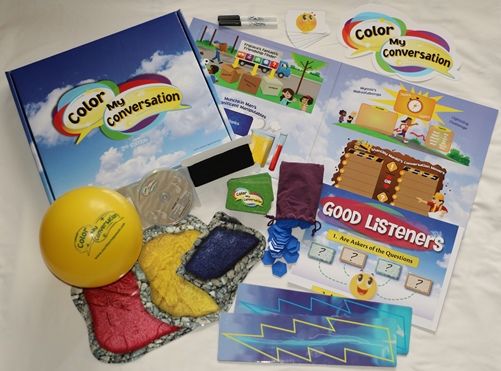
CMC comes as a kit with a link for accessing helpful online training videos. 


Northern Speech Services Color My Conversation


Within the sturdy 14"x16" CMC Kit Box are:

  • 12 color-coded "Conversation Path" Stepping Floor Graphics with no-slip backings and dry-erase fronts
  • 100 Topic Prompt Picture/Emotion Cards
  • 50 Game Tokens
  • 50 Dry Erasable Wall Display Cards
  • 2 Dry Erase Pens
  • Cloth Ribbon (approx. 9.5ft)
  • Game Board (foldable) with 4 Activities on the back
  • a CMC Ball which requires a pump to inflate
  • a Classroom Poster
  • an Instructional Manual on CD
  • 12 CMC Songs on CD
  • Additional Reproducible Worksheets & Activities 

Online are the training videos I mentioned earlier.

In order to use the program, you need nothing else besides a printer, paper, and ink or any worksheets and lessons plans you might want to print out.


What Do the Kids (and I) Think? 


When I asked my children what they thought of CMC, my oldest child (eleven) said:

I like how they used stones that could all fit together to depict conversation. It helped me think about how to walk through a conversation.  I did not like the songs.

My oldest also struggled, at times, with eye contact, which has always been difficult for him, but it is improving.  Also, I think the concrete, color-coded stones helped him to realize how he often jumps into conversation "in the middle", forgetting to bookend them with the niceties of "yellow conversation" hello's and goodbyes.  So, there has been fruit to using CMC with him so far, and I expect there will be more as we get to advanced and expert levels of the program.

My youngest child (six) said:


I liked how the stones were like a puzzle, and I liked the thing where you tossed the balls back and forth to have a conversation.

I thought it was funny that my youngest mentioned the stones fitting together, too.  In all honesty, I did not even realize the stones were shaped in such a way that they could get squished all together into a loose fitting "puzzle path" until my children pointed it out, and, for some reason, that little "cool" thing left an impression on my children.  (Hey, whatever gets them engaged, right?)


Also, it is not a typo that I wrote "balls".  A blow-up ball comes with the kit, but my youngest liked using other balls, too - his football, small balls we have.  So, we went with that.


My youngest was not even in earshot when my oldest offered his comments about CMC, so I know he was not just parenting Big Brother.  They were both genuinely impressed by he design of the stones, and, thus, I was pleased with the quality of materials in the kit.


Then, there is my middle child (nine), who was the biggest fan among my children of CMC.  When I asked her about the program, she said:

I liked Color My Conversation in general.  I especially liked the songs.  Although they are meant for younger kids, I still liked them, because they are kind of catchy and tell you what the conversations are.

(And, yes, to her non-song-loving Big Brother's chagrin, she has been singing and humming the CMC songs about the house at times.)

I really liked the conversation stones.  They are so cool that they are erasable and that they connect.
(Kudos on that stone design, CMC.  That's 3 for 3 here.  A true win!)


I also liked tossing the ball back and forth to have a conversation. 

(It baffles me why two of my children commented on this.  We've ball tossed and done talking sticks before.  It is not a new concept.  But there was something about the stones, ball, and program all together, that appealed to my children.)
 
It was fun to have conversations, but it was sometimes hard when I was having them to keep on track with the stones.  It felt a little bit strange to say "Hello," and, then, wait for the other person before saying more.  It is also really hard to say the "bye" part.  For example, you might say, "Oh, I have to run now," which means "bye" in my mind, but not in the other person's.  They might need "bye".  I combine things like that in my mind.

(The program teaches formulaic conversations at its beginning, which don't allows flow the way my children naturally converse.  At first, I wasn't sure I liked this, but, then, I realized that the "formulas", taught using son, stones, balls, and movement, got my children thinking more and more about HOW they converse and what niceties, expressions, styles, and conversation types might be most appropriate given different situation.  At that point, I decided I quite liked the "formulas" as a starting point.)

It was fun to dance to the songs. 

I really enjoyed Color My Conservations and I think I want to do it as a co-op class if it's possible.

I was surprised when my daughter requested we use CMC as a co-op class, but can absolutely see how CMC could be used as is in one or how some activities, principles, and materials from it could be woven into hybrid speech-and-(fill-in-the-blank) classes.  Now, she has me thinking...

There is one thing I don't have to think much about though: recommending that those looking for a well-written, engaging, multi-sensory program for improving children's conversation skills look at
Color My Conversation.  It truly is simple to use and can benefit children of a variety of ages and abilities.

Learn More


Color My Conversation {Northern Speech Services Reviews}

Forty Homeschool Review Crew families were blessed to review
Color My Conversation with children of a variety of ages and social and speech skill levels.  Find links to all the reviews by clicking through the banner above.

Northern Speech Services

You can find
Color My Conversation by Northern Speech Services on social media at: 


Crew Disclaimer

Wednesday, November 16, 2011

Phoneme I Spy: Fun and Learning in the Car

My 16-month old has not begun talking yet.  One of the activities we use to ready him to do so is to play with phonemes (or the sounds of our language.)  My four year old is still solidifying her knowledge of sounds, letters and onsets (the sounds at the beginnings of words).  My almost-six year old is learning to read.  All three are constantly developing their vocabulary.  Thus, in our car, I Spy has become a staple game for having fun together while sliding in learning.
Now, I know this game is hardly new, but it is one that parents often forget to pull out of their bag of tricks, so I wanted to spotlight it today.  I know we'll be playing ti by request on our way to and from appointments.
Phoneme I Spy


Materials
  • Observant players
  • Time together in the car (or anywhere, really)

Presentation
  1. Have the first player look out the car window and say, “I spy with my little eye something that beings with the sound ~.”  (For example, “I spy with my little eye, something that begins with the sound mmmm.”)
  2. Have other players guess what the first player spied.  (For example, “A mouse?”)
  3. If no one can guess, have the first player give additional hints, such as where the thing is/was located, what color it is, etc. (For example, “It’s by the side of the road.  We just went past a black one.”)
  4. Once the spied object has been revealed, have another player take a turn. (For example, “Mailboxes!”)

Skills
  • Phoneme Awareness and Recognition
  • Auditory Discrimination
  • Visual Awareness
  • Descriptive Vocabulary
  • Clarity of Speech


Quick Tips/Extensions

  • Practice past tense by allowing children to use the clue (and exaggerate the “d” sound in), “I spie~” for things that are now out of sight.
  • Practice other rimes (the vowels and letters following it that form the end of a syllable or word, such as at in cat and hat.), “I spy something that rhymes with ~.”
  • Extend vocabulary by purposely choosing words which you are not sure your children know and letting them know that the word is a challenge they may or may not know and that they should simply try to look for something that matches your description.  Then, offer both the starting phoneme and lots of clues.  Once the children give up or point out what you were thinking of, name it and have them repeat the name.  (Then,sit back and be pleasantly satisfied the next time you play and they use the word as one of their secret spied objects.  We've done this with guardrails, windmills, directional lights, etc.)
  • Practice other early learning skills and vocabulary by varying clues to such things as, “It is (size),”  It is (color),” “It is ~er than a ~,”  “It is (on/under/next to/over/etc.) the ~,” or “It is (descriptive texture word, such as smooth or bumpy).”
  • Key into other senses, such as “I hear with my little ear…” “If I were outside, I could feel with my hand/skin/feet…”
  • Extend awareness and recognition of phonemes (and just plain old silliness), by modeling other words that begin with the phoneme a child uses in his or her clue.  For example, if a child said, “I spy with my little eye something that beings with the sound ‘t’,” You might respond, “Hmmm, I don’t see any t-t-t-tigers outside.  Oh my!  Thank goodness there are no t-t-t-tarantulas in our area.  Could it be a t-t-t-teapot?  Nope.  That’s at home, not outside the car…” and so on.
  • If you have a child, like our youngest, who is not using words yet, on that child’s turn wait a few moments, listening to see if the child makes any utterance of sound.  Then, speak for the child, as in, “Oh, you spy something that starts with the sound ‘g’?  Who else sees something that starts with that sound?”  Play with the sounds!

    What quick and easy games to you enjoy playing in the car?  Do they key into learning skills or are they just for fun?  Do you play any other adaptations of “I Spy” in the car or elsewhere?
    Please share your ideas or links.


    This post is being shared at We Are THAT Family's Works for Me Wednesday because Phoneme I Spy works for helping all three of my children sharpen their skills while staying happy and engaged in the car!  It is also being shared at:


    LinkWithin

    Related Posts with Thumbnails