Showing posts with label Character. Show all posts

Wednesday, August 20, 2014

Sing a Song of Social Skills and Character!

When our family was offered a chance to review Happy Kids Songs Friends & Sharing (Set 1), Happiness & Attitude (Set 5) and Manners & Character (Set 6),  as well as the companion Happy Kids Songs Workbook: Hands-on Activities to Build Character, Social & Emotional Skills, I did not hesitate before saying "Yes, we'd like to do so!"  For, although I have not written much about it lately, long-time readers might recall that our family was on a diagnosis road for a while, and literally driving between therapies for one of my children.  So, anything that encourages strength is social skills and character development is always welcome here.


Of course, the child who could most use both the overt and subtle messages of the Happy Kids Songs sets is in a no-music phase, preferring instead to listen to audio dramas and books on CD.  So, that meant my other children were the ones who really enjoyed the songs so far!

We played the songs in our home on my computer while doing other activities, and, as you can see in the photo above, at least one child sometimes just at and joyfully sung along with the songs on occasion!

What Are Happy Kids Songs?

At the risk of being redundant, Happy Kids Songs are, well, happy songs for kids.  Truly, the product is aptly named.  For, the three downloadable MP3 sets I received, indeed, contain upbeat, cheerful songs for children that emphasize positive attitudes, good manners, and desirable traits, such as sharing, giving complements, and honesty.   

Some of the songs are sung by adults and others are sung by children.  All are professionally recorded and vary in style and tempo.  Each is only a couple minutes along with clear, easy-to-sing along with lyrics.  Thus,  the songs offer an opportunity for little learners to commit positive character messages to memory through the power of song.
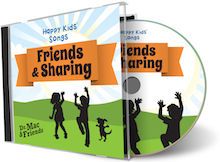

Happy Kids Songs Review

Friends & Sharing is perhaps the most mellow of the collections we reviewed, yet still has catchy tunes, which are:

  • Sailing on the Seven Cs, which is a song that names the ingredients of friendship as caring, consideration, commitment, communication, concern, curiosity and cooperation.
  • Everybody Wants to Find a Friend, which encourages you to reach out to others because everyone wants a friend.
  • Sharing Friends, which reinforces that it is okay when your friends want to play with other friends.
  • Happy as Happy Can Be, which is about how it feels good to be with a friend.
  • Together, which sends the message that you can be friends with someone even when you are not with them.
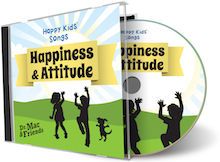
Happy Kids Songs Review

Happiness & Attitude is an upbeat collection that features two songs in the kids rock genre and other at a little slower tempo.  Songs on the album are:


  • Shake It Out and Dance, which encourages children to give things a chance before deciding they cannot do something. 
  • Who Knows What's a Kudo?, which teaches the vocabulary word "kudo" while also exemplifying how to offer true compliments to others. 
  • I Don't Understand, which emphasizes that it's okay to ask questions and that we all have different limitations and understandings. 
  • Be Good to Yourself, which is about being good to yourself and others. 
  • Better Together, which is a feel-good song about being together with friends.
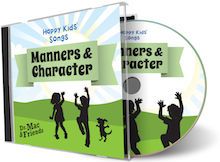


Happy Kids Songs Review

Manners & Character has spirited songs that stick in your head.  These are:

  • H-o-n-e-s-t-y, which shares reasons why it is important to tell the truth.
  • The Magic Word, which, of course, is about saying, "please".
  • Quirks, emphasizes how we all have our differences and unique habits, but that's okay.
  • The Golden Rule, which focuses on doing to others what you would like them to do to you.
  • Six Little Kids, which uses a story to explain how even when people have different perspectives, all of the perspectives can be true.
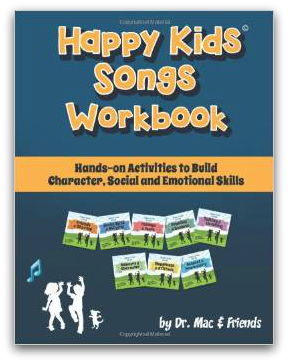
Happy Kids Songs Review


The physical Happy Kids Songs Workbook: Hands-on Activities to Build Character, Social & Emotional Skills 
contains song lyrics, worksheets, coloring pages, puzzles, lesson plans and more for all of the songs in the entire Happy Kids Songs collection.  Some of the materials are geared for very young children (coloring), while others are suitable for older children (crossword puzzles).  The lessons included seem, to me, more appropriate for schools and day cares than homes, but still contain some worthwhile nuggets.

We used the workbook so far just to read the lyrics for singing along.  I will likely use some of the activity sheets later in the year.


As an aside, some of the song lyric sheets and activity pages in the workbook are available for free if you subscribe to the Happy Kids Songs newsletter.  However, to save yourself time and ink, as well as to get bonus lesson plans and activities, the workbook can be a great idea!

Do Happy Kids Songs make me happy, too?

While I certainly do not feel that Happy Kids Songs are essential listening for home and homeschool, I do think they make a worthwhile addition.  They include positive messages presented through upbeat, catchy tunes that two of my three, so far, have been enjoying.   So, that makes them a win for me.

I also think the songs and accompanying workbook would be great for co-ops, classrooms and day cares.  Because Happy Kids Songs are a secular product, they can be used anywhere.

For home or group settings, some things I like about Happy Kids Songs are:

  • Recordings are professional and contain a variety of styles and tempos.
  • Albums are affordable at $4.95.
  • Lyric pages make the songs easy to sing a long with and reinforce reading skills.
  • The songs are fun to listen to and have positive messages.
  • The workbook includes copyright permissions which allow you to copy pages for more than one child at home or in a classroom.

Further, although we love Catholic/Christian resources here, not everyone we know shares our faith.  Thus, I like that we can share the clean, catchy, values- (but not faith-) based Happy Kids Songs tunes with anyone.

The only thing I do not like is that they only come as MP3's.  Honestly, I prefer pre-recorded CD's.


 Learn More


Happy Kids Songs Review

There are five other Happy Kids Songs sets:

You can listen to sample clips of songs and sign up for free song and activity sheets.


All sets target children, ages 3-8.  


Each Happy Kids Songs album contains five songs that can be purchased and downloaded for $4.95.  Individual songs can be purchased for $0.99.


Lyrics and activity pages can be downloaded FREE.
lyrics, activity and coloring pages are available as a FREE download for an added bonus!  - See more at: http://chestnutgroveacademy.blogspot.com/2014/08/review-happy-kids-songs-tos-review.html#sthash.xgWaVhKm.dpuf


You can also purchase a physical copy of the Happy Kids Songs Workbook: Hands-on Activities to Build Character, Social & Emotional Skills for $12.56.


See how 100 or so others are using Happy Kids Songs in their homes by reading the reviews linked at Schoolhouse Review Crew.

 

Click to read Crew Reviews


Find Happy Kids Songs on:


How do you help your children learn and grow with social skills and character?

Crew Disclaimer

Monday, December 3, 2012

The Countdown is On: Making Paper Advent Chains


As a part of our first day of Advent plans yesterday, we made our annual Advent Chain -- a simple and fun way for the children and us to countdown the days until we celebrate the birth of Jesus while also focusing on how He lives within each of us.

The Ideal:  Two Montessori Trays for Making Paper Advent Chains

Flashback:  Nina concentrates as she cuts strips last year.

I had imagined setting up two Montessori trays this year to make our Advent Chain:

  • one with purple paper, a ruler, kid-sized scissors and a pencil, so that the children could draw and cut straight lines to make our Advent chain strips,
  • and, another with the cut paper strips, a pen and the children’s ideas for serving others written out on strips that the children could be used for copywork.

The Real:  A More Free Flow Activity to Transition to Quiet, Focused Time

Drawing Straight Lines

However, Sundays are a bit too free-flow around here for such structure, so, yesterday, we kept the essence of the project, but not the arrangement.  Instead of working from pre-prepared Montessori trays, we set about the project with a more impromptu nature.

After some outdoor family time, Jack needed a nap and Luke and Nina needed a semi-structured activity to help them transition from boisterous outdoor play to quiet (i.e. brother needs a nap) indoor pursuits.  So, upon spying some construction paper I’d purchased for our Advent lessons sitting on the kitchen counter top, I decided that preparing our Advent Chain would be a perfect activity!

Out came a ruler, some writing utensils and the adult scissors, which were all readily available in the kitchen.  Down sat Luke and Nina.  And, the project was underway.

Nina and Luke concentrated on drawing lines and cutting along them to make paper strips for our chain.  They asked if they could make pink ones as well as purple ones this year, which I was happy to agree to.  By doing so, I was able to weave in some patterning discussion – asking the kids what type of pattern we should make and, then, proceeding to help create an A-B-A-B pink-and-purple chain.

Since the children were in more of a construction mood than a writing one, I forwent the copywork idea I had originally had for our Advent Chain project this year and simply wrote out the children’s ideas on each chain link myself.  As I did, I smiled at the works of service that they had come up with during our Christ the King liturgical tea last week.  During the tea, we had discussed how Christ the King, unlike many worldly rulers, leads by serving.  Then, the children had brainstormed ways that we, as a family, might serve others during Advent.  The breadth of their ideas – and the depth of some of them – impressed me as I rewrote them on our Advent chain.

The First Link Accomplished

"We did this!"
Finally, we hung the chain up high in our living room, so Jack won’t be apt to tear it apart, and Nina excitedly took down the first link – an idea the children had come up with last week which I had purposely put at the end of the chain as the children had already accomplished its suggestion today. 

“Give stuff to other people,”  it said.  At Mass, they had given an extra copy of one of our Christmas board books to a family with three young children.  This small gesture of kindness was a HUGE thing for them, in my opinion, as it demonstrated growth in areas of character development and social skills that they have been working on:  not hoarding things we don’t need, sharing, approaching others and getting their attention with politeness, speaking up with people they might not know, etc.  Not to mention it started our Advent off right with a focus on Faith, Others, then Selves.

Undoubtedly, the next 22 days will be filled with similar growth as the children work to honor all the ideas they brainstormed on Christ the King day.

Academic Links for the Next 22 Days
 
To keep us accountable to our focus of service – as well as to add an easy dimension to our Math work this month – I made a simple bar graph for the kids and I to fill out daily. 

Additionally, we will use the chain for practice with counting, addition, subtraction, concepts of time, etc.

Since some of the ideas the children brainstormed involve gifting things to others, practical life skills will be inspired aplenty.  Likewise, there will be handwriting practice as the children write notes and make cards.

And, of course, Luke will work on decoding as he attempts to read some of the links.

For Posterity

Nina with Last Year's Advent Chain
Since I already tossed the paper from the kids’ original brainstorm into the recycling bin and the idea are now hidden inside each chain link loop, I cannot share what the kids’ ideas were this year just yet.  However, for posterity, I would like to list some of the ideas that the kids came up with for last year’s chain.  For it is not from the wind that they get their bad habit of squirreling things away unnecessarily.  In recent weeks, I found a stack of last year’s purple strips that I had kept for who knows what reason.  They are now headed to recycling, too, but first, let me share some of them:


  • “Make a card for someone.”
  • “Paint a picture for someone.”
  • “Hug someone.”
  • “Visit a neighbor.”
  • “Play ball with Jack.”
  • “Let Mommy have computer time.”
  • “Make Luke’s bed.”
  • “Rub someone.”  (i.e. offer a back massage at nap or bedtime)
  • “Offer a compliment.”
  • “Say something nice.”
  • “Tell Daddy he runs faster than us.”
  • “Tickle Jack.”
  • “Make books.  Read them to see if they’re good and give them away.  If they’re not good, don’t give them away.”
  • “Make a bird house.”
  • “Protect the birds by saying, ‘Shoo, squirrel, shoo!’”
  • “Kiss someone.”
  • “Feed the birds.”
  • “Pick a room and do a ten-minute cleaning.”
  • “Clean all the doorknobs and light switches.”
  • “Make a welcome sign.”
  • “Give our neighbor’s food.”
  • “Let Jack play with us.”
  • “Make Mommy’s bed.”
  • “Skip computer time to play with the kids.”
  • “Let Nina go first at something.”

As I recall, I helped the kids brainstorm some of these ideas last year by asking how we might be kind to one another, help people in our neighborhood, help the poor, prepare our home for unexpected guests, etc.  From there, they came up with the ideas.

Flashback to Last Year:  Luke Making Our Advent Chain
Do you make Advent, or Christmas Countdown, Chains?  If so, do you have children generate their own ideas, do you come up with them or do you use a pre-made printable?  What is the focus of your chain?  Service?  Fun?  Prayer?  Family time?  Some combinations of all of them?  We’d love to hear your thoughts.

 This post is being shared over at Montessori Monday.  Click on over to be inspired by many home and school ideas.

Saturday, August 18, 2012

Find Five Ways... A Simple Strategy for Overcoming Unkind Hands, Words and Feet

Unkind hands.  Unkind words.  Unkind feet. 

The boys needing a "relationship repair"...

When you are living with a household of young ones, such things can seem to proliferate. 

My remedy?  Habit training!

Whose habits?  Everyone’s!

Like many children, mine have some frustrating habits of hitting, yelling, threatening, biting, pushing, kicking light-sabering, etc.

In reaction to such behaviors, I am ashamed to admit that I have fallen into some not-so-productive habits of yelling, over-talking, getting upset, doling out punishments or otherwise generally adding to angst and negativity in our household whenever the kids “get into it” with one another or with me.

This is a problem.  A big problem, in my opinion, as it directly opposes our family mission to S.M.I.L.E. 

So, I decided to do something about it.  Something simple.  Something I could stand by.  Something that would focus us all on discipline not punishment and on kind habits to build, instead of negative behaviors to avoid.

Enter:
Find Five Ways

Relationship healed! Smiles restored.
Whenever one of the children uses their hands, words or feet unkindly, I simply stop what we are doing, name what they have done and ask them in a calm tone to find five ways to use their hands, words or feet in a positive way.  I remind them to consider making amends for whatever they have done and repairing relationships with whomever they have hurt.


Example One: Words

When Nina bursts forth with, “I wish my brother was never even born!”, I say, “Nina, those words are hurtful.  Please find five ways to use kind and loving words.”

Then, if she doesn’t begin to do so within a minute or two, I motivate her to do so by letting her know “Nina, you must first find five ways to use kind and loving words before you can join us for (whatever the next fun thing we have planned in our day is.)”

Then, Nina usually gets started:

“Mommy, I love you... Jack, I love you...  Jack, you are such a good brother.” 

I see positive energy building in her, but no recognition of the fact that her words hurt her older brother, not her younger one.  Thus, I calmly say, “Nina,  I love you, too, and so does, Jack.  I bet Luke is feeling sad.  You hurt him with your words before...” 

Within a few minutes, Nina usually then succumbs to an “I’m sorry, Luke.”  Then, I ask her to find for one more way to use kind words and we are off with the rest of our day.

Example Two:  Feet

Luke kicks out at Jack in frustration when Jack comes too close to Luke as Luke is seeking alone time. I come to the room, observe and note, “Luke, you hurt your baby brother.  He’s crying.  I had to stop doing my chore so I could help calm him. Please find five kind ways to use kind feet towards your brother and towards our house.”  Luke balks for a moment, but then walks over to his crying brother to give him a hug. 

He walks to me to give me a hug.

“You are using your feet to walk to each of us to give hugs.  I love your hugs.  You need to use your feet to help our home, too.”

“Aw, Mom.  Why do I always have to clean?” Luke retorts.

“Luke, you stopped Mommy from doing chores right now, so you need to take some time to help our home.  Please walk around until you find three things to pick up and put away.”

Begrudgingly, Luke picks up three things in his room.  Without even realizing it, he picks up a fourth.  I thank him and he goes back to his drawing and coloring.

Example Three: Hands

Jack tries to tear something out of Luke’s hands at the table.  I stop eating, and helping to pry Jack’s fingers off the thing to give back to Luke, I say, “Jack, you used unkind hands.  Hands are not for grabbing.  They are for hugging. Please hug Luke.”  Jack smiles and hugs Luke.

“Thank you, Jack.  You hugged Luke.”  Jack laughs and hugs Luke again.
“What other fun things can we do with our hands?”  I ask.

Nina and Luke suggest things such as clapping and tickling.  Jack and his siblings begin to do each thing. 

By the time we reach five “good” things we can do with out hands, everyone is giggling and we get on with our meal and circle time.

Does It Always Work?

I have been employing this strategy for over a week now with great success, but can already attest:  It does not always work flawlessly all the time. 

Sometimes I have to strongly hold the kids to task, counting off their “kind” actions as they go and sticking to them like a shadow until they finish the challenge.

Sometimes they refuse to act kindly and then are required to “shadow me” until they have found five ways to use their hands, words or feet kindly.  Often, when they are shadowing me, they whine.  Whining is considered “ugly” in our home and “hurts other’s ears”, so if they whine, they have to add five kind and loving ways to use their voices to their list of must-do’s.  It can begin a viscous cycle, but through prayer and patience, I usually endure, and, in time, they reset with positive actions and words.

Will you have success with Find Five Ways, too?  I hope so!  Give it a try and let me know how it goes.

Thursday, August 16, 2012

2012-2013 School Planning: Faith and Character, Part Two (Assessment and Documentation)

 The other night, Nina and I skipped out for some “just us girls” time grocery shopping and stopping by a Staples for their Extreme Deal of the Week. 

While we were at Staples, we also took advantage of their binder trade-in deal, where we could recycle old, empty and abused binders in return for receiving $2 off brand new binders. 

The next day, as I thought about the approach our family is taking this year for Faith and Character studies, I considered how we might best document whatever learning the Spirit leads us to enjoy.  In addition, I wondered what tools we might use to assess how each of our Faith and Character Learning Objectives is met throughout the year.

The answer came to me:  notebooks!


Thus, the children and I took a mini-step yesterday in putting together our Faith and Character Notebooks by hole-punching the St. Anne coloring and narrations we had done as a part of our St. Anne Liturgical tea, as well as the Hail Mary coloring pages we did yesterday as a part of our Assumption Day celebrations, and putting them into binders.

On my next trip to Staples, I will be purchasing dividers, so we can make the next mini-step in our Faith and Character Notebook making, which will be setting up the section of the binders as:

  • Prayer:  copies of traditional prayers the children have learned and those they are in process of learning; photos and observations related to prayer;  a photo of personal prayer corners we hope to set up; etc.
  • The Word:  narrations and drawing of Bible stories; copywork and drawings of Bible verses; etc.
  • Living Our Liturgical Year: drawings, coloring pages and narrations about the saints and Liturgical year celebrations and observances; photos of Liturgical Table displays and Liturgical Teas; etc.
  • Catechism:  copywork of My First Catechism questions and answers; observations, notes and photos related to the Catechism; etc.
  • Sacraments:  photos, observations and notes related to understanding and living the Sacraments
  • Character and Virtues/Christian Living:  examples and photos of character an virtues in action
We may also set up a cross-discipline Geography notebook that will include notations of  where saints lived and Bible events took place in it.

In addition, if all aligns right, perhaps this year will be the year that the pocket children’s calendar focusing on both liturgical and natural seasons that I began envisioning – and even creating – years ago finally becomes a reality, but this year in a notebook form which we can take with us wherever we happen to be.

What are your favorite tools and strategies for assessing Faith an Character studies?  Please share!

Note: It would appear that as I have been taking my planning in bits, I have sharing it that way as well.  The other portions of our planning to date can be found by scrolling through School Planning 2012-2013. 


Please note: Links to Amazon within this post and others are affiliate ones. Should you choose to click through one to make any Amazon purchase, we may receive a small percentage of the sale. This does not cost you anything, but is a choice we thank you for making. Anything we make from links goes straight back into training up our children and sharing how we are doing it with you. Thank you!


Tuesday, August 14, 2012

2012-2013 School Planning: Faith and Character, Part One (Including First Grade Objectives)

Blessed with Morning Devotional Time
Although I haven't shared anything about our school planning for the fall since I wrote Planning to Plan, I have been living my intentions to:
  • honor the hours of these summer days when I can be present with my children without being distracted by an excess of work and appointments.
  • remain ready to take advantage of ten minutes here or fifteen minutes there to ready some of our supplies for the year.
  • utilize longer stretches of time once the kiddoes are asleep to reflect upon the past year and prepare for the coming one without doing so for so long that I see the night begin to turn to dawn.
As I have been doing so, I have realized oh, how I tend to dream so big that little becomes a reality.   

There is just so much I want to do that sometimes I set myself up to do nothing – or at least little beyond planning and re-planning, listing an re-listing, shuffling and then sizing up what I accomplish as “not enough”, which causes me to plan list again... 

It’s a ineffective cycle, and one I am not proud of.

Sometimes I excuse myself as a recovering perfectionist living in an extraordinarily imperfect state that prevents me from  accomplishing what I set out to do.  Then, I realize that I am the one who created much of the imperfect state.  (Just ask my husband about the condition of our bedroom!)  It’s not easy to own up to the fact, but I do.  I admit that there are a gazillion ideas and tasks that crowd my mind, and, sometimes, until I can get them all organized and delineated, I (for lack of a better analogy) spin my tires. 

I don't want to keep spinning, but old habits die hard and so I still find times when my brain spins and spins, kicking up lots of mud, but not moving us towards our goals anytime soon.  The perfectionist in me wants to create a faultless plan before taking action, so success is delayed.  Intention fails to become expediently realized objectives.  In short, there are too many times that I wallow – stuck – unable to create what I have pictured in my head and unwilling to accept anything less.

Such was the case with our Faith and Character studies last year...  I had plans – big plans, but many of the tools and resources I intended to implement remained but a dream.  
Yes, we participated in Mass, read some Bible stories and saint stories, sang along with faith-based CD’s, enjoyed a few Saints Teas and made inconsistent efforts with our Liturgical Tables.  However, formal study of the Catechism, focused Scripture Memory beyond Hide ‘Em in Your Heart CD’s, progress with the Catechesis of the Good Shepherd,  focus on Character Trait/Values Studies, dabblings in Sacred Music Appreciation, attempts at Sacred Art Appreciation, consistent reading of the Catholic Children’s Treasure Box books, daily Devotional use, regular readings of the Psalms and Proverbs and weekly play with Bible felts, Bible Story toys or faith-based story baskets were all lacking.  Some of this was due to circumstances beyond my control , but part of it was also due to the fact that if I could not lay something out flawlessly, I set it aside for a time when I could and, well, that time rarely came.

And, let's be honest, perhaps I was hoping to lay out far too much!  None of the long list of ideas that I just shared are bad.  But, all together, they add up to a lot of mental and even physical clutter that takes away from the simple objective of teaching the children to know and love God and others.

Luckily, as I reflect on my failings of the past year of Faith and Character studies for my children, I also recognize grace at work.  Learning happened anyway.  Granted, I did not recognize all of it as it unfolded, because I sometimes I was too busy berating myself for what I wasn’t doing instead of getting out of my self-centered way to see the amazing things that He was doing.  

So, this year, I plan to let Him take the wheel on Faith and Character a bit more.  I will not set myself up for defeat by delineating such a long list of faith formation and character training ideas and activities.  I will quiet the buzz in my brain and not add to the clutter of my home.  Yes, I will pause, pray and choose one “curriculum piece” at a time to actualize as I feel led to do so.

Along the way, I am confident that the Spirit will guide our family to learn what we need to this year.  If within that learning, we hit upon some of the following Faith and Character objectives, which I hope that Luke, as a first grader, might meet, with Nina and Jack following suit at their own paces, so much the better!

Faith and Character Objectives for First Grade

  • Develop individual prayer life and relationship with Jesus.
  • Pray basic prayers:
-      Sign of the Cross
-      Our Father
-      Hail Mary
-      Glory Be
-      Table Blessing
-      Apostles Creed
-      Prayer to Guardian Angel
-      Morning Offering 
  • Recognize and retell various stories of the Bible.
  • Live the Liturgical Year through celebrating Mass, enjoying Liturgical Teas, creating Liturgical Table displays, learning more about the saints, etc.
  • Recite answers to the Baltimore Catechism questions for lessons 17.
  • Map some of the geography of Bible lands (in conjunction with other studies)
  • Memorize five or more Bible verses.
  • Actively participate in parish Generation of Faith program.
  • Continue to strengthen positive character.

Do you have Faith and Character goals or benchmarks in mind for your children this year?  What are they?

Note: It would appear that as I have been taking my planning in bits, I have sharing it that way as well.  The other portions of our planning to date can be found by scrolling through School Planning 2012-2013.

Monday, March 7, 2011

Megaskills for Toddlers, Babies and Beyond, A Rich Resource Review

Okay, so I broke the promise I made in my A Rich Review: Baby Sing & Sign post by not posting two more reviews on the 5th and then one every week after that. Forgive me. A host of appointments, illnesses, injuries and simply “life” waylaid my focus on reading and writing reviews for 52 Books in 52 Weeks, one book at a time as well as with posting anything at all!

So, before moving on with today’s review let me revise my promise: I am going to try to catch up on January, February and the beginning of March's reading and, then, read just one book at a time, posting about these once a week if life allows.  That means, in all actuality, I will most likely post reviews only about once a month or so.  Gotta go with the flow of life...

Okay, apologies made and – now – on with the review:

MegaSkills© for Babies, Toddlers, and Beyond: Building Your Child's Happiness and Success for Life 
* * * * 1/2 
(Read  my initial Rich Resource Review post to read more about my rating criteria.)


Some time ago, an upbeat, creative and talented mom from a homeschooling group I am a part of – and one who is a queen of finding free and low-cost quality materials – suggested I check out Megaskills: Building Our Children's Character and Achievement for School and Life by Dorothy Rich, EdD. I promptly reserved it at our library, browsed it and liked it.  Upon returning it, I put its name on a "get back to in a few years" list because it was aimed at chidlren four and up and mine were but toddlers at the time.

More recently, I discovered a companion edition to the book, Megaskills for Toddlers, Babies and Beyond. Hoorah! Aimed at parents and educators of children ages four through six years old, this volume is ideal for my family right now.  It is a resource that is going to make my scattered efforts to center in on particular life skills and habits much more focused. It gets:

A * for READABILITY
Megaskills for Toddlers, Babies and Beyond is very easy to read and digest, even with a baby on your breast, a three year old singing songs and a five year old building a construction. Trust me, I know. I read it this way!

Beginning chapters are formatted in short, easy to read sections with large subtitles and a host of bulleted lists.   They deal with such topics as:
  • what Megaskills are
  • why Megaskills are important
  • how to get started with teaching Megaskills
Later chapters are well-organized with menus and clear, concise recipes for age-appropriate Megaskills activities.

There is also is a handy chapter on Tech Skills for young children and one on Measures to use to assess your child and yourself.

Finally, there are five Appendixes, including my favorite, Appendix C, which lists a number of popular early childhood books to go along with each Megaskill. This will help guide me in picking out titles for my kiddoes’ verocious appetite for picure books!

A * for RELEVANCE
Okay, so I guess the aforementioned book list is not enough to earn Megaskills for Toddlers, Babies and Beyond a full star for relevance. But the fact that it focuses activities on the following core skills certainly does:

  • Confidence - feeling able to do things
  • Motivation- wanting to do thing s
  • Effort - being willing to work hard
  • Responsibility - doing what’s right
  • Initiative -moving into action
  • Perseverance -completing what you start
  • Caring -showing concern for others
  • Teamwork -working with others
  • Common Sense -using good judgment
  • Problem Solving -putting what you know and what you can do into action
  • Focus -concentrating with a goal in mind
  • Respect -showing good behavior, courtesy, and appreciation
          (list from page 3 of book)

In fact, the book offers approximately 150 easy to understand and implement activities for building these skills across the continuum of early childhood development from age one through six.

Granted some of the suggested activities are common sense ones, such as:

“RESPECT: When Accidents Happen
Helping children know what to do
• Developmental Theme: Promote Good Daily Habits
When your preschooler spills milk on the floor, explain that you understand that accidents do happen. 
When she drops something she is carrying and it accidentally breaks, try not to get angry. Instead, ask your child to get a sponge or dishcloth and wipe up the spills or get a broom and dustpan and sweep the floor.
When there is a consistent response to accidents in your home, your child grows up knowing that she is responsible”
(from page 138 of the book)

That said, many suggested activities new or fun twists on “old” concepts, such as:

“PERSEVERANCE: Spaghetti Letters
Helping your child name and create the letters of the alphabet
• Developmental Theme: Create and Imagine
Cook and drain one cup of spaghetti that has been broken into two to three inchpieces. Place spaghetti in a bowl with cool water to keep it from sticking together.
Have a cookie sheet or other flat surface ready.
Make a list of alphabet letters on a piece of paper: Aa, Bb, Cc, etc. 
Name analphabet letter and have your child point to the letter that you name. 
Using a pieceof spaghetti, ask your child to form the letter you named.
Give help if needed. The spaghetti is wiggly so letters will not be perfect. 
Seehow many letters you can each make in ten minutes.”
(from page 126 of the book)

Such ideas ensure that there are plenty of "do now"s in the book, earning it a star!

A * for PRACTICALITY
Megaskills for Toddlers, Babies and Beyond is extremely practical! It breaks big-picture ideas (the Megaskills) into simple, yet meaningful activities to build them. Also, it offers parents and educators easy ways to assess how their children are doing with each skill, how they, as parents, are doing with promoting Megaskills on a weekly, monthly and yearly basis.

I love the simple inventories/forms the book provides in Chapter 12 for evaluating and intend to copy them for some Assessment binders I am making for my children.  Very practical!

A ½ * for LONGEVITY
Megaskills for Toddlers, Babies and Beyond will definitely be helpful for my family for the next five years or so since our youngest is less than a year old.  It would also help any family or educator working with young children on a consistent basis.

That said, in fairness to all reading this, I am only giving Megaskills for Toddlers, Babies and Beyond a half star for longevity.  Why?  Well, depending on the age of the children you works with,  the book may not be personally useful for the long term. (However, it is a good enough resource that even if your children “aged out” of the activites the book includes, it would make a great pass-along or library donation!)

A * for VALUE
I have already borrowed Megaskills for Toddlers, Babies and Beyond  from the library more than once and am putting it on my “purchase” list, since it is one that I would like to have handy as a reference for the next – oh – four to six years. For, even though some of the ideas in the book are common sense ones and many are not earth-shattering, I love that so many ideas are collected in one place and organized in an easy-access-way.  For this reason alone, the book can help me maintain focus not only on what my children are learning, but also on who they are becoming – successful, compassionate individuals with a wide range of skills that act as the foundation for character and achievement.

Megaskills for Toddlers, Babies and Beyond is a keeper in my opinion!

For more information on Megaskills, check out the Megaskills Online Education Center.

Also, check out the links at 52 Books in 52 Weeks, where this post is being shared.

LinkWithin

Related Posts with Thumbnails