Showing posts with label Creative Curriculum for the Home. Show all posts

Friday, September 3, 2010

Step Seven: Family Time and Play Dates -- Group Time Space with Creative Curriculum ® for the Home

Today, I am very grateful for friends and family aplenty and space that, although limited, is accommodating enough to enjoy time with guests.  For, since Jack has been born, we have had our fair share of folks swinging by to meet our newest student as well as to help Mama out a bit by watching the kids while I attend to a few things or by having me watch their kids so I don't attend to anything but enjoying witnessing children's play and learning unfold.


As each visitor comes, our “large group” areas get crowded quickly.  The kids and their friends spread out in our small living room with toys to play as we adults talk over and around them.  In the midst of the ensuing chaos, I smile, thankful for having space to host.  I cringe a bit too though, realizing continued reorganization might make everyone a bit more comfortable.

And with this in mind, I have decided it is time to pick up our Creative Curriculum ® for the Home series again with a focus on Group Time Spaces:

Beyond establishing interest areas, the Creative Curriculum® (CC) asks practitioners to identify spaces for group time, for displays and for storage, adapting these areas to children’s special needs.  It also asks that all areas be as comfortable and attractive as possible.

It suggests educators define a space to gather to talk about and plan the day, listen to stories, transition between activities and participate in music and movement.  For us, as a family group space, the kitchen, the deck, the stoop and the living room serve well.  In the kitchen and on the deck, we chat around a table.  In the living room, we enjoy music and movement.  In almost every room, we enjoy story times.  (Yes, even in the bathroom, where the kids have specific potty-time books and, occasionally, tubby time ones!) For company “group times”, however, space becomes more of an issue.  Both our office/play-n-learn space and our living room get crowded quickly.  So, the basement family room – if we ever unsurface and fix it up – may become the group space for play dates and entertaining guests.  It’s all a work in progress.  (Okay, a work stalled for the moment as we get used to having another member in our family and begin to think more seriously about moving toward homeschooling Kindergarten come December.)

Wherever the group time space ends up in our home, we hope to follow these guidelines that the CC suggests that it have:

-          sufficient floor space to accommodate everyone – check, once we are in the basement!
-          comfortable floor seating – check – foam squares and floor pillows for us.
-          space for charts, such as a job charts, daily schedules or charts for graphing  – We plan to actually spread these out in our home in order to keep them less visible to guests while still accessible for us.  Granted, our daily rhythm fridge chart is pretty visible to all!
-          an easel or chart stand to document group discussions or display big books – While we have an easel, I have no intention of placing it permanently in our living room, nor kitchen at this point.  (Maybe later in the basement family room...)  Indeed, notebooks do just fine for recording in our home environment and big book displays are unnecessary as we use few of these.
-          cupboards for storing materials such as CD’s, scarves and instruments and electrical outlets for CD players, etc. – Check.  As mentioned in an earlier post, we rededicated part our living room storage to musical enjoyment.

And, so, our Group Time Space has its own shape and that shape will continue to evolve -- hopefully stretching a bit so things don't feel so crowded when we are welcoming others into it!  How about yours? Where do you host family and friends in your home? How do you make the space work? Do you have favorite tips and discoveries for seating, schedules and charts, etc.? Do share! And, as always, keep checking back. I will continue posting the CC for the Home thoughts and summaries as time and inspiration allow.

In This Series:

Step One: Declaring Areas for Interest in the Creative Curriculum® Home

Step Two: Spaced Out -- Thinking about Space Planning Guidelines in the Creative Curriculum® for the Home

Step Three: Music and Movement Area Creative Curriculum® for the Home

Step Four: Materials Madness -- Basic Principles for Equipping Interest Areas Using the Creative Curriculum® at Home

Step Five: Outdoor Area of the Creative Curriculum® for the Home

Step Six: Displaying and Labeling Materials with Creative Curriculum® for the Home

Step Seven: Family Time and Play Dates -- Group Time Space with Creative Curriculum ® for the Home

Thursday, June 24, 2010

Step Six: Displaying and Labeling Materials with Creative Curriculum® for the Home

“Everything with a place and everything in its place.”  This is, indeed, the rule of any good early education classroom – and any well-organized home for that matter.  But, it is also a rule that we, unfortunately, have yet to fully apply in our home. So, stepping back inside after assessing our Outdoor Area during the last step, today, let's look at how we might apply Creative Curriculum® to displaying and labeling materials.

The Creative Curriculum® focuses on the "everything with a place and a place for everything" rule, reminding practitioners that children benefit from the consistency and predictability of an ordered environment.  It highlights that by knowing where to find things and how things are grouped, children can work independently and constructively and – bonus for the adults –can also care for and clean up their environment much more readily.  It suggests that by having clearly marked places for everything, children are afforded the flexibility of taking materials to areas beyond their “home” for play and learning, but, can also return the materials easier during clean-up time.

To store and display materials the Creative Curriculum® suggests five easy guidelines:

  1. Keep materials that go together in the same place – collage material with glue and paper; cars with blocks and so on.  This seems a no-brainer, but, I must confess, we have materials stored in some very illogical places in my home.  It’s high time, then, to go on a household hunt to group like objects together and put them in accessible places, pending the success of the big de-clutter of course.  No more materials for a single activity housed in four different rooms.  No more collections of everything-the-kids-have-gotten wild-with on top of the fridge. And no more basement disaster area.  A huge, but not insurmountable goal, that I will start tackling now - and, as baby allows - finish in the coming months.
  2. Use containers such as plastic dishpans, clear plastic containers, baskets and shoe boxes to hold materials toys with small pieces.  I love the aesthetic of baskets and other natural materials containers.  However, our limited family budget mandates some plastic and copious amounts of re-purposed materials.  So, baskets on hand, dollar store finds, recycled gift bags, re-purposed food containers, here we come!  As we purge our actual collection of “stuff”, we’ve got to add to our collection of baskets and bins in order to containerize, containerize, containerize.
  3. Hang items, such as dress up clothes, utensils, smocks and whatnot, on pegs, Velcro and child-sized clothes trees.  We love magnet hooks for the side of our fridge and the back of our front door.  Cup holder hooks, peg racks and the like work well in some other areas.  We simply need to discern the best areas for kid-level hung items and, then, go for it.
  4. Display materials on low shelves at children’s eye level and place books with covers facing out.  (Montessori ideals come in handy there)  We work with what we have and are managing, for the most part, to adhere to such guidelines...
  5. Store sharp items, such as knives and graters, out of reach, bringing them out as needed.  We are still working on our balance of child-proofing as versus teaching responsible, independent handling in our home. Here, we tend to ere on the side of independence, allowing the kids to use real glasses and to access some things that might cause others to draw their breath in sharply with an “oh no!”, but it works for us.  Still, with the new baby coming along, we’ll have to be more vigilant again...
    And, wherever materials are stored and displayed, the Creative Curriculum® asks that they be clearly labeled with both words and pictures both on the storage shelf itself, as well as on any containers that hold objects on the shelves.  That way, clean up becomes a matching and literacy game as well as merely an endeavor to care for the environment.   Now, there’s an idea.  On the container and on the shelf – at least for the kids toys – and label everything.  We’ve done this in the Music and Movement area and need to elsewhere.  So, break out the contact paper, packing tape and key chain circles.  Increased label madness, here we come!
     

    Now, enough theorizing, time to get to more display weeding and area labeling!  And, hopefully, to a further step on our CC journey within the next week.  Stay tuned for it, and, as always:

    One final note:  If you would like to join me on this CC journey, please leave comments.  Grab a copy of the book yourself to review and let me know what you're getting from it.  Or, use my summaries and posts as a starting point for thought.  Tell me how you're moving from theory to practice in your own home.  Cheer me on (or give me constructive criticism) about how I am doing.  Or, simply jot down whatever comes to mind.  Deep conversation or silly banter -- my adventures have always been all the better for sharing both along the way.  Thanks! 


    In This Series:

    Monday, June 21, 2010

    Step Five: Outdoor Area of the Creative Curriculum® for the Home

    Finally, here is the Outdoor Space thoughts that I promised in my last Creative Curriculum ® for the Home post before computer woes and other obstacles slowed my course for a couple weeks.

    Why focus on the Outdoor Space right now, when our indoor spaces are all still demanding so much attention?  Well, because good weather is upon us and we find ourselves outside enjoying it more and more often.  I cannot exactly keep the kids (or Mike and me for that matter) inside all the time focused solely on my Order in the Home(school) goal.  But, I can find a nexus between that goal and our desire to enjoy the great outdoors!  The Creative Curriculum® (CC) makes this easy by offering concise guidelines and helpful tips for maximizing the potential of one’s Outdoor Environment.  This delights me!  For both theory and practice often draw us for Jammies School.

    On the theory side, almost all of the philosophies and methods that I am attracted to seem to emphasize outdoor learning, exploration and play.  Charlotte Mason, perhaps, places the greatest prominence on the outdoors, suggesting that children spend hours outside each day regardless of the weather.  Montessori schools often have beautiful outdoor “classrooms” or gardens.  Reggio tends to connect art to nature.  Even our faith studies lead our family outdoors – exploring and being grateful for all God’s amazing creations.  Thus, it is no big surprise that I was pleased when I discovered that the Creative Curriculum® (CC) places importance on outdoor learning, too.  Theoretically, it works!

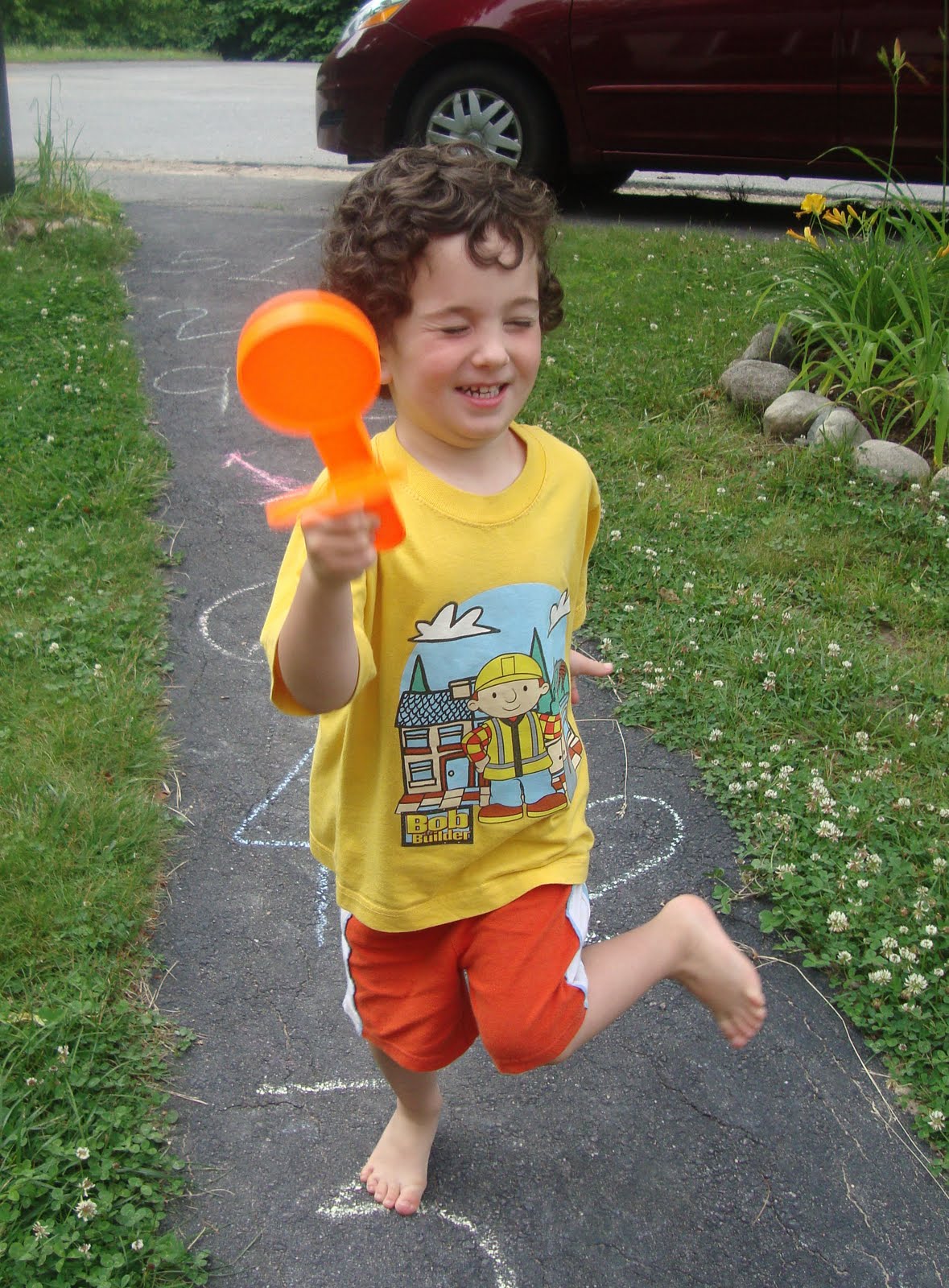
    Plus, in practice, outdoor time work for us, too.  Reading on blankets.  exploring science through bubbles.  Drawing with chalk on the sidewalk, drive and an outdoor easel.  Doing coloring and crafts on the back deck..  Counting pinecones, flowers, clouds.  Playing "Can You Find Something (color)?"  Singing about the great things we see that the Lord has made.  You name it, we enjoy doing it outside.  Indeed, our Outdoor Environment is a natural place for us to focus on our Core Four, Plus. (Faith, Reading, Writing, Arithmetic and Extras)

    So, what does the CC have to say about Outdoor Areas and how can it help us improve our own?

    The chapter in the CC that deals with the Outdoors discusses “How Outdoor Play Promotes Development”, “What Children Learn Outdoors”, “The Teacher’s Role” and “A Letter to Families about Outdoor Play”.  It also details “Creating and Using the Outdoor Environment”, which is what I have focused in on as I continue Order in the Home(school) journey, using the CC as a tool.


    The first step the CC suggests in creating and using the Outdoor Environment is to assess one's outdoor space in order to ensure that there is enough room to accommodate all the children that will be using it at the same time, e.g. 80-100 square feet per child.  This may be out of reach for some family housing arrangements, but – never fear – that’s what parks and playgrounds are for.

    Regardless of if you are looking at only your own yard, or at your yard, plus some local open spaces,  the CC offers a list of parameters to that can be helpful when thinking about an ideal environment.  These are that your Outdoor Space should include:
    • an unobstructed view of the children at all times (when you are not hanging laundry, doing outdoor chores, grabbing the phone, etc.!)
    • easy access to and from the indoor space and a bathroom (or a tolerance for emergency potty breaks in out-of-the-way parts of the yard for potty training kiddos like mine)
    • a drinking fountain and water spigot for attaching a hose (or simply a full water bottle at hand, along with some sort of hose, pond, stream or pool as a water play source)
    • age-appropriate equipment for climbing, swinging and building (or some semblance thereof, depending on the size of your yard.  For example, our outdoor space precludes a traditional swing set, but we do have climbing and building things and may eventually get a swing to hang from our deck or to tie from a sturdy tree branch.  Until such time, we use the neighbor’s swing set and nearby playgrounds, extending our outdoor area significantly.)
    • a storage shed (or some sort of storage plan using re-purposed materials, crates, plastic bins, a garage...)
    • soft materials, such as sawdust, sand or bark under swings, slides and climbers (if you have the space for such things and the funds for the ground cover.  If not, local playgorounds are usually up to safety codes and, as long as you use your common sense and  promise not to sue yourself, your own home spaces should work fine, too, however you fir those swings and climbers into it.)
    •  sunny as well as shady areas (Natural ones are best – think trees, sunflower houses, etc. for shade, but rope and blankets can be fun, too!)
    • a paved or hard-surfaced area for riding, skating, chalk drawings and games (which for home learners not blessed with much sidewalk or driveway sopace, but who live on quiet streets, may just be the street itself, and for those on busier streets, might be a nearby tennis court or parking lot)
    •  a covered area for use during wet weather (or a sense of fun and good protective clothing – puddle jumping and getting wet are part of growing up!)
    •  places to be alone with one or two others (boxes, tents, tires, a porch swing, blankets. etc.)
    •  open, grassy spaces for walking, tumbling, running, kicking, throwing and catching balls (which may just be found at  a nearby park if not in your own yard)
    •  an area for digging (sandbox, rough ground, even just a box of dirt!)
    Now, of course, this list was written with preschool centers in mind, but it can easily be adapted to home use, as I noted in my parenthetical comments.  And, once you’ve assessed where in your own yard or community you might find each of the CC’s suggested components for an Outdoor Environment, you might do well to go on, as we have done, to carving out little parts of it for the different kinds of experiences and challenges that the CC suggests.  These include:
    • playing in sand and water
    • riding on, and pushing and pulling, wheeled toys
    • using indoor materials that can be brought outdoors
    • playing games, building constructions and enjoying pretend play
    • planting a garden
    • caring for living things
    Now, with this list (and the paragraphs of details and suggestions that follow it in the CC book) in mind, it is easy to self-assess and create order and appeal in one’s Outdoor Environment.  To help you along, let me share our thought process for doing so:

    Do we have a sand and water play area, located near a water supply if possible, so children can explore the properties of both wet and dry sand, as well as the properties of water?  And is it equipped with a variety of tools for such exploration?  
     Yes!  Currently we have two freecyled covered green sandboxes.  One we use for sand (and mud!) and the other for water (and shaving cream, and bubbles and...)  These migrate throughout our small back yard depending on where the kids want to play – in sun or shade.  We also have a variety of props we've collected for the kids to use when playing in these – buckets, old bowls and pails with handles, shovels, spoons and scoops; funnels and sifters; old pots, pans and molds; plastic pitchers and jugs; old trucks, busses and cars; plastic people and animals; natural objects, such as pinecones, shells, sticks and stones; etc. the kids don;t tire of our little sand and water spaces yet anyway.  (Admittedly, we are still trying to repurpose something for better storage of these.  Ideas are welcome!)   

    Ultimately, we hope to build a large, more natural sand and dirt area under out deck using logs for borders, lots of sand in one section and a mini-mountain of dirt in another section, but, for now, our small plastic sandboxes dot he trick just fine!   Also, even though we would love to get a small wheelbarrow to add to our props and, sometimes find ourselves scoping out,wished-for items in stores and catalogs, we realize that popsicle sticks, plastic spoons and some recycled plastic containers with holes punched in the lids or bottoms, work just fine as sand and water props, and, in all honesty, the rest is just blessed surplus.  When it all comes down to it, even a box full of sand a d a small dish tub full of water, with such recycled materials would work.  

    A good point of advice that the CC reminds us of though, regardless of what materials are used, is to cover the sand area with a hinged lid, plastic sheet or similar when not in use.  Cats and other animals love to use sandboxes as litter boxes and health problems can be avoided with this simple precautionary measure. 

    Do we have an area where the kids can pedal, push and pull wheel toys to build large muscle strength while promoting balance and coordination?  
     Indeed!  We have a variety of handed-down trikes, scooters and push-with-your legs ride-ons, plus a too-big Green Machine, a kids’ plastic shopping cart and a doll stroller at the moment,  And we have an eye out for wagons, wheelbarrows and bikes...  We use these on the sidewalk and the cul de sac we live on, and, when we feel it is safe, on our very steep driveway.  With safety in mind, of course, we have helmets available.  Along with these wheelie toys, we sometimes use chalk or orange cones to add to our wheelie toy play and, with CC suggestions in mind, we are planning to gather up materials for making signs and creating road markers and directional arrows.  We would also like to start extending our wheelie toy play  more through the use of prop boxes or play crates that can transform our collection into ambulances, fire trucks, mail trucks, gas station equipments, a car wash, etc.  (Okay, so the hose and a few dish pans did well the other day for a car wash!) 

    Do we have a garden located away from more active outdoor areas?  
     Yes, we have a flower bed next to our driveway and a small “lasagna garden” planted with tomato pepper seedlings and some herb seeds we hope will actually grow.  As our yard is relatively small, and somewhat shady – and as none of us has yet to develop a true green thumb – we also hope to use some small, movable container gardens in the future.  (The CC even suggests simply placing a container garden on a two-wheeled cart or wagon so it can moved around to control the amount of sun it gets and to clear space for games – great idea!)  To help us with our gardening efforts, we have several child-sized shovels, rakes and hoes, watering buckets and a hose and, of course, seeds and plants.  Over time, we hope to get better at planting relatively quick-growing, child-friendly, useful and appealing gardens to help the kids enjoy and learn, especially the inevitable lessons of patience and perseverance that gardening requires. 

    Do we have areas where children can practice caring for living things?  
     Yes, not only do our gardens help us teach the kids about plants, but we try to observe and learn about all creatures, great and small, that visit our yard.  We regularly make and hang bird feeders and have a bird bath, and we have making birdhouses on our to-do list.  We also leave our spent blooms up a for a while to attract birds and bugs to come feed.  A bunny visits us regularly.  Cats come by.  Sometimes other animals do, too.  And, we compost – a great boon for worm study!   

    Do we have open spaces for games, building and pretend play, plus equipment to facilitate such play? 
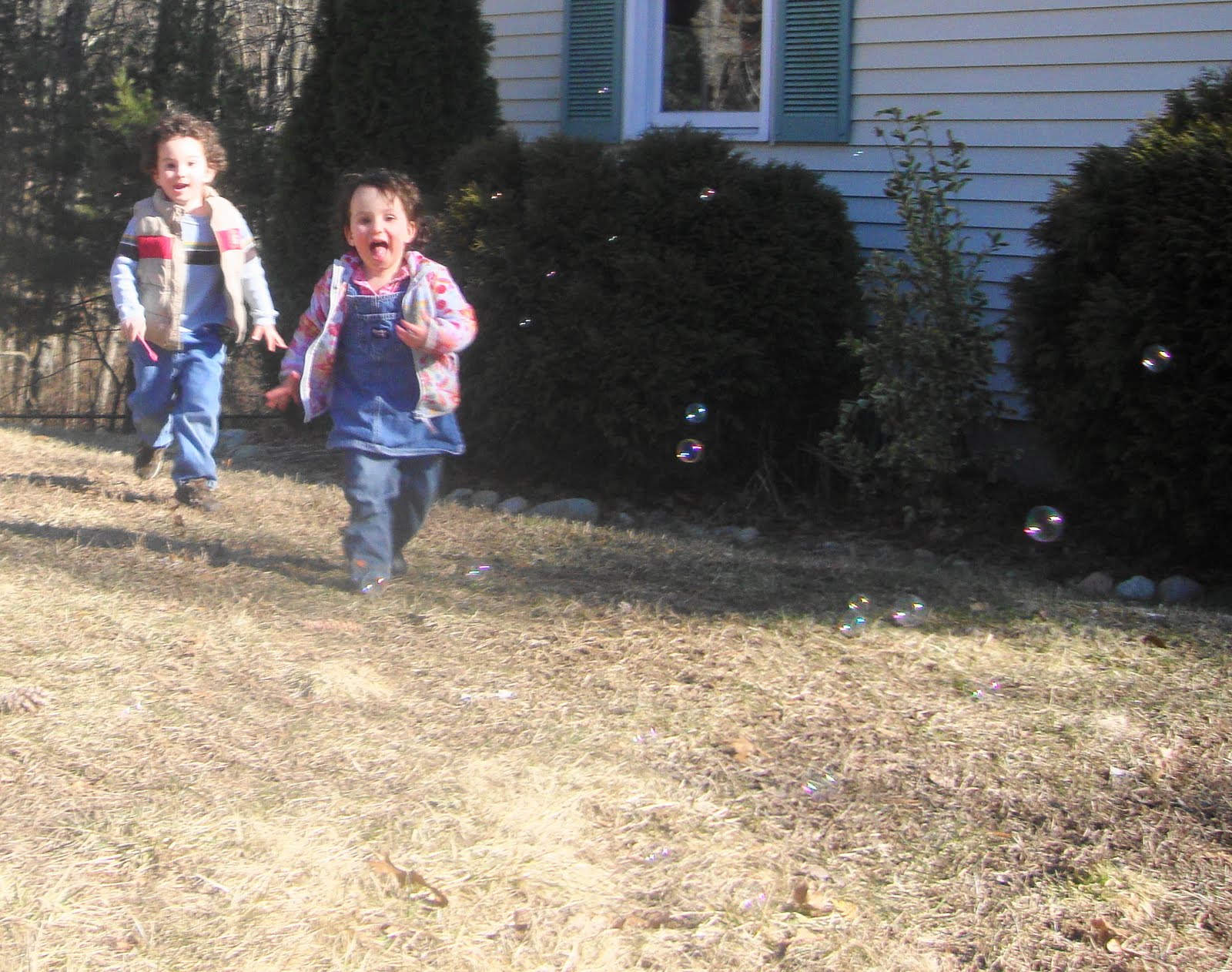
    Indeed, our front yard is mostly open and grassy – a great place to run about and have fun, as well as to catch bubbles, climb on a small plastic climber, set up tents, play chase, etc.  And, our back yard has areas where the kids can enjoy construction (using an old screen, blankets, ropes, clothespins, etc. regularly and hammers, nails and whatnot, occasionally, with closer supervision) and pretend play (where an old plastic shelving unit and stove burner covers from our old stove have made a rather nice outdoor play kitchen area for the kids and some recalled door swings make for a dollie play area).  Plus, we are on the look out for “loose parts” and sundry recycled and re-purposed materials to feed the kids’ construction-imaginations.  Planks of wood, plastic crates, carpet samples and scraps, cable spools, old tires, appliance store boxes, plastic pipes and elbows.  One person’s junk can be our children’s building treasures.  Once our new baby comes and we get our house in order (or at least the former!), we hope to start collecting some of these materials (even if we are in the midst of trying to purge many things!) 

    Do we have indoor materials that can be brought outdoors on nice days both to facilitate learning and to provide a new environment for "old" experiences?  
    Yes, we often use our back deck as an outdoor extension of our indoor learning spaces, and I am working on creating organized grab-and-go type bins or bags to keep by each entrance of our home according to the outdoor activities we pursue by it.  We also sometimes take Movement and Music props out to the deck or front yard to sing, dance parade and play.  We do art activities on the deck, in the sensory sandbox, on the driveway and sidewalk, etc..  (And, we have plans to do even more “Messy Art” outside as the weather continues to be so nice!).  Dramatic play props, most often, of late, in the form of dolls and accessories – the kids’ “kids”, often find their way outside for pretend play with the kids building houses and forts for them, giving them rides, taking them for walks, etc.  And, books are not only enjoyed aplenty during reading sessions on the porch rocker, the deck rocker and on blankets on the lawn, but are also referred to during nature observation and study.  (The One Small Square series is one we love!)  And, if I ever get my desired Montessori and workboxing systems up and running, many of our trays and drawers from these will be taken outdoors, too, no doubt.  Thus, it seems we are doing just fine with bringing inside materials out.  The only thing we need a little help with is keeping them organized and finding their way back “home”.  To this end, we are thinking about creating “play crates” as suggested in the CC for camping, laundry, painting, digging, gardening, woodworking, etc.  Doing so, we think, will help us optimally store and rotate materials, we hope.

    And, so that’s our Outdoor Area thoughts and assessment.  Whew, it was long!  But, what can you expect when discussing something as huge as the great outdoors?  Besides, I am pleased that by taking the time to reflect on our outdoor space, I have not only considered, tidied up and re-envisioned some of it, recognizing we are in great shape even if there are still some "wants", but that we also continue to work toward the main goal – creating better order in our home(school), even as we simply enjoy being outdoors.
    That said, I am now ready to escape the recent heat and to tackle thinking about something a little smaller.  So, within a week, I hope to post about the next step on our CC for the Home journey - notes on Displaying and Labeling materials.  Please stay tuned…

    In This Series:


    One final note, as I have mentioned before, if you would like to join me on this CC journey, please leave comments. When thinking about your own outdoor area, you may want to take a peek at the Outdoors pdf at Teaching Strategies, which details what children learn outdoors by subject and how we might interact with children as they learn and play outdoors.  Also, of course, if you want to journey with me, you can grab a copy of the CC  book yourself to review and let me know what you're getting from it.  Or, use my summaries and posts as a starting point for thought.  Tell me how you're moving from theory to practice in your own home.  Cheer me on (or give me constructive criticism) about how I am doing.  Or, simply jot down whatever comes to mind.  Deep conversation or silly banter -- my adventures have always been all the better for sharing both along the way.  Thanks!

    Monday, May 31, 2010

    Step Four: Materials Madness -- Basic Principles for Equipping Interest Areas Using the Creative Curriculum® at Home

    Creative Curriculum for Preschool- Spanish EditionWhen applying the Creative Curriculum® (CC), interest areas should be equipped with attractive, inviting and challenging, but not frustrating materials.  This charge should be an easy one for anyone interested in Reggio, Charlotte Mason, Montessori or Waldorf education – all of which we appreciate parts of here at Jammies School – since each of these philosophies keys into well-made, beautiful materials that are appropriate to children’s ages and interests.   Indeed, the CC echoes many other philospophies in stating that materials should encourage exploration of topics in science, math, literacy, technology, etc.  Anything from natural collections to sort and graph (math, with echoes of Montessori, Reggio and Charlotte Mason) to gears and clocks to take apart (technology, which meshes with Charlotte Mason handiworks) to resource books for looking things up (literacy, Montessori style).  Luckily, packrat/freecycle-happy me has already collected a store of such types of materials.  Now, it is just a matter of digging them out from the twaddle we have also amassed and rotating them to display in attractive, inviting ways for prime usage!

    As we do this, pointers the Creative Curriculum® offers are:

    -         to offer fewer materials at the outset, allowing time for children to learn to use and care for them (Do I hear echoes of Montessori here?)
    -         to minimize sharing problems by putting out duplicates of basic materials rather than a large selection of different items (This is not really something I intend to do regularly with two, soon to be three, children, but it is a thought for those with more...  That being said, for Montessori followers, this suggestion runs counter to Montessori philosophy and practice.)
    -         to include simple, familiar materials such as stringing beads, crayons and puzzles (Reggio aficionados, especially, can appreciate the amazing things children can create and discover using quality materials and recycled, re-purposed ones!)

    Obviously these pointers are mostly consistent with other education philosophies I am interested in.  Yet, admittedly, they are ones I  sometimes forget to heed – often putting out too much at one time or offering too many unfamiliar or new materials and activities at once.  Thus, as I continue on our Order in the Home quest, getting excited about the variety of materials we have collected that I am uncovering as we move along, and as I delight in the newly improved spaces I create, I continually remind myself to pay better attention to these pointers, remembering a tried and true maxim – less IS more!

    And, with this axiom in mind, I’d like to stop thinking and start doing again – this time by creating a better learn-and-play space in our small yard for my children. Spring has sprung with summer-like weather in our area and we seem to be outside for hours and hours each day.  This precludes me from doing as much with the Order in the Home(school)  opens the door for examining and improving the Outdoor Area.  So, please join me soon for thoughts, reflections and assessment ideas for outdoor spaces based on the Creative Curriculum® .

    In This Series:


    One final note, as I have mentioned before, if you would like to join me on this CC journey, please leave comments. When thinking about materials for your own space, you might want to take a look at the Setting Up a Classroom for 20 Students at Teaching Strategies.  Although meant for schools, not home, this checklist offers and idea of materials to think about acquiring as you hit spring and summer yard sales and thrift shops...  Also, of course, if you want to journey with me, you can grab a copy of the CC  book yourself to review and let me know what you're getting from it.  Or, use my summaries and posts as a starting point for thought.  Tell me how you're moving from theory to practice in your own home.  Cheer me on (or give me constructive criticism) about how I am doing.  Or, simply jot down whatever comes to mind.  Deep conversation or silly banter -- my journeys have always been all the better for sharing both along the way.  I'd love to heat about yours, particularly as pertains to materials selection today.  What are your favorites?  You children's?  How do you present and store them? 

    Thank you and enjoy the day!

    Saturday, May 29, 2010

    Step Three: Music and Movement Area Creative Curriculum® for the Home

    Creative Curriculum®. Charlotte Mason. Montessori.  You name the young children’s educational philosophy, and somewhere in it you are sure to find thoughts on a vital and enriching part of early childhood development: Music and Movement. 

    Although I am anything but musically gifted, I certainly desire to immerse my children in the wonder, beauty and fun of music. In fact, I had them listening to classical music (something I only gained appreciation for later in life) in utero and have focused on filling a portion of each week since with rhythmic rhymes, meaningful lyrics, soothing melodies and interesting compositions.  Likewise, I have collected an array of instruments for the kids to explore with a not-so-secret hope that they will one day learn to read and play music, as I always wished to, but have yet to do. 

    And Movement?  While not trained in this area, I am adept at it.  Indeed, for this Drama Mama, creative movement, silly dancing, beginning yoga and the like all are natural joys to share with children.  Thus, it seems only fitting that the Music and Movement Interest Area in our home became the first one we got to work on when tuning up things as part of our Creative Curriculum® (CC) for the home endeavor.

    The chapter on Music and Movement in CC is rich with ideas not only for creating an environment for music and movement, but for recognizing how the interest connects to literacy, mathematics, science, social studies, the arts and technology.  It also offers ideas on the teacher’s role in music, including thoughts on how to engage children in music and movement and how to respond to children and assess things as they do.  Truly, CC is rich in basic information to extrapolate upon as you create your own Music and Movement program at home. 

    However, for the purposes of my focus on Home(schooling) Organization, I am focusing only on the environment portion of the chapter here:

    CC states that “music and movement involves children in listening activities, joining in group experiences and experimenting with materials on their own.”  Thus, the environment should include:
    • a specific location to store musical instruments:  This might be a pegboard  with silhouettes of musical instruments showing where instruments should be hung, a labeled shelf or a labeled box.
    • storage space for tapes and CD’s that is labeled for easy selection of music:  CD’s may be labeled with pictures of children sleeping, dancing or marching; colors or symbols to identify the type of music, etc.  Selections should include songs that are “fast or slow and soothing; diverse in style and tradition... representative of children’s backgrounds”.
    • an open area with carpeting if possible and tumbling mats:  However, any open space a (inside or out!) will do fine.
    • an easy to operate music player with headphones
    • props in or on picture-and-and word labeled storage:  These might include streamers, scarves, fabric pieces, hats, feathers, cultural costumes, pom-poms, etc.
    • rhythm instruments in easy reach of children: These might include drums, tambourines, kazoos, rhythm sticks, bells, triangles, cymbals, xylophones, melody bells, maracas, shakers, rattles – homemade or purchased.
    Bearing these suggestions in mind and reflecting on the Music and Movement space we have re-organized, here is my quick assessment of our area:
    • Are instruments and props clearly labeled and accessible to children?  Yep!  Although, admittedly, they do take up a relatively large area of space in our small home.  So, eventually I might condense them.  I truly think a couple of bags on hooks or a well-organize basket or bin would do the trick nicely.  Right now, though, our current arrangement works for us.
    • Is there an easy-to-operate CD player for children to use, with headphones, if possible?  Ah, no.  Our family room record/CD/tape player has seen better working days and the kids personal CD player skips.  So, a new CD player is on our wish list.  Freecycle has yet to come through for us, so perhaps a birthday or holiday will...
    • Are there a variety of instruments, a variety of dance props (streamers, scarves, etc.) and a variety of CD’s, representing diverse cultural and musical styles?  Yes, yes and somewhat.  We have a wide variety of rhythm instruments, even if most are of the plastic, homemade and found-for-free kind, rather than the beautiful wooden fine materials and  cultural ones I would love.  We also have scarves in a labeled drawer ready for play and imagination, and, sometimes, bring out other props as well.  And, our CD collection, though currently heavy on the Bible, lullaby and silly songs side, with a smattering of classical, culture-specific and jazz thrown in, can, thankfully, be augmented by our local library to fill obvious holes without breaking our budget.  Now, I just have to get on finding re-purposed or freecycled storage to better house our owned-and-borrowed CD collection.  Ideally, I am looking for something that is easy to access, yet protects CD’s from getting scratched by being “too easy” to access.  Ideas for pre-k friendly CD storade are appreciated!
    • Are there books with words to songs and rhymes?  Indeed! Not only do we  have a few of these out in our Music and Movement area, along with some Montessori-inspired yoga cards, thanks to Meg at Montessori by Hand, and a changing basket of movement cards especially for SPD breaks (currently these wonderful ABC Exercise Cards and soon our Alerting Activity ABC cards), but we also have a collection of music, rhyme and movement books in our larger family library collection that we rotate with the kids’ interests.  And, as we continue on our homeschool journey, we hope to add some Charlotte Mason inspired composer study photos, books and music selections to the area, as well as some Montessori-inspired three-part cards and our growing notebook of Yoga Kids Poses of the Week.
    How is your Music and Movement space shaping up?  Is it organized, accessible and fun to use?  That is key.  Not the size of it!  Truly, please do not think you have to have a sizable area dedicated to Music and Movement.  For, as mentioned, although we currently dedicate a fair portion of our living room to our Music and Movement area, in all honesty, a simple labeled basket of instruments, next to a CD player with a sleeve of CD’s, in an area where you can push a few things aside for movement space would do just as well.  It’s not the size of the space that counts, but the quality of materials in it, and, even more so, the time spent exploring music and movement that counts!

    To help us as we explore our area, if you have some favorite composers, musical artists, CD titles or instrument resources, please share them in a comment!  We are always looking to improve our selection.  And, if you are interested in joining a group to discuss Montessori-inspired Music Ideas, please consider joining the Montessori Music Collaborative, a YahooGroup I began in hopes of getting like-minded folks together to collaborate on lesson ideas, resource lists and other related information for conducting music lessons with our children (and their friends!) As a group, we hope to come up with a basic "music lesson" template/plan.  Then, combining our knowledge and experience, we seek to put together a Montessori-inspired set of Music and Movement lesson ideas.  Of late, progress is slow with all this, but, hopefully, it will pick up as the ebb and flow of all the members’ lives allow. Until then, free exploration is just as fun and useful and I'd love to share ideas for it through comments below!

    In closing, now that our Music and Movement area is established anew, as I dream about equipment and organizational items I still want for it, I cannot help but to pause for another thinking cap moment in my journey through Theory Jungle.  As such, I am asking myself if such wants are truly needs and if they are even helpful.  Thus, next up in this Creative Curriculum for the Home expedition will be Step Four: Materials Madness  -- Basic Principles for Equipping Interest Areas.  Check back within the next few days to a week for it, when I hope to have reading done and thoughts on that step ready to share.

    In This Series:

    Please note: As I have mentioned before, if you would like to join me on this CC journey, please leave comments.  Grab a copy of the book yourself to review and let me know what you're getting from it.  Or, use my summaries and posts as a starting point for thought.  Or, if you want to read what CC says, verbatim, about how Music and Movement promotes development, what an educator’s role in  Music and Movement is, and how to create an environment for Music and Movement, please check out this link at Teaching Strategies.  Likewise, for a one page synopsis of CC Music and Movement ideas see this Sample Letter to Families About Music and Movement.  And, of course, please share with me how you're moving from theory to practice in your own home learning environment.  Cheer me on or give me constructive criticism.  Or, simply jot down whatever comes to mind.  Deep conversation or silly banter --  I appreciate them all.  Thanks! 

    Monday, May 24, 2010

    Step Two: Spaced Out -- Thinking about Space Planning Guidelines in the Creative Curriculum® for the Home

    I have decided that I will attack my May Focus on the Locus of Control in Home(Schooling) front  in part, by continuing the Creative Curriculum® (CC) for the Home exploration I began prior to Lent, but somehow let go for a while.  Now, let me explain that I did not entirely “space out” with the whole CC thing, forgetting to move onto Step Two as I indicated I would in my long-ago last CC post.  I simply chose to stay true to my Lenten promise to myself to save blogging for when all my other tasks and duties were done, and, thus, felt unmotivated to continue much with my CC path. No longer! I am grabbing my thinking cap and my work boots and taking a few more steps this month...

    Now, before setting about to physically create each of the Creative Curriculum’s ® interest areas I mentioned in my last post, I guess I should think about guidelines for them.  In general, the Creative Curriculum® suggests the obvious – that the physical environment of a classroom has a profound effect on children and that a safe, attractive, comfortable and well-designed space helps engage children in activities.  Likewise, it suggests dividing space into the separate interest areas that are stocked with varied, well-displayed materials that offer children a clear range of choices.  As a whole, the classroom should, of course, have spaces which vary in size and set up, allowing for both quiet and louder play and for children to explore as individuals, partners and groups.

    Now that’s all well and good for a classroom, but what about in a home?  As I study the Creative Curriculum®’s ideas on setting up and maintaining the physical environment for optimal early childhood learning, I adapt ideas as I go.  The curriculum’s Space Planning Guidelines were easy!
    • Are there established traffic patterns for such things as entering our home, putting belongings away, using the potty, and moving from one area to another?  Yep.  No worries there.  Although, when the new baby comes, we will have to adapt our entryway to include one more person, as well as include better space for visitors while we are at it.  And, of course, we are always looking to improve the organization and accessibility of storage areas in all the rooms of our house!
    • Have we clearly defined areas that need protection, such as block building areas, library areas, shelf areas, etc.?  To some degree.  In our current learn-and-play space, we had temporarily put down tape lines as a guide for where Luke and Nina could build constructions and leave them up.  We also placed tape lines indicating space in front of shelving that needed to stay clear of toys and construction in order to facilitate putting things away.  And, we put another line around our computer desk to remind the kids to ask before entering Mom and Dad’s work space.  (These were working, but have recently been shrunk and adapted as the room has taken on another temporary use –storing sorted books until we get our home library together.)  Plus, in almost all our rooms, we have cozy reading nooks that remain mostly undisturbed and allow for snuggly reading times.  As we move forward, we will think more deliberately of how to define open spaces, protected spaces, etc.
    • Do we have enough table spaces, allowing the whole family to be seated at once for a snack or meal, as well as for any writing, cooking or other activity that the kids might prefer to do at a table as opposed to on the floor?  Indeed, we do!  And, what a reminder it was for me to read in the Creative Curriculum® that there is no need for extra table space as kids prefer to work on the floor.  Sometimes I envision having perfectly sized children’s tables and chairs in each area of our home – one for snack time, one for coloring, one for game playing, one for you-name-it – but, really, we don’t need these.  The tables and chairs we have suit our needs just fine!  We might even do well to get rid of some of the extra kids’ tables and chairs we’ve collected if we cannot find logical spaces for them.  Cute and perfectly sized or not, they become just distracting clutter when they don’t have a home.  So, I took the first step towards this by selling one such table at our big yard sale yesterday.  Clutter, we release you!
    • What kind of floor surfaces do we have and, therefore, where might different activities work best?  Cooking, art, sand play and water exploration areas work best on floors that can easily be washed.  Blocks require comfortable flooring where kids can sit or work on their knees.  Between the hard flooring in our kitchen and living room, rugged floors in other rooms, a few movable foam floor mats and a handy old shower curtain drop or two, we are fine on this account.  Now, it’s just a matter of training us all to do logical things on logical floor types!
    • Are interest areas near needed resources?  Yes and no.  On the positive side, indeed, we do cooking and art in the kitchen, where a water source is vital.  And, as we clean the basement, we can move some art down there, as we have an accessible ½ bathroom there.  Plus, we have outlets near music and storytime areas, where CD players are used. However, on the negative side, our storage is a mess right now, with many things tucked in the most illogical places throughout the less-used recesses of our home.  Granted, we did purge some things over the weekend and, in the past few months, we’ve made some headway at sorting and labeling in the garage and laundry room, but we still have a long way to go and our basement family-room-to-be looks somewhat like news photos of post-hurricane and earthquake areas.  Thus, many resources are currently lost in the abyss.  More focused sorting and purging are definitely in order, followed by finding logical at-hand homes for things.  As such, the physical steps we partake in, inspired by the Creative Curriculum®, will undoubtedly bring beads of sweat to the brow!
    • Are we capitalizing on areas with lots of light?  Unfortunately, there isn’t a lot of natural light in our house.  But, we do place writing, drawing and reading areas near windows as much as possible and we are working on getting better mood and task lighting in all areas of our home.  Plus, once I get some hanging plant holders, I intend to add “caring for plant” areas in naturally lit spaces of the house, too.  (Right now, our small collection of house plants, which are on their last legs, are atop our entryway shelf – out of reach of curious hands and bumps from moving boxes of clutter but not basking in light.) As we move forward, we truly hope to let there be more light – figurative and literal – in our home.  Until then, with the good weather upon us, we take a lot of our work and play outside! 

    • Are rooms organized so we can see as much as possible from every location to ensure children’s safety?  Eek!  How do you do this in a house with two floors and a ranch design – i.e not a lot of open space.    Not sure, but we do our best to keep the kids within sight! ;)  And, as Order in the Home continues, our sight lines will improve, we hope.
      Thus, the space survey ends.  And, I plan to take a break from thinking cap tasks to start some physical work creating one interest area.  Thus, Step Three will be our Music and Movement Area.

      In This Series:

      One final note, as I have mentioned before, if you would like to join me on this CC journey, please leave comments.  Grab a copy of the book yourself to review and let me know what you're getting from it.  Or, use my summaries and posts as a starting point for thought.  For today's topic, you can also see an excerpt of the book at Teaching Strategies.  Then, ell me how you're moving from theory to practice in your own home.  Cheer me on (or give me constructive criticism) about how I am doing.  Or, simply jot down whatever comes to mind.  Deep conversation or silly banter -- any adventure I have ever partaken in has always been all the better for the sharing that happens along the way.  Thanks! 

      LinkWithin

      Related Posts with Thumbnails