Monday, April 25, 2011

Montessori-Inspired Quiet Time and Bedtime Book Shelf System

Care of environment. Independence. These are two key components of Montessori-inspired living for little ones.  Recently we have been practicing both of these through organizing and using our new Quiet Time and Bedtime Book Shelf system

You see, the other morning when I walked into the kids’ room. it did not look nearly as decluttered as it had when I had left for work the night before. Luckily, it was just a matter of clothes, books and a few toys scattered about which created the mini-disaster look. It was easily taken care of as we focused our family work time efforts that morning on neatening and vacuuming the room, as well as on identifying and solving some of its “problems”.

One Problem: Books, books, everywhere!

Our Solution: Limits and Labels

The kids and I looked at where we house books in their room and talked about how many books should go there. I wanted six; the kids wanted more. We settled on eight, which is two more than comfortably fits on the magazine rack-turned-book shelf that we scored from neighbors who were tossing it, but the number that made the kids feel an initial sense of ownership over the project.

Then, we talked about what types of books we should have there. Since we already were in the habit of keeping books related to seasons, special interests and our Core Four (reading, writing, arithmetic and  faith formation) in the room, this decision came easily. We decided on:

  • a chapter book and a faith-formation book
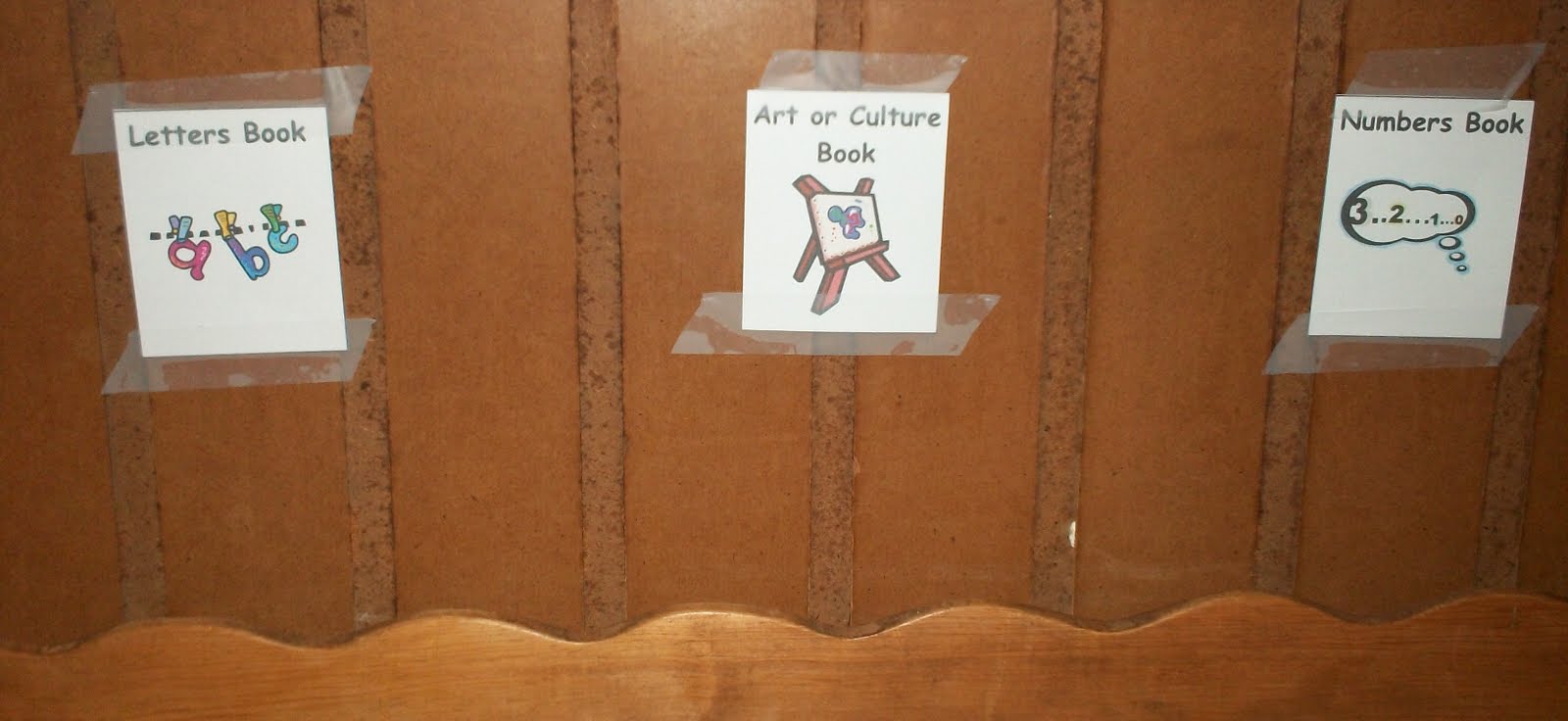
  • a letters book, an art-based book and a numbers book
  •  a choice book for each child

Limits set, it was time for labels.  I made a template and Luke decided which graphics to put into it as picture-cues for our pre-readers.  I then cut the labels out and helped the kids tape them into place where they felt they should go.   Again, the kids developed a sense of ownership over the project/system through choosing graphics and taping labels up themselves.

From there, the kids selected books that fit each category and put them away -- slipping in some math-based one-to-one correspondence, along with obvious teamwork and care of environment skills.

Once we counted eight books in place, we saw there were more books in the room than there were places for them on the shelf.  So, after a few spontaneous moments of simple addition and subtraction with books, Nina raced out of the room with the extras to put them in the living room book basket.

Then, just to solidify the new system, we practiced! We took books out and scattered them about the room. Then, at the call of “tidy time” the kids put them away independently.

Evaluation of the System
Since creating the system, the kids have been doing fair job at limiting the amount of books in their room to eight and keeping them in their designated spaces, although some morning after I have been at work, I still find a couple books on the floor instead of back in the book case. That, I think, is just a matter of getting Daddy and the kids into the habit of putting back bedtime book during our 5 T's.

Besides that, it's been so far, so good with this little organizational project. The new system is helping keep the kids’ room tidier, giving us some everyday math practice and offering the kids an opportunity to show their independence and ability to care for their environment.

Plus, it's been cute before bedtime some nights to see Luke and Nina take their personal choice books out of the case, walk out to the living room book basket and swap them out for other books which they would like read at bedtime.  I guess we can add decision-making skills to the list of natural learning that our little Quiet Time and Bedtime Book shelf revamp has included.

This post is being shared at One Hook Wonder's Montessori Monday since our bookshelf project is inspired by Montessori influences.  Check the links there for other Montessori-inspired work and projects.

Monday, April 18, 2011

Baby Steps towards More Organized Kids Art Supplies: Crayons

Since the Reggio Emilia model of early childhood education piqued my interest, I have dreamed of having an incredible home art studio for my children.  Space and organization (or lack thereof) work against making this dream a reality anytime soon.  But, if I hope to provide my children any semblance of such a space before they transition from preschool to their prepubescent years in the blink of an eye, I’ve got to stop fantasizing and start making time to take baby steps!

One baby step I have taken in the past month is to re-purpose a clear vinyl over-the-door shoe bag as an accessible art supply center for the kids.  Now, I know, this is not anything earth shattering or original but it is a tiny step in a direction I seek to go and, more importantly, it has helped the Luke and Nina keep their crayons more organized for over a month!  To me, that equals success since all my prior attempts at crayon corralling and organization have proved fruitless.

So, what’s the system?  Simple!

We hung the bag over the door to our Office/Play and Learning Space and put plastic cups in the pockets.  We were going to fill each of the pockets, but decided to do so only one medium at a time.  (So the kids can build habits of taking care of supplies slow and steady.)

The quintessential cliche of kid's art supplies came first then:  crayons.  (Not because we like being cliche, but, rather, because I am so tired of finding crayons everywhere, despite different storage and access solutions I have tried in the past for them.)

So, the kids then sorted their crayons out into “color families” by hot and cool colors and ones they thought blended together well.


They put these in the pockets.


Now, whenever they need crayons, they simply go take the cups out and bring them to wherever they want to use them, returning them when they are finished.

Fewer crayons are lost in odd corners of our home; less are being prematurely and unintentionally crushed to bits (say, by being stepped on as opposed to being purposely broken for DIY recycled crayons.)  Everyone knows where the crayons go (except Jack, who is convinced they go in mouths!) 

Life is good.  One baby step at a time, slow and steady, we are succeeding in Organizing Homeschool and supplies. 

Saturday, April 16, 2011

In Honor of National Poetry Month: Bag a Poem and The Ideal

Need a quick, fun, tactile idea for poetry writing?  Please check out my Bag a Poem Post over at OJTA, where I look at bags and other household items through SPD Lenses.

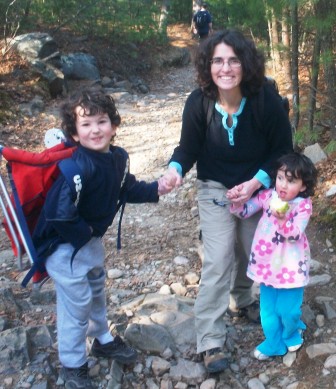
Also, as I head into the weekend, when I know I will enjoy some time with our family's Sabbath Commitment, I wanted to share another poem that I wrote as a part of Jennie Linthorst's wonderful LifeSPEAKS workshop.  This one is about my original dream of marriage and family, which has come partly to fruition, as evidenced by a sunny family hike with three gifts of joy last weekend:

Jack, so content to be headed out for his first "long mountain" hike.  May he always take comfort that our Father will carry him through the more challenging spots in his life, just like his earthly Daddy did on the trails.
It was all we could do to keep up with "Cheetah" Luke, who kept racing ahead of us with excitement.  Thankfully, he stopped to shout out with joy at times, too.  May he always remember to pause for a moment of rest and praise!
When we saw this picture of Nina after last week's hiking adventure, we couldn't help but to smile.  It looks like she is talking to angels.  May the Spirit work in all our kids to help their ideals match God's!
The Ideal

Years I waited
Long years
To meet “that man” who was meant for me.
To be gifted a child,
Or two
Or four
Or more
However many was in The Plan

But once I met him
The dream became blurry
I was told that children may not be possible
Love?
Yes
Love for our own child?
Maybe not

All I could do was pray

So, pray I did
With faith I waited
Praise God
This time not so long…

Sure enough,
Soon enough
You were there
A blessing growing within me

Once again
I could dream freely

A warm house of tradition
Sweetness and silliness
Love and laughter
Friends, Family, Faith and Fitness

Children playing
Laughing
Helping
Sharing the joys of Home

Freshly baked cookies
Friends dropping by
Vibrant family gatherings
A place
Safe
To learn
To grow
To treasure always

To kick up our feet
Or snuggle in
After a day at the beach
Or hiking in the mountains
Visiting
Volunteering
Finding the miraculous in the mundane bits of life
And the spectacular in savored moments
as family

My family
Our family
The family I prayed for since I was but a little girl

Thank you, Lord, for making part of my ideal your reality for me.  Please direct me in training my three awesome blessings up well so we may navigate the trails of this world as a path straight to You!

Friday, April 15, 2011

52 Weeks of Organizing (Homeschool) Challenge

Laura over at I’m an Organizing Junkie began the year off with a 52 Weeks of Organizing Challenge.  Well, here it is Week Fifteen, and I am just jumping aboard.  “Better late than never,” as the saying goes.  And, in my case, better with a single-minded focus for my 52 mini-projects than with my usual scattered approach – starting too many things in too many areas of our home and lives at once, resulting in little success at finishing any.

So, what is my focus:  Organizing Our Homeschool a bit better! 

Yep!  By the end of the year, I hope (key word – hope!) to accomplish 52 “small” projects, which will make our home a bit more organized and our learning activities that much more effective, accessible and exciting.  (And, yes, regular readers, I know I have attempted a similar long-term, short steps project before with my self-initiated Creative Curriculum for the Home, but I got waylaid by life events and lost steam.  So, I am letting that go for now and seeing if Laura’s 52 Weeks might help keep me on-task, motivated and accountable.)

So, with no further ado, let me announce:  We have begun our 52 weeks of Organizing Challenge and yay, Daddy, yay, me! Since Daddy has been around to play house-husband a bit more often of late, in the past month or so, I have made a good start at catching up on half of the fifteen week’s worth of projects I am “behind” on.

I had to laugh when I saw this week's 52 Weeks post over at Organizing Junkie is about Organizing Closets.  For, although the part of our home I began with is not a closet, it was being used more like a deep, dark closet.  during months of pregnancy, ligament pain, hubby being away and having a newborn and two older youngsters vying for attention, I got into a bad habit of tossing things in there "to get them out of the way", before closing the door and ignoring the mountain of mess behind it.

Yikes!  What a disaster that room became.  In fact, I was actually going to put up some "before" photos here to own up to my shame, but -oops- I left the camera out and the kids got to the buttons.  Those photos were accidentally erased, it seems.  (Probably better that way!)

Photographic evidence aside, let me just say the room was not one that was safe to move in.  So, my first 52 Weeks mini-projects involved braving it, bit by bit, from the door in order to begin turning it into a workable Play-and-Learning Space again.  I am proud to say, progress has been being made.  In recent weeks, the following mini-projects have been checked off:

  1. Recovered Play and Learning Space, Pt 1:  I sorted some books and with muscle help from Daddy and even the older kiddoes, removed book boxes from the disaster room to recover our Office/Play and Learning Space.  Granted, the boxes invaded the laundry room, where they are now stacked safely until the basement family room repairs are done and the books can be shelved.  (If the repairs to the basement get made this year, we will cull our book collection further, putting “keepers” in their permanent home on bookshelves in the basement family room - another item for my 52 list!)
  2. Recovered Play and Learning Space, Pt. 2:  To get through the aftermath of my insidious "toss it in and block it out" habit, I had to remove boxes, bins and piles of  “kids’ stuff” and other junk that had piled up in the room.  Some of this was thrown out altogether; some was freecycled or donated.  Much of it is now stacked with a minor semblance of order in the garage until it can be further sorted, organized and labeled according to mini-projects yet to come (Can we say, "future mini-project?").
  3. Recovered Play and Learning Space, Pt. 3:  I uncovered the boxes and bins of breakables, memory items and other “important” stuff from the center piles in the room and, after having to part with a few items that sadly didn't make it, I stacked the rest in neat boxes “safely”  along one wall of the room until the basement family room repairs are done and the items can be put in their permanent homes.  To be honest, I really don’t like it still in the room, but i cannot think of a “safe” place elsewhere to put it. (Ideas, welcome).
  4. Rediscovered “Work Shelves”:  I rummaged through the house to find any and all white shelves that could be re-purposed once again as work shelves for the kiddoes.  I must say that cheapo ClosetMaid-type shelves have served me well over the years as toy storage, book storage, clothing storage, end tables, shoe bins, low benches for the kids - you name it.  I love their flexibility, even if I dream of getting furniture and storage pieces that are a bit more high-end.
  5. Set Up Uniform Trays and Bins on “Work Shelves”:  After realizing I will not get around to re-purposing collected clementine boxes by reinforcing the bottoms of them and, perhaps, painting or covering the sides of them, and also recognizing that not only did I not like the look of these boxes “as is”, but also that smaller bits of learning materials fall right through their non-reinforced bottoms, I gave in and spent a few dollars.  With help from Dollar Tree cookie sheets and bins, I set up the shelves with practical “pull out” containers for play and learning materials that have a uniform look I can tolerate.
  6. Created a Baby Corner:  I cleared one corner of the Play-and-Learning Space for Jack, setting out up to three activities/toys on the floor for him to access. I ensured there were no loose cords or other dangers in the corner and that space can be “fenced off” if need be once we start spending more time in the room again.  (Now, I just need to keep an eye out for an inexpensive non-breakable mirror or reflective surface to put up on the wall for him.  Anyone know of one?)
  7. Made Morning Lotto Charts:  Recognizing the need to find more time for cleaning and organizing overall, and to get a better start on our days, I worked with the kids to create Morning Lotto Charts.  We put these on the well, at first, to get used to using them.  Then, we moved them to the kitchen table.  Now, they are in binders.  (My goal is to create a “mission control”, “household notebook” or whatever you wish to call it, for each of the children over time so they are trained never to get as disorganized as I have become.  Wish me luck.)
  8. Made 5 T’s for Bedtime Charts:  Knowing that sleep (and good sleep habits!) are vital to maintaining both health and an alert mind for learning and play, the kids and I created 5 T’s for Bedtime Charts to help us re-focus on pleasant bedtimes, which, I believe, will lead to more pleasant and productive days!
And so it is that I not only have begun my 52 Weeks of Organizing Homeschool efforts, but documented them also.  I apologize for not including visuals, but (a) there was that button mishap with the camera and (b) if I wait to post until I have photos taken, cropped and uploaded another week or more will slip by before I finish this post.  I don't want that to happen. 

Why?  Because, even though I have made a fair start on my own, without the well-wishes, encouragement and tips afforded by others meeting similar challenges I am not sure I will stay motivated to stay the course.  So, please, bring them on!

Thursday, April 14, 2011

Honoring Autism Awareness Month with Move to Learn, Learn to Move

S-O-S Research is hosting an awesome review and giveaway bonanza beginning tomorrow in honor of Autism Awareness month and, while I have hardly been organized enough to get a giveaway together here at THH for it, I somehow find time to put together the Autistic Like one over at OJTA, which is included along with some other great giveaways and reviews there that you'll have to check out.

I also wanted to reprise and update a review I wrote months ago of a book that I keep finding myself taking out of the library -- one that is great for home educators, playgroup leaders, co-op teachers. classroom teachers, and, I believe, even therapists seeking some themed ideas:


Learn to Move, Move to Learn: Sensorimotor Early Childhood Activity ThemesLearn to Move, Move to Learn! Sensorimotor Early Childhood Activity Themes by Jenny Clark Brack


* * * * 1/2 

Looking for lesson plans for sensorimotor activities?  Brainstorming sensory diet activities to match various seasonal, nature, holiday and other themes?  Just looking for some background and new ideas?  Learn to Move, Move to Learn! might be a good book for you!  Written by a pediatric occupational therapist with over 14 years’ experience in school settings, as well as experience presenting nationally on sensory integration, handwriting, learning disabilities, ADD and learning-related visual deficits, and published by the Autism Aspberger Publishing Company, Learn to Move, Move to Learn! offers a host of tried-and-true concrete, themed ideas for early childhood educators in a ready-to-go lesson plan format that both school educators and parents can draw from.  In addition, it provides information on planning activities and adapting them to different children’s needs, as well a host of useful checklists and resource lists.

Learn to Move, Move to Learn! easily earns a star for Readability with wide margins, relatively large fonts, cute graphics and a great format.  A comprehensive table of contents guides readers easily to just the information they might be looking for.  Chapters on “Overview of Sensory Systems”, “School Readiness Skills”, “Program Structure”, “Adaptations”, “Dynamic Problem Solving”, “Planning” and “Lesson Themes” quickly provide readers with a variety of information they might seek – both theoretical (but easy to read!) and practical (in plenty!).  Also, there is a quality selected Biography and a resource list of companies that provide sensory equipment, supplies, books and website addresses that relate to the books themes.  Plus, an Appendix with a “Signs and Symptoms of Sensory Integration/Processing Dysfunction” checklist, a number of “Progress Data Collection Forms”, a “Lesson Planning Form”, an illustrated list of “Definitions of Positions Mentioned in Lessons”, a list of “Recommended Children’s Books” and over 25 pages of large black-and-white drawings/patterns that can be used with lessons round out browsing pleasure.  Read cover-to-cover or browsed as needed, Learn to Move, Move to Learn! is definitely an easy to navigate and digest book!  (I read it while the kids did activities and/or laid on my lap and shoulder.)

As one can imagine just from reading its chapter titles, this book also provides plenty of Relevant information.  I loved how it helped me wrap my head around how easy it is to make traditional lesson plans and activities into quality sensory integration ones through an easy to follow (and duplicate!) sensory integration, theme-and literature-based, transdisciplinary, inclusive model.  The lesson format the book presents is simple yet comprehensive.  It includes:
  • a Warm Up, introducing the lesson theme and including things such as story reading, simple songs, finger plays and action songs
  • a theme-related Vestibular activity that might include rolling, spinning, galloping, running, hopping, skipping, jumping, crab walking, bear walking, scooter board work, obstacle navigation or the like
  • a theme-related Proprioceptive activity that might include lifting, carrying, passing, pushing or pulling heavy objects, making “kid sandwiches”, jumping or Theraband stretching
  • a theme-related Balance activity to build on the foundation of an integrated vestibular and proprioception system that might include balance beam work, walking on a hula-hoop, jump rope or strip of tape, playing balance games, doing kid yoga or working on balance boards
  • a theme-related Eye-Hand Coordination exercise, such as throwing and catching, using balls, balloons and bubbles or throwing something at a target, to help with mastery of such purposeful skills as cutting on a line, stringing beads and reproducing letters, shapes and numbers
  • a theme-related Cool Down activity, such as a relaxation exercise, simple songs, finger plays or story time, to foster a “just right” alertness level in preparation for the final lesson activity
  • a Fine Motor task, related to the theme, of course, that might include art with a focus on process, making a snack, cutting and gluing, coloring, drawing or some sort of a tactile activity

This plan format, although it may seem “heavy” or “difficult” to put together and carry out at first glance, seems quite do-able after browsing the plethora of concrete lesson examples included in the book.  Truly, after reading Learn to Move, Move to Learn!, planning lessons in the format becomes almost second-nature.  Thus, for the lesson format and concrete plans alone (and, trust me, there was plenty more I found relevant, worthy of “doing now” or “thinking abut later” in the book!), Learn to Move, Move to Learn! earns its Relevance star hands down.  It certainly has helped me see how simple the seemingly complicated task of integrating sensory learning into everyday life with my children can be – formal lessons or none!

With this in mind, Learn to Move, Move to Learn! earns a Practicality star from me, too.  I have already tried out some of the activities included in it with my children, plan to eventually make some activity choice cards based on the illustrated definitions of positions in the book’s Appendix, and have found the book has only added to my “Oo, I can do that!” list, not my “lost in theory jungle” mire.  Truly, I found the book packed with ideas for easy, steps to take towards creating opportunities for rich, fun sensory-integrated activities based on themes with the kids!  In fact, I have used it multiple times since discovering it. 

Among other things, the books inspired the puddle jumping activity that was a part of my Sensory and Skills Spring Activity Bags, was the inspiration for our Sensorimotor Fun for A Snowy Day and is a resource I am turning to in order to plan some upcoming play days and co-op experiences.  I simply love it!

For me, with a five-year-old, a three-year-old and a nine-month-old, the book definitely earns a Longevity star, too, but for all, perhaps it should only get a half-star.  For while I have definitely ordered it form our local library time and time again -- and still have it on my to-buy list -- since the seasonal and typical theme topic for learning activities in it are so great, I realize that for others, once the lesson plan format is digested, the themed lessons culled and the Appendix used, the book might not have as much staying power.  In essence, for homeschoolers and parents with kids leaving their early education stage or educators with classes that rotate in age from year to year, the book might not be so useful in the long run, but those with young ones, like me, as well as for home daycare and preschool owners, early childhood specialists, early elementary school teachers, camp staff and therapists who work with young children regularly, the book would be a great addition to their more permanent shelves.

As for Value, I think for its ease of use, rich information, variety of activities and well-researched and tested ideas the book is one that would be worth a purchase.  Granted, with our budget being what it is, I have simply been trading off with other readers in borrowing it regularly from the library, but, when I get some money together, I would still love to purchase it and other Jenny Clark Brack's other stuff - like her CD which I would love to hear!  
You can learn more about Jenny and her materials and get some great info at her site SPD Connection.

Learn to Move, Move to Learn! Sensorimotor Early Childhood Activity Themes by Jenny Clark Brack is definitely: worth a lengthy look, if not a purchase.  Enjoy it! 

A few more you titles might like that I have reviewed are:

Growing an In-Sync Child, Sensory Integration:  A Guide for Preschool Teachers and Starting Sensory Integration Therapy.

(Just click on the titles above and you'll find the reviews.)

Also, please share some of your favorite related titles in the comments section, so I can check them out.  I am a resource junkie!

Honoring Autism Awareness and National Poetry Month

Not too long ago, I was selected as a Mommy Blogger for Signature Moms, where I am committed to writing two posts a month.  I was quite honored to be selected and excited by the great opportunity Signature Moms will provide for networking, learning from and sharing with other local parents, as well as with the wide world of blogosphere, about all things kids and parenting. 

This week, I dedicated my post there to honoring Autism Awareness and National Poetry month, for although I am neither a parent of an autistic child nor an established poet, I am touched by both things.  Through our experiences with Luke, I have come to know, appreciate and empathize with folks in the Autistic community and, as recent participant in a LifeSPEAKS poetry workshop, I have been embracing my love for writing poetry again.

So, if you want to read a bit about both -- including a poem I wrote entitled "Grace as I see My Gift", please click on over.

Wednesday, April 13, 2011

Read Aloud to Real Challenges: An Early Literacy and Challenge Class with a Christian Flair

This spring, at our spring co-op, I am teaching a course for 5-8 year olds that I planned called Read Aloud to Real Challenges: An Early Literacy and Challenge Class. Basically, it is a hands-on storyhour, where we read a story together each week before doing a related challenge that is tied in to some tradition or story within our faith.

This past week I facilitated our first class – and, boy, did we have fun. For those who would like to borrow my ideas, I am sharing a detailed description of the lesson below.

Welcoming Prayer and Stretch
Welcome students to the class, explaining that we plan to have a lot of fun in the coming weeks reading stories, doing challenges and using our gifts of creativity and problem solving, among others. Explain that we’ll have to really use our mind during class, and that I believe one of the best ways to get our brains going is by stretching our bodies. Teach the following prayer and stretching exercise which will begin each class:

 We thank you God for the sky above, (Stretch onto tip toes, arms up high, really reaching for the sky) and for the ground below. (Bend over and touch toes or floor.)  We thank you, God, (lunge to one side, really stretching arm out) for everything (do the same to the other side)  that we come to know. (spin around and sit down).


Warm-Up Challenge
Explain that now that we have stretched our bodies, it is time to stretch our brains with a little mini-challenge. Place a pile of foam letter stickers (which actually contains the letters for each child’s name in it) in front of the students and tell them their challenge is to organize the stickers into as many groups as there are children. For example, if there are only three children in the group, let them know that they must organize the stickers into three groups that make sense.

Then, allow the students to work together, trying different approaches to organization. Expect them to do such things as sort the letters into some kind of alphabetical order, into piles by color, into groups of the same letters. As they do so, comment only on what they are doing, not on what they could or should be doing, and if their efforts meet the challenge guidelines. For example, “Oh, you have all the A’s together, and the L’s, and a J, and two S’s. That’s one way to sort the stickers. Do you have more than three groups though?”

If the students seems to be getting frustrated, offer increasingly less-subtle hints until you note one student “discovering” the key. (A big hint might b taking attendance and noting that there are four A’s among all the names on the list.) Once a child starts to “get it”, encourage others to note what that student is doing and to follow suit.

After everyone has taken their own stickers, offer each student construction paper, so they can choose a color they like to make a name plate for themselves. Note that “we don’t have a trash bin for the pieces we are ripping off. What could we use to collect our trash until we can get to a trash can?” Let a student solve the problem, perhaps suggesting putting all small scraps on a piece of newspaper.

Read Aloud: Albert’s Alphabet
Albert's AlphabetCongratulate students on working well individually and as a team to meet their first challenge. Explain that you will now read a book about a duck that has his own letter challenge to meet. Then, read Albert’s Alphabet slowly, really inviting the students to look at the detailed illustrations on each page, noting how Albert attacks his challenge, how creatively he used materials, etc. Have fun talking about the strategies and materials he uses, his creative ideas, etc., as well as predicting in what ways Albert might make the next letters – especially the “Z” at the end. Also be sure to point out the paper plans Albert sometimes uses if no student notes them first.


The Main Challenge: Building the Holy Spirit
Referring to Albert, comment that he sure had a gift of creativity and that God gives each of us gifts. Ask if anyone knows about the gifts related to something the Church honors this month. Ask if anyone knows what this month is dedicated to. (The Holy Spirit).

Elicit and expand upon what the students know about he Holy Spirit, using print outs from Catholic Culture for background and visuals if you wish. Ask if anyone knows a symbol for the Holy Spirit, perhaps one that is a bird, like Albert is a bird. (Dove). Then, explain that the word D-O-V-E will be the basis of our Big Challenge today, but that, first, we need to think about how to approach any challenge.

Using Albert’s challenge, as well as the mini-challenge from the beginning of the class as examples, briefly discuss the approach we will take to challenges in our course:

  1. Identify the challenge or problem.
  2. Brainstorm ideas on paper, through discussion or just by trying things out.
  3. Testing our ideas and revising them as necessary.
  4. Sharing our results.
Offer white boards and highlighters or dry-erase markers for students who might like to write about or sketch their plans as Albert did in building some of the letters he did in the book.

Finally, draw attention to a set of materials – paper scraps, cardboard tubes, tape and craft sticks – and a set of tools – scissors, glue, pencils and crayons, and offer the challenge guidelines:

Your challenge is to build the letters D-O-V-E using the materials and tools provided. The letters must be freestanding and they can only be made using the materials provided.

Let the students use their creativity to do so, stepping in only to offer guidance about respecting the space your are in (for example, putting newspaper under constructions that are being built with messy dripping glue) or using each other for help when needed (for example, “You can work individually or as a team. Either way, go ahead and ask each other for help or suggest ideas to each other.) Focus on process over product, being aware that some students may not be able to complete the entire word before the end of the class period.

If there is time at the end, which is unlikely, have each student share how they approached the challenge – their ideas, revisions and successes. If there is ample time, offer a second challenge: Now, build your own name.

Notes:
For larger groups, consider making Design Brief Hand Outs, such as the one found at one of the sites that inspired this plan.

Have fun, enjoy and be amazed, as I was, at the creativity God gifts each and every one of us and the gusto with which children work together to use it!

And, if you happen to try this out, be sure to stop by and let me know how it went.  I always enjoy collaborating to tweak and improve plans for future use!

This post is being shared at We Are THAT Family's Works for Me Wednesday, since both co-op, and free resources online that can be adapted for our lesson plans, really work for me.  What works for you at home, school or work?  Link up to share at WFMW.

LinkWithin

Related Posts with Thumbnails