Friday, July 10, 2020

Immerse Kids in Survival Skills & Adventure with a Classic Book & Excellent eGuide {A Progeny Press Review}

{Some links which follow may be affiliate ones.}

Disclaimer: I received a FREE copy of this product through the HOMESCHOOL REVIEW CREW in exchange for my honest review. I was not required to write a positive review nor compensated in any other way.

If you are a book study guide lover or just want to cherry pick ideas from an excellent eGuide as your lower elementary through high school students read classic stories, I encourage you to ch
eck out Progeny Press, a popular Christian vendor of study guides for literature that makes it their mission:

"To teach our children to think clearly, to understand literature, and to rely on the scripture for truth and values, and enjoy themselves while they do it!"

We're recently been checking out their 
My Side of the Mountain Study Guide by Carol Clark - an eGuide meant for students in grades 5-8 which can be completed in 8-10 weeks - and I can honestly attest that it is a thorough, varied guide chock full of ideas for learning, review, and discovery.


The guide is written to be used in its entirety for independent unit-based engagement and study. However, it is also designed and organized in such a way that parents and/or students can easily scan it to pull an idea here and an activity there for more flexible enrichment or targeted study.

The Study Guide Comes in a Handy Digital Format


When you order your
 My Side of the Mountain Study Guide, or any eGuide from Progeny Press, you get instant access to a downloadable study guide and separate answer key.

The interactive PDF format of the eGuide works on our Windows laptop, and, I hear, works on Macs, too.

Once  opened with the FREE Adobe Readerprogram, the eGuide allows students (or parents who have students narrate to them) to enter answers directly on the computer and save their progress as they work. (I believe with an a
lternative app the fillable fields of the interactive guide can work on mobile devices and tablets, too.)


This interactive PDF format is convenient! It means that do not have to print any of the guide if you'd rather just have your kids work onscreen. Or, you can easily print just what you need or want - the whole guide at once, a single lesson or page as students need it, or multiple copies of pages for your family's use.
All the convenience and learning. None of the paper and ink waste. Love it!


What I love even more is that the answer key can also be easily printed or accessed onscreen which can help parents/teachers to check student work without having to read and answer questions on their own.

Plus, there is free technical support offered should you encounter any difficulties when using the digital guide and answer key. This, though, I doubt would be needed by anyone, since the eGuide and Answer Key are so easy to use. Seriously, everything worked A-okay here with this study and one we did previously.


The My Side of the Mountain Study Guide Is
One Complete Study Guide!

When I said the My Side of the Mountain Study Guide is "a thorough, varied guide chock full of ideas for learning, review, and discovery" earlier I meant it 100%.

The eGuide offers:

  • author information
  • story synopsis and background
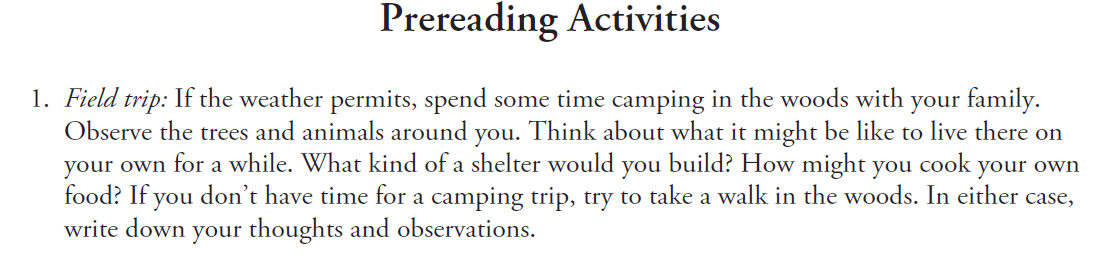
  • pre-reading activities
  • vocabulary study
  • Bible study
  • critical thinking
  • comprehension questions
  • post-reading activities
  • writing prompts
  • resource listings
  • literary device activities
... and more. In doing so, it really gets students engaged and learning as they immerse themselves in reading classic literature and thinking about survival skills, adventure, and faith.

Included in the 63-page interactive eGuide are:

  • Literary Techniques to include adjective use, alliteration, allusion, anthropomorphism, assonance, comic relief, coming of age (or bildungsroman, which was a new word for me), conflict, dramatic structure, facts vs. opinion, flashback, full-circle ending, irony, metaphors and extended metaphors, mood, onomatopoeia, oxymoron, paraphrasing, point of view, recapping, similes, suspension of disbelief, verb use, and more.
  • Moral Lessons and Character Values about such things as acceptance, being alone, bullying, fear and worry, daily life, honoring parents, hospitality, lying, patience, provision, superstitions, and understanding God.
  • Activities and Writing Assignments to include at and design, cooking, creative writing, a crossword puzzle, drama projects, essay choices, field trips, health & nutrition, journalism, journal writing, letter writing, legends, maple syrup, math connections, parody, plant research, poster projects, research writing, rock climbing, safety chats, science connections, wooden toys, and more.
  • Suggestion for Further Reading, which include more materials by the same author and books that tie in with or are similar to My Side of the Mountain.

You can find samples of the eGuide at My Side of the Mountain Study Guide.


Why We Chose the My Side of the Mountain Study eGuide and What We Thought


A few years ago, I got it in my head that I wanted to use the well-loved classic, 
My Side of the Mountain by Jean Craighead George, to start an outdoor book-and-adventure club with friends. However, life kept happening and the club never came to be. Still, I wanted to read the book with my younger two children before they age out of it. Thus, when an opportunity came up to review the My Side of the Mountain Study Guide by Progeny Press, I took it as a prompt to break the book out for some relaxed Mom-and-us style learning.

Key word there is relaxed! Because we were using this thorough resource during the bridge from spring into summer when we tend to wind down more formal studies, I opted to use the eGuide in a non-traditional way with my children.

Basically, we read my old, weathered copy of 
My Side of the Mountain together as we swung on an outdoor swing together, laid on a blanket in the sun, or snuggled before bedtime. Then, every few chapters, I would break out the study guide with the kids and use it for prompts for faith-and virtues-chats, oral quizzes about vocabulary, literary devices, etc.

I also browsed it for ideas for enrichment for practical life and survival skills among other things.


This led to nature walks and explorations...

 ...salads with wild edibles...


 ... some strawberry picking...


... foraging for clay and trying to make clay ovens...


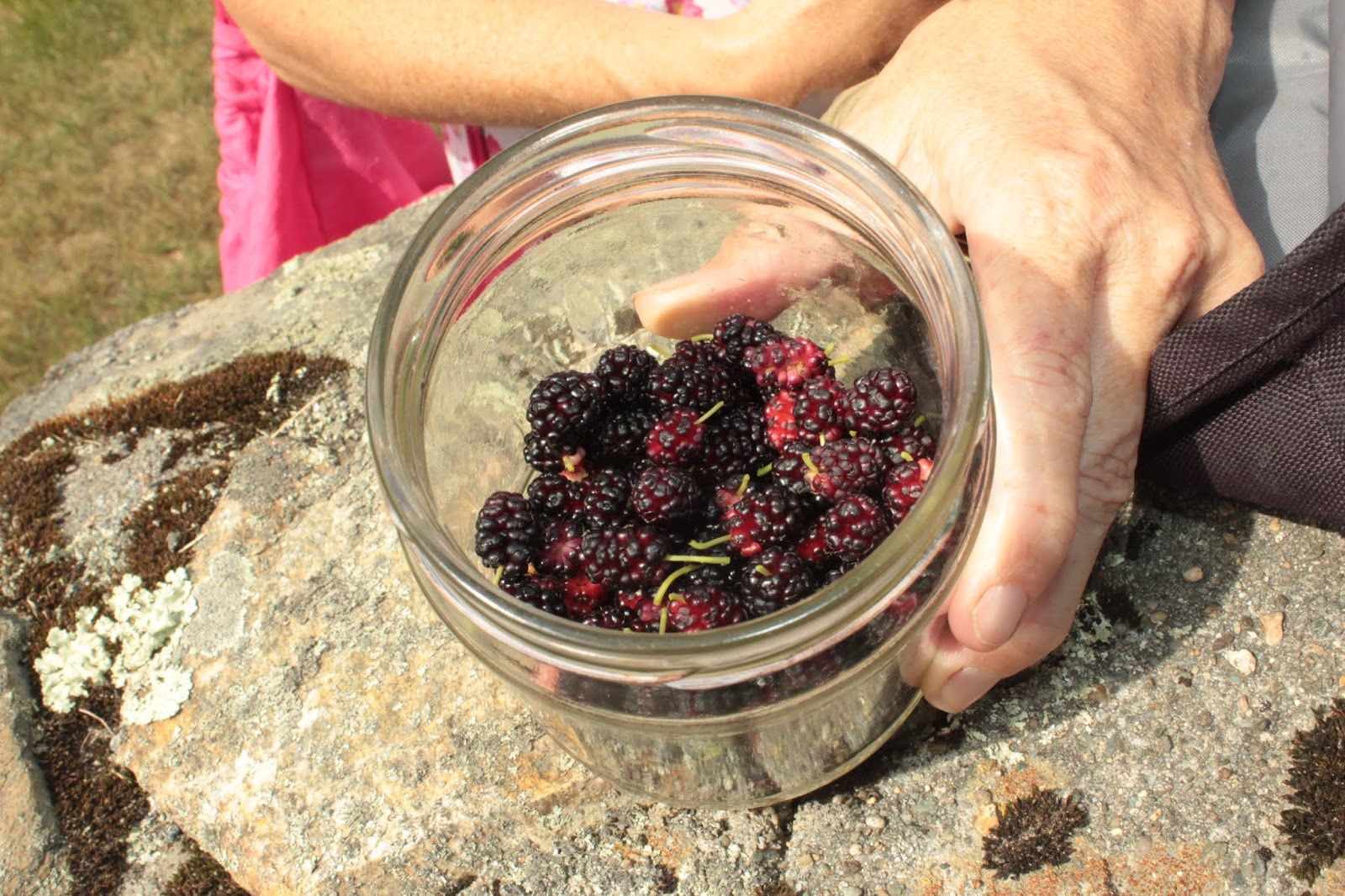
... picking mulberries...


...building fires...


... picking black raspberries...


... making chocolate covered strawberry deliciousness...


... foraging for and whittling walking sticks...


... and more!

There has just been so much inspiration for hands-on, outdoor, fun and learning!
Or course, there has been indoor learning, too.

Sometimes, I read my children questions from the guide and had them answer orally while I took quick notes on their answers in the fillable fields so I would remember which questions we'd already covered.


One time, when we did this, I set a timer, gave the kids game chips as points for every correct answer and, let the child who had the most chips at the end of the game choose if we would have a snuggly read together or watch one of the movies we'd found in the resource section together before bed.


The winner chose the latter, so we found free access to one of the recommended movies on Youtube. Then, as we began watching it, my other child came in, and the movie engaged us all.

After watching, the movie we dovetailed into natural conversations that night and the next day during which the kids compared parts of the movie to My Side of the Mountain (especially the survival aspects and the ideas of running away and coming of age), chatted about survival skills, and discussed some cultural and faith points that  the movie and our eGuide-enriched study of My Side of the Mountain brought to the fore.


I was delighted with all this and grateful for the eGuide, since I had never heard of the movie before and do not think we would have happened upon it without the eGuide's suggestion.

I also do not think our entire experience with My Side of the Mountain book would have been as rich as it has been without the eGuide. I am grateful that the eGuide allowed us to embrace natural, relaxed learning, to find some great extension activities/resources, and to review some key literary devices, vocabulary, and more.

The My Side of the Mountain Study Guide certainly is a blessing that has all the typical vocabulary exercises, comprehension questions, writing prompts and literature device studies that you'd expect in a literary unit study which can be used traditionally or in a more relaxed way. It also focuses on connections between the classic book of one boy's adventure and coming of age and Scripture and offers a wide array of optional activities and further resources to engage students in wonderful exploration and learning.

I most certainly recommend the My Side of the Mountain Study Guide to others with middle school age learners whether they like independent literary studies or relaxed, hands-on family learning like us.


Learn More

Progeny Press gets a two thumbs up from me both for this My Side of the Mountain Study Guide and for an earlier Progeny Press review of their Give Me Liberty E-Guide due to how well it is written and designed and how family-friendly they are with wonderful extension ideas and permissions that allow you to use the eGuides with multiple children within your family.

Progeny Press earns similar ratings with other families, I hear, for its wide variety of E-Guides geared toward elementary schoolers, middle schoolers, and high schoolers.  You can read about some of the other titles offered among the 64 Progeny Press social media, blog, and video reviews that Review Crew families have shared.


You can find Progeny Press on:


Sunday, July 5, 2020

"The Peace of All Things Is the Tranquility of Order" FREE PRINTABLE Copywork or Journaling Set


Today, in a beautiful homily, a quote by St. Augustine grabbed ahold of my attention and continued to resonate. So, I decided to create a FREE PRINTABLE copywork/journaling set with the quote on it.

My thought is that my children - and yours - can use the quote as simply copywork in cursive...


... or printing.


To this end, as I often do, I have designed the printable with clear spaces between each word of the quote to help children remember to leave spaces between words as they copy and have also used a double thick line at the bottom of each blank line to help children remember to ground their letters.

Or, if children are beyond the copywork stage, they can use the quote as a journal prompt, filling the blank lines with their own thoughts after reading the quote or after reading the City of God, where the quote is taken from.

Either way, I pray this simple FREE Printable 
"The Peace of All Things Is the Tranquility of Order" Copywork or Journaling Prompt Set encourages your children to write beautifully and think deeply.

If you'd like me to share more Copywork & Journaling Prompt sets, just let me know.

You can find 
more free, printable copywork here,  

Sunday, June 28, 2020

Get FREE Printable Prayer Before the Crucifix Copywork in Cursive and Printing


Last week, when I shared a FREE PRINTABLE Anima Christi copywork set, I explained that my youngest has a desire to join the Server's Guild at an FSSP parish some distance from our home and that, as a part of doing so, he must commit to praying certain prayers daily, before Mass, and after Mass.

One of those prayers is the Prayer Before the Crucifix, which I have just discovered has more than one version.

In the missals at our local parish, we learned these words for the prayer:


Behold, O kind and gentle Jesus, I kneel before you and pray that you would impress upon my heart the virtues of faith, hope and charity, with true repentance of my sins and a firm purpose of amendment.  At the same time, with sorrow I meditate on your five precious wounds, having in mind the words which David spoke in prophecy: “They have pierced my hands and my feet.  I can count all bones.”  Amen


However, the FSSP parish uses a longer version of the prayer. Thus, I decided to make my son a copywork set to help him learn this version, and, like I often do, I am sharing the free printable Prayer Before the Crucifix set here in case it might bless you and yours.

Also, as is typical of most of the 
free copywork sets I share here, the Prayer Before the Crucifix set includes a cursive model...


...a print model...


...and a blank line sheet.


That way, your children can choose to practice their printing, cursive, or both.

Also, as I often do, I have used a double thick line at the bottom of each line on the blank sheet to help children remember to ground their letters and have also used spaces between each word on the model to help children remember to leave spaces between words as they copy.

I hope this simple Prayer Before the Crucifix set is helpful for your children as they work on practicing prayers and handwriting.

You can find more free, printable prayer copywork here!

Gain an Indulgence

"A plenary indulgence is granted on each Friday of Lent and Passiontide to the faithful who, after Communion, piously recite the above prayer before an image of Christ crucified; on other days of the year the indulgence is partial." — Enchiridion of Indulgences, No. 22

Sunday, June 21, 2020

Get FREE Printable Anima Christi Prayer Copywork in Cursive and Printing


Our youngest became an altar server at our local parish on his name day about two years ago and has since expressed an interest in joining the Server's Guild at an FSSP parish some distance from our home.

Having visited the that parish for Mass recently, our son's enthusiasm only grew, so we are looking into the training he will need to undergo and understand that, as a part of it, he must commit to praying certain prayers daily, before Mass, and after Mass.

One of those prayers is one he is not that familiar with: Anima Christi Soul of Christ).

So, I have made him copywork of the prayer and am sharing a FREE PRINTABLE Anima Christi set here for others who may benefit from it.


Just like other free copywork sets I have shared, the Anima Christa printable includes a cursive model, a print model...


...and a blank line sheet.


That way, your children can choose to practice their printing, cursive, or both.

Also, as I typically do, I have used a double thick line at the bottom of each line on the blank sheet to help children remember to ground their letters and have also used spaces between words on the model to help children remember to leave spaces between words as they copy.

I hope this simple Anima Christi set blesses your and yours as you work on practicing prayers and handwriting.

You can find more free, printable prayer copywork here!

Learn More about the Anima Christa

The beautiful Anima Christi was composed in the first half of the 14th century and, as a favorite of St. Ignatius Loyola, enjoyed renewed prominence through his 16th century “Spiritual Exercises”.
Sometimes attributed to Pope John XXII, the prayer was enriched with indulgences in 1330. Then, it seems that in 1854 Pope Pius IX revoked all previous indulgences and granted instead:
  • an indulgence of three hundred days every time the prayer is recited, with at least contrite heart and devotion;
  • an indulgence of seven years, once a day, to priests who shall say it after saying Mass, and to the faithful, after receiving holy communion.


The
1968 Enchiridion of Indulgences assigns the a partial indulgence.
O Immaculate Mother, pray for us

Thursday, June 18, 2020

Learn about History with the U.S. Life Saving Service {A Review}


Disclaimer: I received a FREE copy of this product through the HOMESCHOOL REVIEW CREW in exchange for my honest review. I was not required to write a positive review nor compensated in any other way.

Flexible and fun history that can be used for home, co-op, classroom, or museum program use?  That is what Rebecca Locklear delivers with her Exploring the U.S. Life-Saving Service 1878-1915: 17 Student Workshops with 120 Activities (which we've recently had an opportunity to review) and, I hear, The Mayflower at Cape Cod – Stories, activities, and research that connect 1620 with life today that other Homeschool Review Crew families have been enjoying. 

Engage in Learning about Courageous Life Savers from the Late 1800's and Early 1900's


My family receive a digital version of the 120-page Exploring the U.S. Life-Saving Service 1878-1915 book which is chock full of information and ideas to guide students in grades 4-12 in an investigation of the time period of 1878-1915 through the lens of the U.S. Life-Saving Service - a forerunner of the U.S. Coast Guard which installed eight-member rescue teams on remote coastlines of the USA.

With portions to read, critical thinking and problem solving activities, group work (which can be great if you participate in a co-op, scouting, etc.), and research areas, the curriculum is a well-rounded one. It also aims to capture and keep student attention and make learning memorable, accessible, and relevant through activities such as:

  • art
  • cooking
  • drama
  • games
  • music
  • science
  • stories

and more.


Material in the book is written at level that students in grades 4 and 5 can enjoy and grasp, while older students, parents, and teachers can learn and enjoy, too. That makes it great for family studies.

It is also broken into four workshops - or units - with additional art and research ideas, which makes it adaptable for a short study (cherry picking a single workshop) or a longer one (moving through all four workshops and extending with research).

Any way that 
Exploring the U.S. Life-Saving Service 1878-1915 is used, it surely aims to make students enthusiastic about learning about the courageous and good-humored men who rowed out through violent storms to rescue folks aboard shipwrecks and makes for an interesting addition to history studies!

Our Experience


Although 
Exploring the U.S. Life-Saving Service 1878-1915 is written in such a way that entire families can enjoy it together, because my 14-year-old has a heavy, self-selected workload right now, I chose to dive into the Exploring the U.S. Life-Saving Service workshops with just my 13 and almost-10 year olds.

We started by reading material fro the introduction and watching a linked Youtube video and, then, carried on with other reading, watching, and activities, completing the "Life at the Station House" workshop and dipping into some others.


My almost-10-year-old had this to say about our experience so far:


I never actually knew about the Life Saving Service before. I think it is interesting. Did you know they shot lines out of canons to attach to masts to save people? Did you know that they each had a cooking day? And did you know they had to sit in a tower   number hours and ring a bell every 30 minutes to tell people they were awake? I learned all this and more.


My favorite part so far was making the bread with molasses using the muffin recipe from the book. We learned molasses was made back then by people stomping on sugar cane.


We also made a chowder (with our own made up recipe because the life saving men often created their own recipes with what they had available and chowder was a common dish.)


I recommend this to people who like history.

And my 13-year-old said:

The U.S. Life Saving Service study taught me about the live saving stations. I did not know much about them before. 
One of the worst things I think that they had to do besides saving people in storms was stand up for four hours on watch in frigid weather looking for ships in distress. 


I thought it was interesting that they all took turns cooking for each other. In some ways that sounds interesting, but in others not so much. I like the stories and play they told about it. It made it seem more like actual real life than just reading it, and it was funny. We also learned that these days you cannot kill a lobster in some countries by boiling it.
It is illegal in some place, because they say lobsters can feel pain. Of course, the live saving station men did not follow that rule. They boiled lobsters, hunted for food, fished sometimes when on drill, and more. 


A motto of the life saving servicemen was that the book says you have to go out to save people. It does not say you have to come back in. The men had to be brave, courageous people willing to face danger, death, and terrible weather to save others. In between, they also faced extraordinary boredom at times just doing drills, cooking, watching, waiting...
I liked this study and want to finish using it. I think it would be good for late elementary school through middle school

So, as you can see, so far so engaged here with my kids and this resource. That makes me happy!

Happier still is that the resource connects to local history for us!


We realized that we are blessed to live within driving distance of some of the remaining life saving stations.


So, the other day, we drove to one, hoping to be able to tour inside. 


Of course, though, due to current events, the place is closed this season. Still, we were still able to view the exterior and imagine the life the men led inside.

We also were able to enjoy some of the same beaches that the men may have done their work on. Granted, we did this in beautiful sunshine, not stormy gales, all the while recognizing how the men would have had to navigate the cold, wavy seas during inclement weather to rescue people and, at times, products.


We hope to return to the station we visited once it opens and also hope to foray in a different direction to another one. Having done Rebecca's study, such field trips will be especially meaningful.

We recommend the study as an interesting one that can easily adapt for home, classroom, and group use, engaging students through a wide variety of activities and are grateful for having had this opportunity to learn more about local and national history through the lens of the Life Saving Service.

The life, work, and legacy of the men in the Life Saving Service surely is interesting and worthwhile to learn about!


Learn More


Over 60 Homeschool Review Crew families reviewed either Exploring the U.S. Life-Saving Service 1878-1915: 17 Student Workshops with 120 Activities or The Mayflower at Cape Cod – Stories, activities, and research that connect 1620 with life today over the past few weeks. Click through to find social media and blog reviews.


Find writer Rebecca Locklear on Facebook. You can also sign up for Rebecca's email newsletter through her website where you will find more ideas and information from this talented writer and multiple-subject teacher of materials for preschoolers through 12th graders who is also a professional pianist, choral director, and outdoor enthusiast with a motto of Dum vivimus, vivamus, which in Latin means “Let us LIVE while we live", which shines through in her work.

We enjoy Rebecca's work!

LinkWithin

Related Posts with Thumbnails