Sunday, March 10, 2019

4 Easy Steps to Planning a St. Joseph's Day Feast

I was asked recently for a step-by-step of how I organize liturgical year gatherings. So, today, I am sharing the simple process that friends and I went through to pull together what turned out to be a fun and faith-filled St. Joseph's Table last year.

The Solemnity of St. Joseph is coming up on March 19 - a perfect day for getting together with friends to pray, eat, and observe this special day of the liturgical year through enjoying a St. Joseph Table - and a time you don't need to sweat the prep.

Trust me on this!  


You can delight in a fabulous feast day celebration as a family or with friends with very little advanced planning. 


In fact, last year, friends and I put together our St. Joseph table with but 24 hours advanced notice!

Image may contain: people sitting, table, food and indoor

Three tiers represent the trinity.

A white tablecloth represents the pure love of God

Fish remind us of the apostles.

Fruits and vegetables remind us of the abundant harvest that was shared after a drought when the first St Joseph table happened.

Pasta with "sawdust" reminds us of St.  Joseph and
beans recall the fava beans that people ate during the period of having no food before they prayed for St. Joseph to intercede and the rains and harvest came.

Cupcakes bring cheer with their special toppers.

Flowers should be lilies for St. Joseph, but, instead, are just what we had.

Cookies and fruit make a flowering St. Joseph staff of St. Joseph.

Image may contain: food

More pastries and savory dishes were added as more families arrived.

How did we do it?

We used four easy steps you can follow:


1 - Get Word Out that You'd Like to Enjoy a St. Joseph Table


Of course, if you plan to celebrate St. Joseph's day as a family only, you can skip this step.  However, if you'd like to enjoy a St. Joseph Table with friends, getting word out is your first step.

In the past, I have personally invited friends to my home or secured a host family and planned a group St. Joseph Table with plenty of advanced notice.  That is, until last year, when I found myself posting the following in a local Catholic Facebook group on March 18:


LAST-MINUTE ST. JOSEPH'S TABLE GATHERING ANYONE: I got behind in life and failed to suggest this earlier, but am throwing it out today in case anyone would be up for an impromptu gathering.
Tomorrow is St. Joseph's Feast day. Would anyone like to host a POTLUCK St. Joseph's feast day table anytime from 4 p.m. forward? If so, give a shout here in a comment with time and location, and others who'd like to go, comment with what you'll bring.
I can provide the a white table cloth and 3 tiers for the table, a candle, a gluten-free, casein-free "sawdust pasta" dish inspired by tradition as well as some sort of "flowering staff" (though not my usual one as I could not find the cookies this year) and perhaps some other things. I just cannot manage to provide the hosting location right now. 


Image may contain: table and indoor 

Within an hour, someone responded with an offer to host!

You could do similarly - getting word out via Facebook, texts, phone calls, emails, or just chatting with friends.


2 - Set a Time and Location, Making It an Official Event for Your St. Joseph Table


Once we had a host location and time, we made our St Joseph Table event "official" by creating a Facebook event page and inviting all the local Catholic homeschoolers we knew.

If you do not use Facebook, you could use a free planning tool such as Perfect Potluck or just go with good old fashioned phone calls and face-to-face chats to make official invitations.


3 - Share Ideas and Resources to Get Guests Excited and Thinking about What They Might Add to the Feast


While some of our invited guests were already familiar with St. Joseph Tables from past celebrations, others were brand new to the idea.  So, my next step was to shard the following ideas and links with our guests.

(Note: The photos were not part of what I shared as ideas and links, but, rather, examples of how people responded.  Each photo is something that was brought to lay on our table. Yum!)


Image may contain: 1 person, food

Find pictures, explanations and links of some of our past St. Joseph Tables at our 1st St. Joseph's Table, Our 2nd and 3rd, our 4th, and our 5th.
If you do not know much about St. Joseph's Tables, here is a great explanation! 
A Slice of Smith Life has shared about her beautiful table, which is inspiring! 
Catholic Cuisine offers wonderful recipes and more! 
Some things that could flesh our our table if you'd like to bring them are:
  • flowers, particular lilies
  • a St. Joseph statue or peg doll
  • oranges (traditionally given to children on this day)
Image may contain: 2 people 
  • St. Joseph prayer cards (mine are missing)
  • any great St. Joseph story you have 
  • traditional breads (or cut outs of fig newtons or gluten-free tortillas) in symbolic shapes, such as lilies, sandals, ladders, saws, hammers, nails, beards, ladders, canes or staffs of St. Joseph, crosses, palms, wreaths symbolizing Jesus, artichokes, grapes, and twists
Image may contain: fruit, food and indoor 
  • grapes or other fruit and vegetables, symbolic of an abundant harvest shared
Image may contain: food 
  • beans (Fava beans are traditional, but any can do!) 
Image may contain: food 
  • 12 whole fish (to represent the twelve apostles or the miracle of loaves and fishes; or one, if that's all you can manage: tuna, sardines, white fish, whatever....shellfish and seafood, particularly Baked Red Snapper are often traditional)
Image may contain: food 
  • pastries, and possibly symbolic pastries with fig in the following shapes: Monstrance, chalice, cross, dove, lambs, fish, Bible, and hearts. (GFCF fig newton-like cookies are an easy one to shape!)
 Image may contain: food and indoor

  • Pupaculova: bread baked with dyed Easter eggs reminding of the close approach of Easter (or just any festive pastry)
 Image may contain: drink
  • grapes, olive oil,olive salad, and dried figs: which are reminders of vineyards and orchards of Sicily
  • Pignolatti: fried pastry in pine cone shapes, reminders of the pine cones Jesus played with as a child. 
Image may contain: food 
  • Mudica: Pasta Milanese with browned and seasoned bread crumbs sprinkled on top to represent the sawdust of St. Joseph, the carpenter - or a GF version
Image may contain: fruit and food 
  • a fruit or veggie Italian flag (green-white-red) 
  • fruit in a serving dish (to remind us that saying "yes" like St. Joseph brings fruit to our lives
  • wine (traditional and reminds us of the Miracle of Cana) 
  • no meat 

As you can see from the photos above, the ideas shared offered plenty of visuals, background information, and recipes for each participating family to be able to think of something to gather, make, or buy to bring to our table.

Feel free to simply copy and paste this idea list for your guests!


4 - Leave the Rest to the Holy Spirit 


Once the ideas were shared, we left the rest of our planning up to how the Holy Spirit moved each family and simply trusted that those who were able to make it would bring enough food for a beautiful and filling table and that we would all be blessed by a time filled with faith, friendship, fun, and, of course, feasting.  

We were not disappointed!


Image may contain: 3 people, people eating, people sitting, table, child, food and indoor

We actually ended up with more food than the table we had set up could hold...


Image may contain: 4 people, people sitting, people eating, table, food and indoor

... and learning more about the feast day.

Granted, as the person leading the "teaching" portion of our celebration, I had forgotten to get my favorite St. Joseph book 
- Joseph's Story by Patricia Pingry  - out of our library in time, and also was not able to unbury both of our copies of Prayers to My Favorite Saints and Prayers to the Saints before we left for the gathering, but I was still able to use print outs from some of the links above, a saint book, and the children's background knowledge - plus God's grace! -  to offer a decent chat anyway.


Image may contain: 8 people, people smiling, people sitting

Everyone, then, was able to focus on praying and a chat about St. Joseph and the history and traditions of his feast day.

Image may contain: 19 people, including Martianne Stanger, people smiling, people sitting, living room and indoor


Then, the children enacted Jesus, Mary, Joseph, the saints, and angels coming to the table...


Image may contain: 3 people, including Martianne Stanger, people smiling, shoes and indoor

...before digging in!


Image may contain: 2 people, people sitting and indoor


Then, everyone chatted and played right through when it was past-time to go home.

Image may contain: 2 people, people sitting and child

Truly, our St.Joseph's Table gathering was a blessed and beautiful time - all coming together in 24 hours.


If you'd like to put together a St. Joseph Table this year, then, take our testimony as proof: Enjoying a St. Joseph Table with friends does not have to be a huge, time-consuming undertaking.  It can come together quickly and meaningfully.

We encourage you to give it a try!


Need More Ideas and Inspiration for Celebrating St. Joseph's Feast Day?


This year will mark the sixth anniversary of when my children and I began partaking in the tradition of a St. Joseph Table.

In the past, I have shared about each of our tables, including pictures of what we ate, descriptions of our activities, and links to specific books, prayers, and resources.

Come now, and take a walk with us down Memory Lane...


Our First St. Joseph's Table


Our first St. Joseph Table was super simple - and super fun to share with friends.  It included coloring and a construction-themed playdate!

Our 2nd and 3rd St. Joseph Tables

Our second St. Joseph table was even simpler and celebrated as a family breakfast while our third began to get a little bigger and included a playdate with prayer, drawing, crafting, and more.

Our 4th Included Prayers, Crafts, and More

Our fourth was one of my favorites! A friend hosted it, and we were able to involve whole families - even Dad's - in plenty of prayer, crafting, and eating!

Our 5th Brought Fond Memories, Too

Our fifth was filled with delightful dishes and good company! 

And, our sixth, as I already explained was a fine example of the Holy Spirit helping last-minute preparation turn into a lovely time honoring the Solemnity of St. Joseph with friends.


We hope this walk down memory lane provides you with plenty of inspiration for beginning, reviving, or sustaining your own St. Joseph Table traditions.  


Image may contain: one or more people


St. Joseph, pray for us!

Monday, March 4, 2019

Victus Study Skills {A Review}

Traditional study skills are something my family sometimes neglects with our eclectic homeschool style, yet I know they are important.  So I was happy to receive the Victus Study Skills System to use with my children and ended up trying out Level 2: Elementary (2/3-4/5) and Level 3 (5/6-10/11) and reading through the rest. 


What is the Victus Study Skills System?

The Victus Study Skills System is a program that has been developed and taught for over 40 years, equipping thousands of students with strategies and skills to become life-long learners.  It teaches study skills to primary, elementary, middle school, high school, and college students using student workbooks, a teacher edition, and supplements.

Ideally, the 10 lessons of the course are taught in five one-hour sessions over five consecutive days, using the same basic concepts at each of the program's four levels, but, of course, going deeper with each subsequent age bracket.  This means, if you wish, you can teach children at a variety of age levels at the same time with each level working on age-appropriate materials that coincide with one another.

Further, the creators of the Victus Study Skill system believe that repetition is the mother of all skill, so they recommend that the course be reviewed yearly.  That way, as students mature, they can better master understanding and skills.

Basically, primary students are introduced to
 terms and concepts. Then, elementary school aged students build on those basic ideas and begin to learn and apply new study and life skills.

By middle and high school, students better establish skills as habits in all areas of life. Then, college-bound and college age students not only master the basics, but also establish good habits and understand the importance of time management and related skills as a way of life.


Of course, it is not vital for students to start using the Victus Study Skills System at the primary level, though. Nor is it necessary to use it at all four levels.  The system is flexible and can be effective regardless of if a student jumps into it at Level 1, 2, 3, or 4, does it just one time, or repeats it in each subsequent year of schooling. 

The Victus Study Skills system works at each level, step-by-step, to focus students on such skills as:
  • understanding personal learning styles
  • time management
  • goal setting
  • organization
  • note taking
  • active listening
  • test preparation
  • test taking

After reading through the complete program at every level and trying two levels of it with my children, I can say that for students following traditional learning approaches, the Victus Study Skills System offers a time-tested and practical way to teach, build, and reinforce study skills.

In fact, I can recall learning similar skills in middle school and high school and many of those skills served me well through the years.


Will It Really Help Every Child?


When I took on this review, I pictured using the system together with my 8, 11, and 13 year olds to stretch my children beyond their typical comfort zones and learning styles in order to introduce and teach study skills in just five short hours.

To be honest, that did not happen.

The program - though wonderfully well thought out and organized - just did not appeal to my children and so it dragged some.

Why?  Well, my children were immediately put off by the Study Habit Checklist towards the beginning which talked about taking notes, preparing for tests, and taking tests.

Why were they put off by this?  Well, that's just not how we tend to "school".


So, I explained to my children that this program is for all students and many students do, indeed, take regular tests, etc.  I also explained that at some point in their learning and work career, they will likely face the challenge of traditional study needs and tests, so this course will help prepare them for it.

Then, understanding why my children had little desire to spend our precious present on something with little relevance to them, I said,  "For now, we can skip some questions and parts, but let's give the course, overall, a try." 
I encouraged them. "It will surely have some relevant ideas and may be interesting."  

Thankfully, the next portion of the program - the learning strengths quiz - held greater appeal for my children, and they actually asked to take the quizzes written for their own levels and, then, to do the ones written at different levels to compare results.


Following the children's lead, we discovered that the quizzes at different levels came up with similar, but no exactly the same, results. They also, thankfully, re-ignited my children's interest in the program again.

So we carried on.

In doing so, I admit, I veered away from the lessons as written, and chose to skip the tips pages related to learning strengths, paraphrasing and adapting the suggestions from these pages to our less schooly style of homeschooling before moving on to the mission, statement, time management, and goals sections.


Then - ugh - parts of these lessons had my children feeling a bit disenchanted by the "schooliness" of some of the material (such as a focus on improving grades). So, again, we adapted and worked to make materials relevant to our eclectic, sometimes relaxed and delight-directed,  way of homeschooling.

Through doing so, my children picked up some helpful strategies and I noted a new way of looking at goals as versus objectives.


Then, came sections focused on strategies for note taking, test prep, and tests, which held little to no relevance for my children, but which I could see being a wonderful resource for them should they choose to take outside classes which require such skills or should they decide to dual enroll in their high school years or go to college as a step in pursuing their vocations.


Thus, we chatted about how and when the skills in the latter half of the program might help them and even found some applications for our here-and-now with note-taking and memorization ideas that my children could use for some classes and clubs they have chosen to partake in this year.

Final Thoughts

Obviously the Victus Study Skills System was a less-than-best fit for our present homeschool style; however, I can see its merit.


In fact, having tutored homeschool, private school, and charter school children for years, I can definitely see how the Victus Study Skills program could be a huge help to brick-and-mortar school children, be well-suited to homeschoolers who follow a structured, school-at-home style approaches, and act as an excellent preparation tool for any style of homeschooler that chooses to enter college.

Learn More


If you'd like to see what homeschoolers of various styles thought about the the Victus Study Skills System, find reviews of 50 Homeschool Review Crew families.

Read all the reviews.


Find the Victus Study Skills System on social media:


Crew Disclaimer

Sunday, March 3, 2019

Go Egging with this FREE Spy Wednesday Printable!

In preparing for Lent, I realized that I have yet to share the printable that my children and I created last year to use on Spy Wednesday - the Wednesday of Holy Week when we recall how Judas made a bargain with the high priests to betray Jesus for 30 pieces of silver.


Thus, today, I am sharing it - both so that I won't forget again and also so that you will have plenty of time to print it and gather and stuff eggs before Spy Wednesday.

Why might you want to egg on Spy Wednesday, you might wonder.

Well, because it is a kid-friendly way to live the liturgical year while spreading truth, giving to others, and covering the sad spying Judas did with a secret effort for good!

(Of course, you might also want to look into other Spy Wednesday traditions, which vary country by country, and family by family.)

Now, back to an egging tradition...


My children and I first began egging together in 2013 and have  since continued to do so between Spy Wednesday and the end of the Easter season. 

Using Our 2013 Printable

The first couple of years that we did so, 
we used a FREE "You've Been Egged" printable that we created and shared in 2013, posted it on people's doors and secretly went about egging in their yards.

https://drive.google.com/file/d/0B6Lk1nwk2KPdQWVack9OLUNjdU0/view?usp=sharing
Egging Post-Easter Sunday

Then, in 2015, after the children enjoyed Spy Wednesday egging so much that they wanted to do more egging post-Easter Sunday, we decided to create another FREE printable for specific use after Easter Sunday.
We used that printable until last year, when, after discussing how Lent is a more somber and penitential season before the bright and joyous Easter one, we decided that we wanted to change things up a bit.

Get this FREE printable!


My children and I agreed that it would be fitting to create a more Lent-themed printable and to include prayer aids - such as a rosary, a holy medal, a prayer card, etc. - in some of the eggs we distributed.  That way, we could not only spread truth and love, but encourage others to pray.

So, that is what we did.


Then, we headed out...


...and snuck about making reparations for Judas by spreading love and truth instead of ill will.


We look forward to doing it again this year and hope that by sharing our FREE Spy Wednesday Egging printable, you might be able to easily do similarly if you wish!


May your Lenten journey be meaningful and blessed!

Monday, February 25, 2019

Go Back in Time to See Moses Lead the Israelites out of Egypt and Jericho Fall {A The Secret of the Hidden Scrolls Book Series Review}

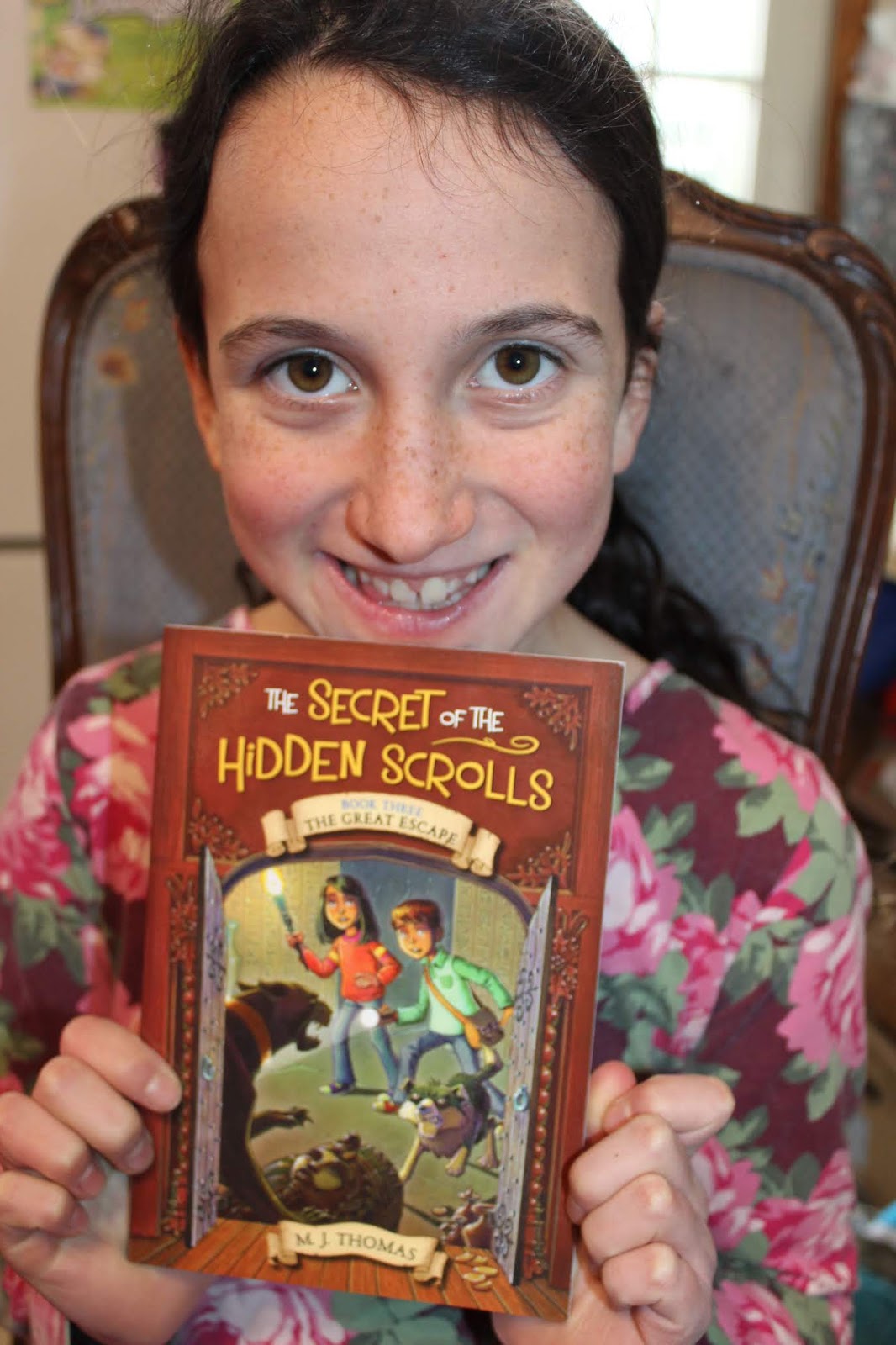
Interesting, adventure fiction set in Bible times and true to Bible stories!  That's what my youngest two children and I recently enjoyed as we read Books #3 and #4 of The Secret of the Hidden Scrolls series from WorthyKids, an imprint of Hachette Book Group.


{Some links which follow may be affiliate links.}

When we were given the opportunity to review 
The Great Escape (Book #3) and Journey to Jericho (Book #4), my youngest cheered. He remembered Books # 1 and #2 of the series, which we'd read for a prior review, well, and was excited to see where the two main characters - Mary and Peter - and their dog, Hank, would go next.  My daughter was curious, too.  So, as soon as the books came into the house, we began reading them together.

What Is the Premise of the Secret of the Hidden Scrolls?


In The Secret of the Hidden Scrolls series, two siblings, who are staying with their Great Uncle Solomon, end up traveling back in time with their Dog, Hank, to different Biblical periods, having to solve mysteries on scrolls in order to return to present times.

While in Biblical times, the threesome meet real Biblical characters, witness key Biblical events, face evil, and solve mysteries. As they do, readers become engaged in adventure, imagination, and fun, while also learning more about Bible stories.

Why Were These Books Written?


Author M.J. Thomas went looking for engaging books that would teach kids about the Bible, but could not find any to his liking.  So, he decided to write such books himself, naming the main characters after his son, Peter, niece, Mary, and dog, Hank.

He wrote the books so they could be read as independent reads for children ages 6-9 at a grades 1-3 reading level or enjoyed as read togethers.

Each 100+ page softcover book includes adventure, time travels, and Bible stories that capture children's attention while building their faith and knowledge, and the books conclude with references to encourage families to dig deeper into the actual Bible. 

What is The Great Escape About?


My daughter offered to tell you about Book #3. She said:

The Great Escape is about two children named Mary and Peter who travel back in time with their dog, Hank, to the time of Moses. They land in the middle of the desert and somehow find themselves inside a pyramid, where a black panther tries to attack them.

Mary and Peter escape, swim across the Nile River, and meet a girl named Shephara. The girl invites them to her house, and they discover that Shephara is a princess.
Shephara, Mary, and Peter witness Shephara's father, the pharaoh, refuse Moses' request to let the Israelites go for the first time.  The Nile River then turns to blood. The same sort of pattern goes on for all the plagues except for when the firstborn son of every family dies. For that final plague, Mary, Peter, and Hank end up with the Israelites and Peter is not killed by the Angel of Death. 

Then, Peter and Mary travel across the Nile River with the Israelites before they solve the secret of the hidden scroll and return to present day.  

They ask Great Uncle Solomon what happened to their friends in Egypt and reads them the Bible story. 

Even with the pattern of the plagues, the book does not get boring.  The author M.J. Thomas keeps it entertaining by presenting things in different ways, such as Peter's journal, Shephara dealing with the plagues because her father is so stubborn and listens to his "Great Magician" who does "magic" (tricks). 

I have read the story of the plagues and Moses and his people's deliverance from Egypt in the Bible and think that this book keeps to the real story. It just adds fictional characters to help readers picture themselves back then. 

The book also has a couple pages that tell you where in the Bible to find the people, places, and events from the story. 

I would recommend this book to kids who like entertaining chapter books written with simple words and a few illustrations. People who like fiction, the Bible, and Bible History will like this book.

What Is Journey to Jericho About?


My youngest son offered to tell you about Book #4.  He said:

I read Journey to Jericho over my mom's shoulder as she read the book to my sister and me. In this book, two kids named Mary and Peter and their dog, Hank, travel back in time to the fall of Jericho. They carry with them spy gear from their Uncle Solomon and a scroll with secret words they have to solve in order to get back to Uncle Solomon's house. 

In the beginning of the story, Mary and Peter are at their Uncle Solomon's house and discover a secret room. They go in it, and Uncle Solomon finds them. He tells them about how he was a spy and gives them supplies and spy names - the Bear and the Monkey.
 

Then, Peter and Mary hear the lion's roar and know it is time to travel back in Bible history. They end up in the Israelites tent with the tabernacle, are caught, and are accused of being spies. They get out of that trouble and being welcome in the Israelites camp.
 

Later, they follow spies into Jericho, defend a young girl who is bullied, and make friends with her family. Her family helps them escape from a Man in Black and get out of Jericho.
 

They hide in the mountain, cross the Jordan (which was hard), witness the Israelites marching around Jericho, and sneak back into Jericho to warn the friends they made there to escape.
 

The Man in Black tries to catch them and steal their scrolls, but due to the angel Michael and Mary's spy skills, he fails. The walls fall and the secret of the scroll is solved just as Mary, Peter, and Hank were going to get stuck back in time.
 

Mary and Peter fall into the couch of Uncle Solomon and ask Uncle Solomon to read them the rest of the Bible story about Jericho. They ask if the Ark of the Covenant was ever found, and Uncle Solomon says, "No, not yet."  They reply, "Maybe we can help." Uncle Solomon then says, they have more adventures to come.
 

I thought it was interesting to see how Mary and Peter's story joined in with the real story of the fall of Jericho, which I already knew about. It is fun to read about the kids' adventures and to kind of imagine what it would be like to be them. This book is a good way for people who know the Bible stories to see them in a new way and for people that don't to learn about them.
 

I would recommend this story to younger listeners and readers who want to learn about the Bible in a different way.


In these books, author M.J. Thomas brings readers on adventures back to Biblical times alongside siblings Peter and Mary and their dog, Hank.
 

The recommended reading age is ages 6-9, or grades 1-3, and I'd say that is right on target.  I will also add that the stories, though relatively simple, are written well enough that even my 11 year old child with dyslexia remained engaged reading an occasional page to me and having me read the rest.


Learn More


I appreciate how each of the books we've read from The Secret of the Hidden Scrolls series engages my children with a clever combination of Bible stories and fun characters solving a mystery as they adventure back through time to key Bible events.

If you'd like to read about the first two books in the series, read
our prior review.

Learn about Books 1 and 2.

Want more opinions about Books 3 and 4? Click on through to read any of the sixty Homeschool Crew Review family's thoughts about these books.


Read all the reviews!

Find Worthykids on social media:


WorthyKids
Crew Disclaimer


LinkWithin

Related Posts with Thumbnails