Wednesday, August 23, 2017

Layering Everyday Homemaking into Life {A Review and Discount Code}

My home needs all the help it can get, so I was happy to review The Everyday Family Chore System from Everyday Homemaking over the past month.


Everyday Homemaking was written by Vicki Bentley - a Christian homeschooler, author and speaker, and parent who raised raised her own eight daughters and fostered nearly 50 other children through the years, too.  Thus, as you can imagine, the book is written in a succinct, helpful, down-to-earth way that can help you create structure and routines that will help your children:
  1.  to be responsible members of a family who diligently serve one another
  2. become efficient at chores and living skills as they go from observing you performing specific tasks, to doing them alongside you, to doing hem on their own.

I received a 90 page PDF version of
Everyday Homemaking and found it a motivational and practical read.  The book consists of five parts: 
(1)  The Introduction:

This portion of the book captured me right away as it is subtitled: "You may be wondering:Who is this woman, and why is she telling me this?" and, then, goes on to explain just that. As it does, the author explains that she is "not a child training expert; (but) simply a well-practiced mom who has made a lot of mistakes along the way, tried to learn from them (with God’s grace), and is willing to share what has
worked for our family over the years."  She also says that as a response to requests, she is sharing "some of the principles that worked in her family and some examples and ideas to provide a springboard – and hope!"   

Hope!  Yes! That is what my household needs.  I am such a poor housekeeper, and, despite years of working to improve my own habits and to build better ones in my children, we are all very much works in progress.  So, having tried-and-true tools and wisdom to help my children and I all become increasingly responsible, caring, sharing members of of our family when it comes to household tasks - and just life in general - is a blessing.


(2) Laying a Foundation


This section discusses child training from a Christian perspective and
details four principles: 

  • Have realistic and age-appropriate expectations.
  • Establish rules or standards.
  • Have a working knowledge of family discipline
  • Tie strings to their hearts.

What stuck out for me most in this section was the reminder that
:
We want our kids to show stellar character and good judgment in their decisions. However, it has been said, “Good judgment comes from experience. Experience comes from bad judgment.” Give them opportunities to learn from mistakes when they are young, being sure that the consequences are safe and relatively temporary.


Paired with a powerful comparison between how we react as parents when children do things wrong as opposed to how a policeman speaks and acts when pulls someone over for speeding, the section was quite timely for me to read. One of my children, in particular, has been pushing limits a lot lately and my reactions to his pushing could be improved, I know.

The reminder that, "Someone will very likely test the rules today. It is just part of the territory when you’re a parent. You can prepare yourself in the family service arena by having age appropriate
expectations, pre-set consequences, and a sense of humor," was an excellent one for me!


(3) Implementing the Plan


This section gets into the nitty gritty of how the author used her system when raising her family and how you might tweak it to best fit your own family.  It includes practical examples, some sample lists and charts, and, most appreciated by me, a down-to-earth voice of wisdom that encourages us to reach for ideals while still living with what's real in the moment.


Within this section is my favorite "tool" of the entire book: a two page Life Skills Checklist that begins at Age 2 and moves through age 13+.  This list has some dated items on it (such as, "Make a long-disance call," and "Use a payphone.").


However, the majority of it is relevant and helpful, with the BEST part (in my opinion) being little numbers in brackets after listed skills, which give you an idea of when a child should master a skill.  So, for example, under Age 5, it says, "Put away clean clothes (9)"  That means a child of five is capable of beginning to be trained in the job, but may not master it until age 9.  And, under Age 4, it says, "Learn to swim (12)", so it looks like my kids are right on target.  We got them in water early and they are still mastering their strokes.

This section includes pre-labeled cards and tags - as well as blank ones - to be copied or printed and prepared for use.  Cards are printed on every other page so you can just print, cut, and go with them if the author's cards work for you.  If they don't, you can use them as a sample for making your own, or supplement them with your own made from blank cards.

When I received the book, I was most excited about the detailed How-to-Do-It cards in this section, because I have long wanted to make similar ones for my kiddoes, but just have not gotten to doing so.  However, upon reading the cards carefully, I realized they weren't quite right for our home situation, so I am just using them as models to develop my own - appreciating their detail, and, at times, humor.  (Or at least I find some humorous!)


Yep, those details highlighted above speak of wisdom and motherhood to me!


...And this one (above) cracked me up.  Does she know my kid?!?


Yes!  How often do the highlighted things become a small issue in my home?

(5)  Suggested Resources


The final pages simply list other books and online ideas from Everyday Homemaking.

How I've Used the Book

Obviously, I read the book with an encouraged and thankful heart.  So many parts spoke to me and I found myself jotting down both inspirational and practical ideas.  In the end, though, I did not, however, choose to implement the system as written.  I could just see clothespins and detailed paper cards adding to the clutter in my home instead of working to curtail it at this point (because our home is hugely cluttered and is exploding with paper as it is!) 

Still, I took parts of the book and system to heart and am rolling ideas from it into our existing routines.

We have long had a Five Before Breakfast routine, which, at one point, was even written on a hand-shaped paper cut out like one shown in the book. 


We have also had an established Family Work Time (FWT) period, during which the children (sometimes Daddy) and I work together for 30 minutes on household chores, sometimes together and, sometimes, independently.  When I began this habit, my intention was to train children in jobs much the way this book explains how to, and, then, to request they do those jobs independently while I do other ones.  However, as I looked at some of our recent FWT lists, I realized we've been in a holding pattern - where children are doing familiar jobs, but I have not been training them in new ones.  Thus, the book's Life Skills Checklist and Detailed Work Cards have come in handy for me in deciding what skills to train my children in next (both for FWT and just for life!)


Another thing we have had for a while are Job Jars.  When I initially made these, they were meant to help us with FWT as well as with times when the children wanted to spend their free time earning special privileges.  Basically, I wrote tasks on popsicle sticks and set them in a jar.  When a child pulls a stick, the child completes the tasks and puts it in the "thank you" jar.  Daily, I reset the daily jobs to the first jar and, weekly,  I reset the weekly ones.


On one side, sticks are labeled with the location of a task and if the task is a daily (D) or a weekly (W) one.  On the other side, a specific task is written. I also put a colored line at one end to indicate which of my children had been trained in the task (blue for my oldest, pink for the next child, and orange for my youngest)  That way, my children can quickly pick tasks they are able to do! 


Use of these jars comes and goes in our home, but has definitely increased again since I read
Everyday Homemaking.  I have also realized it is time to draw some additional color lines on some sticks as my youngest has been mastering new tasks, and there are quite a few tasks we could well use to add to the jars!  (Again, the book's lists and cards come in handy for me as a resource.  I use them to judiciously add jobs.)

Finally, the Life Skills Checklist has me thinking more specifically about what Practical Life activities to focus on this year.  In reviewing the list, I realized my children are "ahead" of the game in a few things, but there are quite a few skills they could use introductions to or mastery of, so these two helpful pages are becoming our Practical Life "backbone" for the year.  Thank you, Vicki Bentley!
 

Would I Recommend This?

I most certainly have gleaned encouragement and practical ideas from
Everyday Homemaking, so would recommend it to:
  • parents who are just starting out with chore systems and want a tried-and-true one that is flexible or copy-and-go depending on your style
  • parents who seek to revamp their existing chore systems using tried-and-true wisdom
  • parents seeking ideas on how to increase accountability and responsibility in their children.
     
I would not recommend it to people who do not like reading things from a Christian perspective, though, as the author's Christian world view comes across strongly in the book.  That said, even for folks like this, the book could be helpful as the chores system, some tips, and tools within it would work in most homes, I think! 
Everyday Homemaking truly presents tips and tools that can be added to your current chore habits and routines to revitalize and improve them,  or the system described in the book can be used on its own as a "new" complete chore system for your household! 


Learn More

 The Everyday Family Chore System typically sells for $15.99 as an e-book or $19.99 printed, however, until September 5, you an use the DISCOUNT CODE TOS10books at checkout to receive a 10% discount on any of Vicki Bentley's books!

You can find Everyday Homemaking on Facebook.


Everyday Cooking and Chores Systems for your Family {Everyday Homemaking Reviews} 
 
Ninety Homeschool Review Crew families received one of the following two books to review.  Click through the banner to find links to read what each of us thought:
.
Everyday Cooking
The Everyday FAMILY Chore System

How do you help your children see helping with household tasks as a way to serve your family and, then, train them to serve with efficiency and diligence?

Crew Disclaimer

Sunday, August 20, 2017

Celebrate St. Rose of Lima's Feast Day


August 23 is the optional Memorial of St. Rose of Lima, the first canonized saint of the Western Hemisphere and the saint whose name a local church bears.  Thus, I plan to sprinkle our week with faith, food, and learning that relates to St. Rose of Lima.

As I brainstorm some S.K.I.L.L. T.I.M.E + activities and a simple feast day meal, I thought I'd share them in case you, too, would like to weave saint-based learning, food, and fun into your week.


Saint Rose of Lima S.K.I.L.L. T.I.M.E + Ideas 


{Disclosure:  Some of the links which follow are affiliate ones.}


S - Spell and Learn Words  

My daughter always cheers when we play our spelling word game, so, we'll likely write "Saint Rose of Lima" on mini-white boards and then try to create as many words as we can from the letters within the saints' names within three minutes.  Before beginning our timer, we'll recall that every word has to have a vowel in it and, then, suss out what vowels (and r-controlled vowels) we could use in our words, such as:

/ă/ a
/ā/ a, ai, ea, ei
/ä/ a
/ĕ/ e, ea
/ē/ e, ea, ei, i, ie
/ĭ/ i
/ī/ i, ei
/ŏ/ o
/ō/ o, oa, oe, oo
/ö/ o, oo, oe
/ŭ/ u, ou
/ū/ u
/ü/ u, oo
/oi/ oi
/ow/ ou

Plus, the R-controlled vowels ER, IR,  EAR, AR, and OR.

 
We'll also look for consonant blends might help us form words (like fl, fr, sl, sm, sn, st, and str.) and, perhaps, recall some quick reminders of strategies:

  • thinking of rhyming words (i.e. "sat", "rat", and "slat")
  • using plural "s" or "es" and 3rd person singular verb "s" or "es" (such as "lot", "lots", "tan" and "tans")
  • finding as many words as possible from just one word in the name before moving onto the next (as in finding "a", "an", "tan", "tans", "I", "is", "as", ""in", "sin", "tin", "tins", "it", "nit", "sit", "its", "nits", "ant", "ants", "at", "sat", "nat" and "nats" in "saint" before adding the letters in the word "Rose" to add, "art", "rain", "sane" and so forth)

From, there, it will be time to set our timer, find words, write them down, then compare them with each other when the timer goes off.

K - Keep Reading to Yourself


The children, as always, will be able to choose their own reading for "Read to Self" time, including the following saint day selections which I will pull from our home library as well as order from our public library:

 
http://amzn.to/2ijCq3T
"St. Rose of Lima" Saints and Angels by Claire Llewellyn


http://amzn.to/2ijumzV

"St. Rose of Lima" in Lives of the Saints: An Illustrated History for Children by Bart Tesoriero
http://amzn.to/2wnSAz5

"Saint Rose of Lima" in More Saints: Lives and Illuminations by Ruth Sanderson


https://www.amazon.com/His-Likeness-Reverend-Charles-Yost/dp/B0044PJA76/ref=as_li_ss_tl?ie=UTF8&qid=1499053377&sr=8-2&keywords=in+his+likeness+yost&linkCode=ll1&tag=traihapphear-20&linkId=2ebe10380eac9f63deb605a0f9622f0b
"Saint Rose of Lima" in In His Likeness


I would love other recommendations of Saint Rose of Lima reads, too, if you have any.


I - Illustrate and Write

For copywork/studied dictation the children may choose from any of these quotes from St. Rose of Lima's writing:


"The gift of grace increases as the struggles increases."
"If only mortals would learn how great it is to possess divine grace, how beautiful, how noble, how precious. How many riches it hides within itself, how many joys and delights! No one would complain about his cross or about troubles that may happen to him, if he would come to know the scales on which they are weighed when they are distributed to men."

"Lord, increase my sufferings, and with them increase Your love in my heart."

"Apart from the cross there is no other ladder by which we may get to heaven."

"Let men take care not to stray and be deceived."
 
We might also write brief narrations about St. Rose of Lima's life, and, since she took special care of the poor and is patron to the Philippines, we may also write to a child we sponsor in the Philippines.


L - Listen to Reading

This week, we will begin reading Saint Rose of Lima together.


http://amzn.to/2vRknqm


If you don't have access to any books that include Saint Rose of Lima in them, you might simply read one of the following online pieces:


  • Saint Rose of Lima, which includes the reflection:
    It is easy to dismiss excessive penances of the saints as the expression of a certain culture or temperament. But a woman wearing a crown of thorns may at least prod our consciences. We enjoy the most comfort-oriented life in human history. We eat too much, drink too much, use a million gadgets, fill our eyes and ears with everything imaginable. Commerce thrives on creating useless needs on which to spend our money. It seems that when we have become most like slaves, there is the greatest talk of “freedom.” Are we willing to discipline ourselves in such an atmosphere?


  • Saint Rose of Lima, which has biographies for young families, practiced families, and experienced families.


L -Learn and Play with One Another Using Language Arts

Among St. Rose of Lima's symbols are:

  • a crown of thorns and roses (symbolizing her purity and beauty and the penances she underwent) 
  • a needle and thimble (significant because Saint Rose of Lima worked as a lace maker to help support her family and is patron of embroiderers and needle workers)
  • a spiked crown (again, for St. Rose of Lima's suffering)
  • an iron chain (because it is said she whipped herself with one as a voluntary penance)
  • roses (which represent holiness and purity)
  • an anchor (which represents steadfast faith in the face of great suffering)
  • the Holy Infant (because she had a great devotion to the Holy Infant and His Blessed Mother)

We might see how many of these symbols we can include in collectively written silly stories or more serious prayers.


T - Think, Read and Write About Math

After reading St. Rose's biography, I may challenge the children with such story problems as:

  • St. Rose of Lima was born April 20, 1586 and is said to have begun strong devotions at five years old.  In what year did her strong devotions begin?
  • St. Rose of Lima died on August 24, 1617.  How old was she when she passed?
  • St. Rose of Lima was beatified 50 years after her death.  In what year did Pope Clement Ix beatify her?
  • She was canonized by Pope Clement X four years later.  What year was that?

 
I - Investigate and Problem Solve with Math


It is said, that, St. Rose of Lima and "and her brother Ferdinand built a tiny hermitage in her father's garden. She planned to live there. It was so small that her mother protested. 'It is big enough for Jesus and myself,' said Rose. Here, for the remainder of her life, she was to spend all of her days and part of her nights in contemplation, performing the penances which she devised to punish herself for the sins of the world."

As a challenge, using Brain Builders, a doll figurine (to represent St. Lima, and a Jesus figurine, I may challenge my children to build tiny hermitage models.

Thinking of St. Rose of Lima's quote, "
Apart from the cross there is no other ladder by which we may get to heaven," I may challenge them to build a ladder-like form or tower that has crosses in it and can reach as high as possible toward the heavens.


https://www.amazon.com/MindWare-66009-KEVA-Brain-Builders/dp/B00IECWX5G/ref=as_li_ss_tl?ie=UTF8&linkCode=ll1&tag=traihapphear-20&linkId=f10582afe6c473bf312723023bc776dd


M - Master Math Skills Together

 
St. Rose of Lima died at the young age of 31.  Thus, we may use this number and our Cuisenaire Rods to review and practice math concepts together, such as:


  • Is 31 even or odd?  Prove it using rods.
  • How many ways can you make the number 31 using rods?  What addition facts do these bring to mind?
  • What are factors? (Numbers you multiply together to get another number.) So, what are the factors of  31? (1, 31)
  • What is a prime number?  (A number that can only be divided evenly by one.)  Is 31 a prime number?

E - Exercise Math Skills on My Own


In 31 short years, St. Rose of Lima offered much to our Lord.  With this number in mind, I will challenge my children to use all four basic operations (addition, subtraction, multiplication, and division, create 31 math problems that equal 31.


+ Extra Learning and Fun


  • Virtues:  We will likely discuss temperance, fortitude, justice, and prudence in relation to St. Rose of Lima. Also, since she was charitable providing for the physical needs of the poor, the sick, orphans, and the elderly, we may chat about how we might serve such people this week, too.
     
  • Handiwork:  Among other peoples, St. Rose of Lima is patron of embroiderers and florists.  We may try our hand at some embroidery, sewing, or flower arranging.

  • Practical Life:  St. Rose of Lima is also patron of gardeners, so it will be a perfect time to take care of some overdue garden chores.
  • Food Fun:  We will likely have a meal or snack of "roses".  We may use GFCF tortilla wraps to try out something similar to these tortilla roses, or I might have the kids experiment with making rose shapes from GFCF bread slices rolled out.  Alternately, I might just serve bread with some other rose-shaped food, maybe having the kids get fancy cutting strawberry roses. (I know I won't make mini apple rose pies this year, but want to save the idea for the future!)  

  •  Herb Tasting:  St. Rose of Lima is said to have fasted on bread crusts and bitter herbs at times.  Remembering this, we may have an herb tasting, seeing which herbs in our garden - or at the farm we go to - taste the most bitter.
  • Nature Study and Poetry:  In Mysteries, Marvels and Miracles: In the Lives of the Saints, you can read about how Saint Rose of Lima sang with the birds.  Thus, we may go on a nature walk to spy birds and listen to their song.  We may also study the words of St. Rose of Lima's song as poetry:
 Tiny singer, flit your wings;
Bow before the King of kings.
Let your lovely concert rise
To Him Who gave you songs and skies.
Let your throat, full of carols sweet,
Pour them before the Eternal's feet
That we His praise may magnify
Whom birds and angels glorify.
I shall sing to Him who saved me:
You will sing to Him who made ye.
Both together, we shall bless
The God of love and happiness.
Sing, sing with bursting throat and heart!
In turn our voices will take part
To sing together, you and I,
A canticle of holy joy.
{As the bird flew away:}
The little bird abandons me:
My playmate's wings ascend.
Blessed be my God,
Who faithfully Stays with me to the end.
 
  • Art Study:  We may examine paintings of St.Rose of Lima pictured saint books or online, noticing details, color palettes, what we like, etc.  Alternately, as it is said that St. Rose of Lima was drawn to stare at a picture  Christ crowned with thorns, we may study an artwork depiction of Christ like this.

  • Geography:  Of course, we will find Peru on maps and globes.

Of course, pending how the week unfolds, some of these ideas may not come to fruition this year and others may pop up, but any which way, with these ideas gathered in one place, we'll be able to dive into St. Rose of Lima faith, food, and fun for years to come. t

As always, I would love to hear your favorite resources, traditions, recipes, and ideas related to St. Rose of Lima as well. 


St. Rose of Lima, pray for us.

Sunday, August 13, 2017

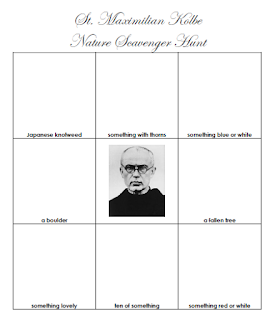
Get a FREE St. Maximilian Kolbe Nature Scavenger Hunt Printable!


Last year, I shared 4+ Sensory-Smart Ways to Learn about St. Maximilian Kolbe and mentioned an idea for a scavenger hunt that I had after reading about the symbolism of the reliquary used for the St. Maximilian Kolbe relics my children and I were able to venerate. 


{Disclosure: Some links which follow are affiliate ones.}
 
This year, I thought I would create a new FREE St. Maximilian Kolbe Nature Scavenger Hunt printable based mostly on St. Maximilian Kolbe's life as told in the Loyola Kids Book of Saints, which I plan to reread to my children before going on our nature walk.  


In case you do not have time to get the book, however, I included a page of discussion points with the scavenger hunt so that you can easily retell parts of St. Maximilian's story on your own:


  • Japanese knotweed: Father Maximilian started a Catholic magazine and newspaper that reached hundreds of thousands of people in just a few years. He, then, traveled to Japan to start another even though he spoke no Japanese.   (If you do not have Japanese knotweed in your area, just cross this one out and put something else that might remind children of Japan or the far east in this box.  Something hair-like: Fr. Maximilian grew a long beard before traveling as a missionary to Japan as a long beard was respected there at the time. Later, he has his beard shaved off and some of hi whiskers are now included in reliquaries.
  • Something with thorns: In 1939, Nazi invaded Poland and began a thorny occupation. Because Fr. Maximilian was an outspoken priest, the Nazis wanted to shut down his popular magazines. So, they arrested and imprisoned him briefly in 1939. Then, in 1941, they arrested him again and sent him to Auschwitz in Poland, where he became prisoner # 16670 and later died. 
  • Something blue or white: In prison, Fr. Maximilian wore a blue and white uniform and lived in a large, cold building where he slept on a board.
  • A boulder: Fr. Maximilian was forced to do hard – and sometimes horrifying - work, like carrying boulders, moving large trees, and carrying dead bodies to ovens where they would be burned. 
  • A fallen tree: Fr. Maximilian was starved and beaten in prison. Once, a guard strapped a plank to Maximilian’s back and made to run. When he collapsed, he was kicked and whipped. 
  • Something lovely: Despite hardships, Fr. Maximilian never stopped loving God or others. He persisted in prayer through sad, desperate situations and tried to help other prisoners.
  • Ten of something: When a prisoner escaped, Nazi prison guards decided other prisoners would be punished to discourage other escape, so they selected 10 prisoners who would be starved to death. 
  • Something red or white: One of the prisoners cried out, “My poor wife and children! I will never see them again,” whereupon Fr. Maximilian said, “I would like to take the place of Sergeant Gajowniczek.” So, Fr. Maximilian and nine others were taken to a cell to starve to death. After several weeks, only four men – including Fr. Maximilian – remained alive. At this point, the Nazis gave them injections to kill them. Fr. Maximilian died on August 14, 1941 at age 47, a martyr pure in his love for God. This fulfilled a promise he had made Our Lady when he had a dream as a child in which she held out a red crown and a white one to him, asking him if he was willing to accept either of the crowns – the white one meaning he should persevere in purity and the red that he should become a martyr. He said he’d accept both. 
  • Saint Maximilian (free space): When Fr. Maximilian Kolbe was canonized a saint in 1982, an elderly Sergeant Goajowniczek, his wife, and his children were present in St. Peter’s Square. God’s love – as shown through St. Maximilian Kolbe – had saved his life. St. Maximilian put love before even his own life.

Also, as you can see in the discussion points, I have included an alternative for Japanese knotweed in case you don't have any in your area.  In the FREE printable pdf, there is a second scavenger hunt sheet with this alternative on it.

In the boxes on the scavenger hunt, children can make a sketch or write a verbal description of what they found.  You can see my Saint Anthony Nature Scavenger Hunt post to get a visual of how they might work.


More Liturgical Celebration Ideas for This Week


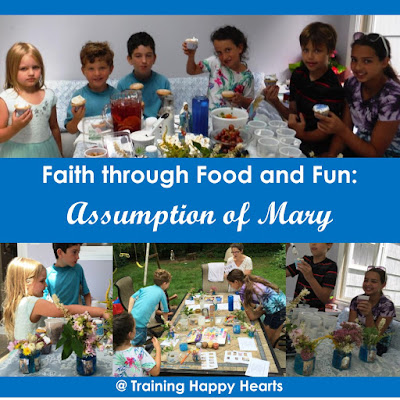
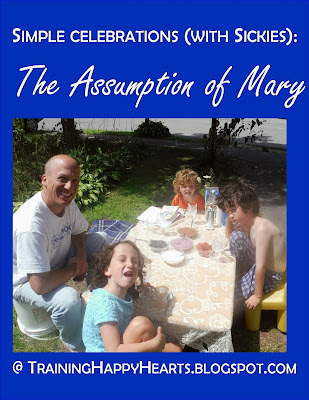
Click through any of the images or text below for my ideas and inspiration about St. Maximilian Kolbe and the Assumption of Our Lady (which is August 15.)


http://traininghappyhearts.blogspot.com/2017/08/celebrate-assumption-of-mary-with-food.html


http://traininghappyhearts.blogspot.com/2015/08/plan-for-assumption-day-playdate-round.html

I'd love to see snapshots of your nature walk if you go on one.  I also welcome your ideas for living the liturgical year with children.

Wednesday, August 9, 2017

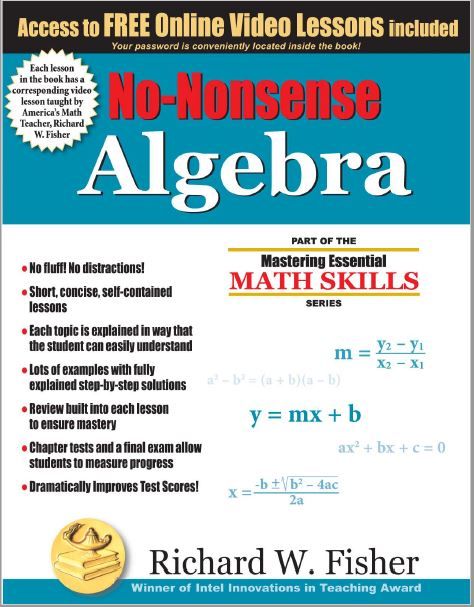
It Really Is Non-Nonsense Algebra {a Review}


My oldest son likes to learn math independently in short stints of 15-20 minutes, preferably online.  I like to check in on his learning, preferably offscreen.  Thus, when I saw No-Nonsense Algebra from Math Essentials, I thought, Perfect!  (Or almost perfect.)  The online portion of the program could appeal to my son and an offline paper portion appeals to me.  (He might not be 100% ready for full-on Algebra, but he definitely could stretch with pre-Algebra, and may even roll right into the rest without problems.  So it was that I opted to review this high-school level Math course with my just-entering middle school son.

What Makes the Program Helpful?
 

No-Nonsense Algebra consists of a 275-page softcover book and a corresponding series of video lessons taught by Richard W. Fisher (which can be accessed using a code in the book.) 

Each lesson is:


  • concise (so math lessons need not drag on on any given day)
  • self-contained (so students who struggle with particular concepts can bone up on those specific topics without having to do every lesson in the book)
  • inclusive of helpful hints, clear examples, exercises for practice, and exercises for review (so mastery happens)
  • explained both in writing and through video lessons (which helps reach students with different learning styles, or, in the case of my family, helps reach paper-loving Mom and screen-loving son)

Chapter Reviews and a Final Review are also included in the book, as are helpful extras, which include:

  • solutions for all problems  (so student can self-check their work)
  • a glossary (which is handy for students who have not internalized "math speak")
  • a list of important formulas (which helps Moms like me who have not done Algebra in ages, and, of course, helps students, too)
  • a list of important symbols (which is, again, handy for those who confuse or have forgotten math-related symbols)
  • tables for multiplication, commonly used prime number, squares and square roots, and fraction/decimal equivalents (which are super handy for children who struggle to recall facts and figures)

Truly, I am impressed with how complete and concise
No-Nonsense Algebra is.  The program lives up to its name by offering a way for students to achieve math mastery without having to wade through fluff and distractions - and without Mom or Dad having to do much 1:1 teaching.

How Did We Use It?
 

Of course, when using No-Nonsense Algebra with students below high school level, sitting down 1:1 can be helpful, so that is what my son and I did when we first cracked open No-Nonsense Algebra.  Or rather, we sat down 3:1, for, when I sat down with my oldest to complete Lesson 1-1 together, my two younger children decided to join us.  They were curious about the video lesson.  So, I capitalized on the moment,  had all three children grab paper, and completed that first No-Nonsense Algebra lesson together. 

To my surprise, even my seven year old met with success when adding integers during Lesson 1-1.  Honestly, I did not think he would be able to do it, but, he was interested, and, as the lesson progressed, he quickly caught on to the rules of how to add positive and negative numbers,  So did my 10-year-old daughter.  Lessons are that clear!

Thus, the following day, out of curiosity, I suggested that we all sit down together again to study Algebra.  As we completed Lesson 1-2 on Subtracting Integers, my seven year old lost interest, which I was completely okay with, for this program is a high school program and my 7-year-old is just a typical child - not a math savant. 

I thought my daughter might also lose interest in joining her big brother and me for Algebra lessons, but, surprisingly, she did not.  Instead, she persisted and happily completed Lesson 1-2 alongside her big brother, even asking me to grade her.  Since we don't typically do grades here, and, since she has been doing math at a much lower grade level than her big brother, I was both amused and impressed by her desire to work through
No-Nonsense Algebra lessons.


Oh, how my daughter beamed knowing she'd just learned some math alongside her big brother- and had done well at it, too! It was such an awesome moment.  My daughter had been suffering from lack of confidence in her skills, and the fact that she liked the No-Nonsense Algebra lesson format and succeeded with it thrilled me!

Going with this success, I kept our family's approach to
No-Nonsense Algebra the same for the next two lessons: Mom and the kids on the couch with a laptop, the book, some notebooks, and a few pencils.  However, as we got into multiplying and dividing integers, something became obvious: whereas my oldest son could handle the work, holes in my daughter's mastery of multiplication and division facts prevented her from continuing her streak of Algebra success. 

My daughter clearly understood concepts presented in the lessons, but struggled with quick and correct math fact recall and, thus, did not do all of her figuring right.  Thus, before she could get down about her progress with
No-Nonsense Algebra, I gave her a big hug and said, "Wow!  You have been doing HIGH SCHOOL math and you GET IT!  The only reason you've had some trouble here is because the paths in your brain that help you quickly recall facts are not 100% yet.  When you get those down, you are going to be a whiz at this!"

At this, my daughter smiled, got thoughtful, and asked if we could go back to work on her facts and, then, return to Algebra. "Why, absolutely!" was my response, and, so, the next day, she was back to math fact drills and practice while my oldest continued with
No-Nonsense Algebra.

At this point, I asked my oldest if he was ready to try doing his
No-Nonsense Algebra on his own, which he was.  So, I explained that he could even check his answers on his own after he completed either all the odds or all the evens on any given page, and, then, if he had succeeded with the problems he attempted, he could be done for the day.


Since then, 3-5 days a week, my son has used No-Nonsense Algebra as he main math curriculum.  At first, he did well with this - succeeding with lessons and seldom complaining.  However, when work got harder, the complaints began:  "This is too hard."  "I don't like this."  "No, I don't need your help. I can figure this out, but it's stupid."

"No, it's not son.  It's challenging, but useful and well explained.  I am happy to help you if you need me to do so. Daddy is, too.  Then, if you still don't get it, we can pause for a while," was, more or less, my response.

As is typical for my son, he did not want the help nor did he want to push through the tough spots.  For, my son does not like when he does not "get" math concepts right away, nor does he like it when he cannot easily solve problems in his head.  He likes copying problems out of a book onto notebook paper even less. Still - I am happy to say - he pushed through all these "don't likes", persisted with learning, and made it to Lesson 1-12 by Monday of this week, which impressed me (and proved to both him and me that he can succeed with higher level math when he puts his mind to it and has a quality resource to help him!)


What Are Our Thoughts on the Program and Would We Recommend It?
 

When I asked my son about his experience with No-Nonsense Algebra thus far, he said:


 "No-Nonsense Algebra is an algebra program that teaches using online videos and a workbook.  In each video, a teacher explains what the video is about (a math point) and asks you to write along with what he is saying.  He takes you through examples.  Then, the workbook has more problems that you have to do alone.  It has the answers in the back so you can check your work.

I think there are too many problems on most pages, so Mom has me do half of them - which I still think is crazy.  If I get most of them right, I can keep going with the next lesson.  If I don't,  I have to do more problems.

The lessons are set up to do a ton at one time - the short videos and all the problems, but my mom said, when we are busy, I can just do 15 minutes of work at a time. That usually means the video and some of the problems.  When we are not busy, I do a video and all of one half of the problems.

I really don't like this (doing 1/2 the problems in a lesson), because it takes up time, is frustrating, I get things wrong, and I have to do more problems.

The man teaches well.  I will give him that, but the workbook is hard and my mom does not let me write in it.  I don't like copying problems and doing the work out.


I think I might like it later, but right now, it is above my grade level. I want to do some more 6th grade math and, then, may try this again."

So, as you can see, my son is progressing, does not like to practice math with a lot of exercises, and has come to a point where we need to pause our work on
No-Nonsense Algebra, not because the program is not a good one - for it is excellent - but because my son could benefit from a bit more lower math before progressing further.  (This is not surprising since he is only 11 years old and has, to date, used a hodge podge of math resources in a sometimes super relaxed way.)
 

With this in mind, I believe that once my oldest completes a bit more "on grade level" math, he will be in a prime spot to excel with the rest of
No-Nonsense Algebra.  I think my daughter will, too.  In fact, she asked if she could add a quick comment to this review, and, said:

I did the first few lessons of No-Nonsense Algebra, but then it got a little too hard. 

I discovered Algebra is fun, but I need to learn more of my other skills before I can continue.  I want to go back to this book when I finish my other skills.

Did you hear that?  My 10 year old said written Algebra is fun!  She wants to learn more using this resource.  And she will! 

So, even if my daughter is on pause with the program, and I am giving her big brother a break from it, too, I am keeping our
No-Nonsense Algebra book at the front of our math cubby as incentive for my daughter to get through the work of solidifying her basic math facts, so she can get back to applying algebra concepts using No-Nonsense Algebra.  I am also considering getting her the 4th and 5th grade or middle school books that  Math Essentials offers, since it appears that the format of the lessons  - with video explanations and examples, and uncluttered pages of written examples, exercises, and review  - work well for her.

Likewise, I will encourage my oldest to return to
No-Nonsense Algebra as soon as he is ready to do so.

I would say
Math Essentials would work well for other children who prefer concise, straight-forward, math learning or review, too!  I am truly pleased to have been introduced to No-Nonsense Algebra for my own homeschool purposes as well as to have this resource now to recommend to high school students that I mentor who are preparing for college entrance exams or just struggling with high school math.  No-Nonsense Algebra, I believe, can help students reach math mastery fairly quickly and painlessly, not to mention inexpensively.  (Where some math curricula cost big bucks, this full algebra program currently costs just $28.95)

Learn More


Get social with Math Essentials on Facebook at https://www.facebook.com/math.essentials/


No-Nonsense Algebra {Math Essentials Reviews}

See what 60 Homeschool Review Crew families thought about

No-Nonsense Algebra.

Crew Disclaimer

LinkWithin

Related Posts with Thumbnails