Sunday, March 12, 2017

Enjoy a St. Patrick's Day with Art, Music, and a Poet-Tea

Would you like to add a little art, music, poetry, food and fun to your St. Patrick's Day this year? 

Then, you may wish to take a peak at how we enjoyed a St. Patrick's Day Poet-Tea with friends last year.:
 
"AMP"ing Up the Liturgical Year


First, for those who are unfamiliar with our A.M.P. It Up Club endeavors, a quick synopsis:

Since 2015, some friends and I have been getting out children together for a once-to-twice a month club to "amp up" our focus on art, music, and poetry in our lives.  Typically, at our meetings we:


  • recite (and sometimes write verses of) poetry.
  • briefly study composers, compositions, music styles, or instruments.
  • experiment with different styles of artwork, sometimes after completing quick picture studies.

We also tie our meetings to the liturgical year at times, since all of us are Catholic and enjoy celebrating together. That's exactly what we did for St. Patrick's feast day!


The Setting


We kept our setting fairly simple:


  • an off-white tablecloth (because the lacy, white tablecloth I wanted to use, reminiscent of Irish lace needed to be laundered after a just-us celebration earlier in the day)

  • green and blue candles (because the color green is now associated with St. Patrick's day, but St. Patrick was often depicted in blue in earlier art)

  • several Irish-themed knick knacks (just for fun since we had them out already)

  • a shamrock candle holder that my niece had welded and given us as a gift (to remind us of the legend that St. Patrick used shamrocks to teach about the Trinity)


  • a print out about Celtic crosses (so we could explain them to the children)

A St. Patrick's Day Poet-Tea


{Disclosure: Some links which follow are affiliate ones.}

To begin our Poet-Tea, we prayed grace and chatted about what we knew about St. Patrick the Saint and other St. Patrick's day traditions and lore using the food on our table as a starting point.  The fare included:


 Green Matcha Donuts (going with the Irish green theme)

 Potato Hashbrowns (because Ireland is known for its potatoes)

 A Potato-and-More Frittata with "Shamrock" Garnish (because we all need a little protein!)

 An "Irish Flag" Veggie Tray

 Traditional Irish Stew

 A Fruit Rainbow (for the leprechaun legends)

 Green Smoothies(for Ireland's green)  "Liquid Gold" Juice (for the leprechaun legends again), Chocolate Silk (just because we like it) and Irish tea

 More Potato Hash (for Ireland's potatoes)

Leprechaun Gold Juice Wigglers (because my children love juice wigglers)

Oatmeal (because some of mine loves "Irish" oatmeal)


https://www.amazon.com/Prayers-Favorite-Saints-Joseph-Picture/dp/0899425240/ref=as_li_ss_tl?s=books&ie=UTF8&qid=1449390974&sr=1-1&keywords=Prayers+to+My+Favorite+Saints&linkCode=ll1&tag=traihapphear-20&linkId=2ec782f8961fd4e623aa928d098aef85

I also drew the children's attention to the illustration and text about St. Patrick in Prayers to My Favorite Saints and led them in further prayer. 


As the children began to eat, for the poetry portion of our Poet-Tea, I read them St. Patrick's Breastplate and some Irish Blessings, (but only a few, so we could all enjoy just eating and chatting together.)  


Then, while we cleaned up the tea, those who wished to took turns playing with our green bodysock (which my children always ask me to pull out at this time of year!)


After that, I offered the children their choice of copywork of Irish blessings or St. Patrick's Breastplate
(found FREE at Proverbs 22:6 Academy!) to do for a brief time and encouraged those who wished to pen their own Irish-style blessings.


Music Appreciation and Games


After a short period for copywork, we knew the children were ready to move and groove, so I played some traditional Irish music while the kids danced.  


We talked a bit about what types of instruments we heard in the music and played a bit of "dance freeze".


https://www.amazon.com/St-Patrick-Three-Brave-Mice/dp/1589806638/ref=as_li_ss_tl?ie=UTF8&qid=1489291499&sr=8-1&keywords=st+patrick+and+the+three+mice&linkCode=ll1&tag=traihapphear-20&linkId=e450d20608cbd0fbe564f01d0a4f696a

Then, I asked if anyone could tell me about St. Patrick and the bells and shared a bit from one of our favorite seasonal picture books, St. Patrick and the Three Brave Mice, before taking everyone outside to play our old favorite Snake Freeze,which is always a hit. 


The children so enjoyed playing sneaky snakes.


Running up to steal the bell..


Trying not to be heard...

 
And catching one another...


The Mamas did, too!  So many laughs were had by all.

Imaginative Landscapes Artwork


Once we everyone had had turns at our game, we gathered together to do a picture study about landscapes in my ARTistic Pursuits Elementary Book One.  


https://www.amazon.com/Saint-Patrick-Ann-Tompert/dp/1563976595/ref=as_li_ss_tl?s=books&ie=UTF8&qid=1489293251&sr=1-1&keywords=saint+patrick+ann+tompert&linkCode=ll1&tag=traihapphear-20&linkId=a40d135949fb42e5f96ac9ec50fcac33


Then, we browsed some of the beautiful landscapes illustrations in Ann Tompert's Saint Patrick and other seasonal picture books I had in our book basket before setting to work using pencils, Cray-Pas and Crayola Oil Pastels to create our own imagined landscapes. 


Some of the children went with the Saint Patrick's Ireland theme for their artwork and others did not.  See:


All enjoyed our time together observing Saint Patrick's Day with art, music, poetry and more.  In fact, once the children completed their artwork, they were not quite ready to stop celebrating...


Indeed, they decided it was time for a parade.
 
Some Final Fun


In years past, my children have enjoyed many Irish and St. Patrick's day themed picture books, including:


https://www.amazon.com/Patrick-Patron-Ireland-Tomie-dePaola/dp/0823410773/ref=as_li_ss_tl?ie=UTF8&linkCode=ll1&tag=traihapphear-20&linkId=f97f1434b82bc722110331a80fef7b60


https://www.amazon.com/St-Patricks-Day-Morning-Bunting/dp/0899191622/ref=as_li_ss_tl?ie=UTF8&linkCode=ll1&tag=traihapphear-20&linkId=66179450b2e1069bfba972b6e230788a


https://www.amazon.com/Last-Snake-Ireland-Story-Patrick/dp/0823414256/ref=as_li_ss_tl?s=books&ie=UTF8&qid=1489291952&sr=1-1&keywords=the+last+snake+in+ireland&linkCode=ll1&tag=traihapphear-20&linkId=7aa993dc388f2880616cebc34bd72b00


Thus, little family traditions of having our bells and drums out around St. Patrick's day and parading around with them have sprung up.  This year, these traditions were shared with friends in our own little noisy parade.


More St. Patrick's Day Ideas

If you'd like other ideas for celebrating St. Patrick's Day, you may wish to click on through to some of these:


http://traininghappyhearts.blogspot.com/2016/03/sensory-saint-patricks-day.html


 I'd love to hear about how YOU celebrate St. Patrick's Day or approach art, music, and poetry. 
St. Patrick, pray for us!

This post was shared at the 40 Days of Seeking Him Link up

Tuesday, March 7, 2017

Take a New Look at an Old-Fashioned Curriculum {An Eclectic Foundations Review}

If you have a "late bloomer" and are looking for a gentle,  old-fashioned, language arts curriculum with a Christian flair, then  Eclectic Foundations Language Arts Level B would be worth a peak.


Although I cannot say my daughter loves the program, she likes it enough not complain when using it, and she is making progress with skills as we work through it.  Plus,  I am delighted with how easy it is to use and how flexible the time we use it in a sitting can be!  

On days when my children have parkour, I pop the curriculum materials into a bag with a pencil and highlighter and my daughter and I simple "open-and-go" with them (skipping word card work if it comes up) for 15-30 minutes.  On days we are at home, we work from 10-40 minutes on all parts of the program, depending on what else we have going on.  On days when I have to focus on my oldest during skill time, I sometimes ask my daughter and her little brother to play "the spelling game" or the "reading game" using the word cards from the curriculum that my daughter has cut and colored already. 

To play the game -which is not in the curriculum - but which is easy to do with the provided cards, my children lay the cards out face down in a "game path".  Then, one rolls a die and moves to a card.  If playing the spelling game, the person who lands on a card hands it to the other person and the other person read it.  he person who landed on the card then tries to spell the word and, if successful stays on the card's space.  If not, the player returns to his or her prior space.  When playing the reading game, the person who lands on the card simply turns it over and reads it and, then, tries to make a question, statement, or command using it."

The ability to close a lesson shortly after a timer goes off or when another child or activity needs my attention, as well as pick lessons up within seconds with no prep at all is this curriculum's biggest boon to me right now.  The fact that it gently moves my daughter through reading, handwriting, comprehension, poetry, grammar, and other typical ELA skills is a win, too!

What Do You Get and What Does It Cover?


Upon opening our
Language Arts Level B package, I found:

  • a soft-cover Teacher's Guide which is spiral bound and lays flat.  It begins with two pages of simple, clear instructions and an overview and then gets right into super easy to follow, concise lessons plans for 144 lessons, with one page per lesson plan, which is divided into McGuffy Reader work, Phonics, Handwriting, Poetry, and Grammar.
  • a thicker, softcover, spiral-bound, Student Workbook which contains 144 lesson's worth of lined handwriting and phonics word list pages, large-font poetry text, and simple grammar exercises.
  • a thin, softcover, spiral-bound, laminated set of Phonics Practice Sheets.
  • a set of cardstock word cards for children to color in according to the part of speech for each word.
  • a spiral-bound printout McGuffey's First Eclectic Reader, which is not typically provided since the reader can be found digitally online at no cost.

Together, these items make up a complete ELA program for those who are a bit beyond decoding C-V-C words, not too far into grammar, and ready to move ahead.

Lessons are meant to be completed 3-4 days a week over 36 weeks and require nothing more than the program materials above, plus:


  • index cards for one lesson
  • additional 3/8' ruled handwriting paper for extra practice if desired
  • a pencil box, baggies, and/or elastics for word cards
  • crayons, markers, or colored pencils for word cards
  • thin dry-eraase markers and a rag
  • a pencil
  • scissors

My daughter and I also added the use of a highlighter (to highlight parts of poems as opposed to pencil circling them), dice and "guys" (to play games with the word cards), and a small whiteboard, because she prefers writing on whiteboards to paper sometimes.

My Daughter's Thoughts... and Mine

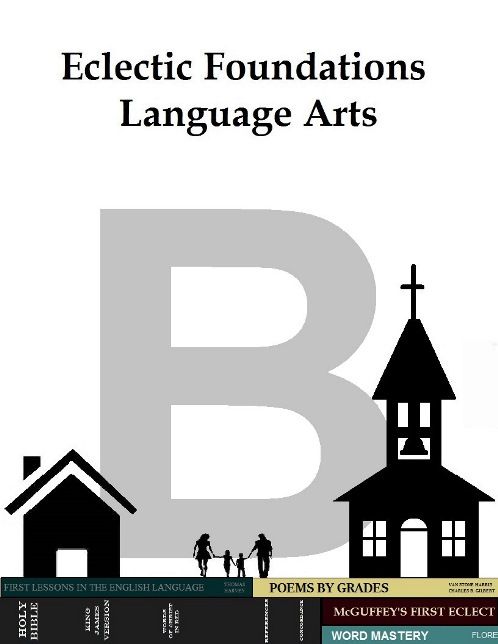
When I asked my daughter what she thought about Eclectic Foundations Language Arts Level B, she said, "I like the cover.  I don't know why.  I just like it." 


Language Arts {Eclectic Foundations }


Odd.  I had not even thought about the cover design.  But, hey, if she likes it, that's a good thing, right?

Then, I asked her about the curriculum itself and she said, "I like that we can do it in small amounts of time, but I think it's boring."

Well, that may not seem like a glowing opinion, but, for her, it is!  My nine-year-old struggles so with English Language Arts and so anything that can be done in small amounts of time is GREAT for her... and for me.  Short, regular practice is proving to be what keeps her moving forward lately while keeping us both sane.  She has not had a single tear or outburst during ELA 1:1's with me since using
Eclectic Foundations (which is something!)  and I have been able to rest in the comfort of knowing we are getting somewhere , gently and slowly, but steadily.

As for my daughter's "boring" comment, that is not the fault of the curriculum.  It is a combination of two things.  First, my daughter's comprehension and listening level is much higher than her decoding one, so she now tires of "young" level readings such as those in the McGuffey Eclectic Reader (even if she needs such a level so her reading may bloom at last, I pray!)  And, second, as we have many projects, outside classes and club activities lately, we are in a more "get-it-done" mode with reading, writing, and math.  Skill work basically becomes Mom setting a timer to keep us on focused and giving a bit of time to basic studies and, then, having us use an "open-and-go", whatever-speed-the-day-can-muster ahead effort to move along.

My daughter also went on to say, "I like that you can write on the Phonics Practice Sheets and erase them, but I don't use them very much."  That is true.  We have used them a little, but not much simply because we have been in that "get-it-done" mode for our skill work lately and I have her doing other things for independent work.

Referring to the Eclectic Reader work and lessons, my daughter said, "I like the pictures in the book, but I don't like how in certain lessons you go back.  It's confusing and crazy.  I just want to go forward, not backward and forward and backward and forward."

My daughter  actually had not told me this until I interviewed her for this review and, silly me, did not pick up her feelings earlier.  So, after she made his comment, we chatted.  I explained that the "going back" is meant to offer built-in review in the lessons, but my daughter asked if we can just use the reader moving forward without going back now that our review period is over.  I told her I'd be happy to adapt the lessons in that way for her.  (I think she wants to prove she can read the whole thing and does not need the "full lessons" to do so, so I will give her a chance to prove herself.)

I, then, asked my daughter about the student book, whereupon she said, "I like the cursive and the poems in the student workbook.  It is easy to find the rhymes and it's easy to read (with Mom's help) because you know there are rhymes.  I also like the pictures and that the pages are not too busy."

The fact that the font is a good size and the pages are not too busy is HUGE for my daughter's success.  She struggles with small font and busy pages and needs plenty of white space when decoding things.  However, she likes illustrations, too.  So, the student workbook works well for her.  The only thing she (and I!) might like to see is a few more line drawing to help keep that whole "boring" thing at bay for kids like mine who want a little more visual interest, but need white space, too.

She also added, "I don't like the word lists, because they are hard.  So, we stopped using them and went to lessons from the book that the lists are based off."  This is true.  Even though we have gone over silent e words before, my daughter till struggles with them and felt discouraged right away with the word lists, so by the time we got to Lesson 14 or so, she'd asked if she could use simpler words instead.  Since the word lists are based on Word Mastery by Florence Akin, which is free online and which we have a print out of already (which, oddly, my daughter and I had had a failed foray with a few years ago), I said, "of course" and pulled out my Word Mastery binder.  Lo and behold, my daughter happily (and confidently wet through the first few pages of it, so we have been using that now instead of the Phonics section of the lesson plans and student book.

We have also been using the provided word cards for reading, spelling, and grammar pratice.  My daughter said, "I like coloring the word cards... I play games with them... They are extremely easy to read, which gives me confidence..."  Hoorah!

She did not have anything to add about the grammar lessons, but I do,  I love them!  So simple and gentle.  No need for extra books or drill and kill exercises.  The grammar portions of the program have been a great reminder to me of how natural grammar lessons can be for developing readers.  Thank you, Elizabeth Ratliff, for making them so easy and effective.


Will We Continue to Use the Program and Would We Recommend It?


As I already mentioned, my daughter has set a goal of reading through the Eclectic Reader "without going backwards" during our upcoming 1:1 times, so I will  honor that goal with her (and gently get in some of the McGuffey's lessons as written by browsing the Teacher's Guide and bringing up talking points, etc. when I can.  (The concise lesson plans will make this easy to do!)

Also, as I already mentioned, I will be skipping all Phonics lesson plans for now because we have opted to level down for Phonics, starting at the beginning of Word Mastery.  However, should my daughter "catch up" to the place the
Eclectic Foundations Language Arts Level B Phonics lessons begin soon, I will likely move back to these lessons, which are apportioned in far friendlier (i.e. briefer) word lists than Word Mastery.  Likewise, we may use the Phonics Practice Sheets more once we get "on level" again.

Because my daughter wants to improve her cursive, we will continue to use the basic Handwriting/Copywork portions of the Student Workbook.

I will also continue on with the Poetry at least once every week or two since my daughter enjoys it and the selection of poems is lovely.

The Grammar sections, which I love, will be slid into our lesson times, too.  In fact, I am thinking of using them as a guide for 1:1's with all my children. Because their gentle approach is so do-able, I am fairly certain I can transfer the points made to whatever each of my children is reading/studying.

In short, now that our review period is over, I will be using most of the portions of this well-written curriculum and continue to relish it's open-and-go style.  I am happy to have things laid out so concisely and to be able to progress with natural, old-fashioned style learning with my daughter at this point in our homeschool journey.

If you are looking for a gentle, straightforward, open-and-go ELA curriculum with an old-fashioned flair for a "late bloomer" or a child who is "right on level", I recommend checking out
Eclectic Foundations.  Truly, I am encouraged by the fact that I can use Language Arts Level B for five minutes to a half hour at any given seating to move my daughter forward with ELA skills and knowledge encouraging without prep work for me, busy work for my daughter, or complaining from my daughter. 

In all honesty, t
here have been other ELA programs and approaches I have tried with my daughter which I have appreciated for various reasons, but, none have been ideal long-term and none fit our needs of the season.  Eclectic Foundations Language Arts Level B - with its flexibility, ease, and effectiveness - does!  I am happy we were introduced to it through this review opportunity and think others like us will appreciate it, too.

Find Out More

If Eclectic Foundations sounds good to you, but your child's abilities seem below or above Level B, try out another level.  You can read about which level might be appropriate at the Eclectic Foundations website.
If you are interested in hardcopy Eclectic Foundations curriculum, don't dally before getting it.  The website
notes: "After our current inventory sells, we will be using a different publisher.  Unfortunately, this will mean a price increase of our products.  Teacher's guides will increase to $15, and student workbooks will increase to $32."

To preview the first four weeks of the curriculum, print out phonics sheets and word cards, or look at Scope and Sequence, find links to pdfs here.

Language Arts {Eclectic Foundations }

Find
Eclectic Foundations on Facebook. 
 
Language Arts {Eclectic Foundations Reviews}


Eighty Homeschool Review Crew families reviewed either Eclectic Foundations Language Arts Level A, Level B, or Level C.  See what each family thought of this easy-to-implement, old-fashioned curriculum. 
 
Crew Disclaimer

Sunday, March 5, 2017

Look for the Relics of the Passion Near You

If you seek a meditative prayer experience this Lent, I suggest checking to see if the Relics of the Passion will be in your area, or, if they won't be, downloading a pdf of the booklet for the Call from the Crucified Heart program.


We were blessed this past week when a friend let us know that the Apostolate for Holy Relics would be visiting our wider vicinity with their Call from the Crucified Heart program.
My children were introduced to relics two years ago when we visited a parish hosting the Treasures of the Church.  That experience got them excited about relics and eager to learn more, so we, later, took advantage of opportunities to visit a church hosting St. Maximilian Kolbe's relics and, then, to go venerate Padre Pio's heart relic.   As these experiences were all positive ones, I made sure to prioritize getting our family to the
Call from the Crucified Heart program.Our Experience

The
Call from the Crucified Heart program, as we experienced it, lasted more than an hour and was presented in both English and Spanish, with every other meditation offered in English. (The church we went to for the program typically offers both English and Spanish Masses and, thus, provided a translator to read the Spanish meditations.  I do not think every church that hosts the Relics of the Passion opts for a bilingual program.)
To help non-bilingual folks like me and mine follow along, booklets with the full text of each mediation were provided in both English and Spanish.  Luckily, these had some black-and white images throughout them which helped my non-readers understand the story being told without me having to whisper-read the English versions of the Spanish meditations to them.  (My children know the story of Jesus' passion well, and, so, the pictures effectively "cued" them to some degree about what was being spoken about in Spanish.)


During each meditation, a local Knights of Columbus member held up one of eight rare holy relics related to the Passion of Jesus:

  • the relic of the True Cross
  • a piece of stone from the table or room where the Last Supper was held
  • a piece of the Column of Flagellation
  • a piece of the Crown of Thorns
  • the effigy of the Veil of Veronica (touched to the original veil)
  • a replica of the holy nail which contains filings taken from the true nails that were imbedded in copies to make relics of a lower class
  • a piece of bone from St. Longinus, the centurion that pierced the side of Jesus
  • a thread from the cloth used as the wrapping for the Burial Shroud.

Between each meditation, musical selections were played and sung, and, throughout the entire program the
Holy Eucharist was exposed to "underscore that time-transcending gift that connects us from His Passion to His Presence with us today," as the Apostolate for Holy Relics site explains.

At the conclusion of the narrated portion of the program, we were blessed with
an opportunity for personal veneration of the relics. 
I appreciated the experience, overall and plan to reread the meditations  from the program when I have quiet time later this Lent, since I missed some of them "live" due to my kiddoes' needs for potty runs and reminders to focus. 

At the end of a long, busy week  - and with half of the the
Call from the Crucified Heart program  presented in a language my children not understand - my children, admittedly, had difficulty staying 100% engaged in the entirety of meditative portion of the program. However, they did fairly well throughout it and said they were happy to have been there.  (As was I!) They were especially pleased with the opportunity to move through the line for personal veneration, touching their rosaries and other holy objects to the relics, and my daughter has since knelt down in prayer with the sacramentals she brought to the program set up on a chair in front of her (which was such a sweet vision for me to witness.)


Of course, my children also enjoyed sharing the experience with friends. 

We are so grateful to have dear friends who share our faith and our desire to learn more about its rich history and traditions.  We pray you and yours are surrounded by opportunities to grow in faith among friends as well and are thankful that the
Apostolate of Holy Relics is working to preserve and present part of our Catholic heritage.

Learn More about the Relics of the Passion

You can donate to the Apostolate of Holy Relics, request to host their programs, find out if they will be in your area, and read more about the history of the relics program at the Apostolate of Holy Relics website.

This post was shared at the 40 Days of Seeking Him Link up

LinkWithin

Related Posts with Thumbnails